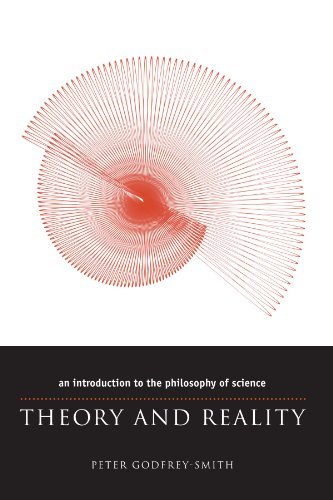
Ebook Info
- Published: 2009
- Number of pages: 288 pages
- Format: PDF
- File Size: 7.96 MB
- Authors: Peter Godfrey-Smith
Description
How does science work? Does it tell us what the world is “really” like? What makes it different from other ways of understanding the universe? In Theory and Reality, Peter Godfrey-Smith addresses these questions by taking the reader on a grand tour of one hundred years of debate about science. The result is a completely accessible introduction to the main themes of the philosophy of science.Intended for undergraduates and general readers with no prior background in philosophy, Theory and Reality covers logical positivism; the problems of induction and confirmation; Karl Popper’s theory of science; Thomas Kuhn and “scientific revolutions”; the views of Imre Lakatos, Larry Laudan, and Paul Feyerabend; and challenges to the field from sociology of science, feminism, and science studies. The book then looks in more detail at some specific problems and theories, including scientific realism, the theory-ladeness of observation, scientific explanation, and Bayesianism. Finally, Godfrey-Smith defends a form of philosophical naturalism as the best way to solve the main problems in the field.Throughout the text he points out connections between philosophical debates and wider discussions about science in recent decades, such as the infamous “science wars.” Examples and asides engage the beginning student; a glossary of terms explains key concepts; and suggestions for further reading are included at the end of each chapter. However, this is a textbook that doesn’t feel like a textbook because it captures the historical drama of changes in how science has been conceived over the last one hundred years.Like no other text in this field, Theory and Reality combines a survey of recent history of the philosophy of science with current key debates in language that any beginning scholar or critical reader can follow.
User’s Reviews
Reviews from Amazon users which were colected at the time this book was published on the website:
⭐This book seems to satisfactorily achieve its proclaimed goal — that is, its goal of offering an intelligible overview of both the history of the philosophy of science over the twentieth century (its entire history takes place in the twentieth century, with a less combative aftermath over unsettled issues persisting into the present century) and a subsequent, ahistorical presentation of the dominating themes of the philosophy of science in our time. Towards this end, it surveys in detail the perspectives of the Vienna Circle, the Logical Positivists, the Logical Empiricists, Karl Popper, Thomas Kuhn, Imre Lakatos, Larry Laudan, and Paul Feyerabend, and then proceeds to the perspectives furnished by “feminist epistemologists” (the very existence of whom insults the man of intellectual honesty, but whose parasitic influence must not be ignored), Robert Merton and other sociologists of science, various prominent theories of causal explanation, the relevance of Bayesianism to current thought on the philosophy of science, and perspectives favoring and opposing empiricism, metaphysical naturalism, and scientific realism as contrasted with instrumentalism.The author does not bother to conceal what his particular perspective on certain positions are; for example, he openly declares his adherence to a moderate form of empiricism, to naturalism, and to realism. Generally speaking, one would anticipate that an introduction of this sort to the field as such, while not avoiding personal perspective entirely (that’s not possible, as there is no such thing as a non-biased work), would tend to be a bit more subtle in such respects. I suppose I don’t find this problematic in any case, but I might as well note that I do not find very convincing his attempted rebuttal of the “theory-ladenness of observation” retort levied against empiricism by many in philosophy of science, concerning both its radical and moderate forms. It is simply not possible to view, perceive, or describe the world in a manner that does not rely heavily on rationalist, non-empirical elements. Also, while I myself subscribe to scientific realism as a sort of heuristic, to defend it more strongly than that is a pretty futile endeavor, a barrier which clearly the author believes himself to somehow circumvent or at least mitigate.Of course, there is much to praise about the author’s perspective. In particular, he seems to competently mix and match the strengths of the major thinkers into one system while disposing of the weaknesses of each thinker.I think, as long as one plans to read a bit more on the same subject after the book, _Theory and Reality_ offers a beyond satisfactory account of the field for the layman.
⭐I think by philosophy of science Peter Godfrey-Smith means sales philosophy of science because throughout he seems to be pitching the science instead of engaging in it. Also, he feels women scientists do best in primatology studying chimps and baboons. I hope that doesn’r reflect the author’s general attitude toward women. Finally in the chapter on naturalism where he illustrates the Müller-Lyer illusion–two lines of equal length where the line with the arrows at the end of the line pointing toward each other is supposed to appear longer than the line with the arrows at the end of the line pointing away from each other–the illusion is convincing mostly because it’s not an illusion: the longer line measures 1 and 7/8th inches and the shorter 1 and 6/8th inches. I believe somewhere in the book the author mentions that very little cheating goes on in science. I believe him. I guess he included the Müller-Lyer illusion to remind scientists how to do it in case they’ve forgotten.
⭐This book is an extremely good summary, to a large extent in chronological order, of many of the main developments in philosophy of science (over the past hundred years or so), from the point of view of the author, Prof. Godfrey-Smith. The writing is, for the most part clear and understandable, at the level of a high school student or first year college student. Nevertheless, to supplement a study of philosophy of science at a more advanced, but still introductory, level, I think that its clarity and simplicity is helpful. The author’s “voice” intrudes, but that is not unhelpful, in my view, because it makes it clear that we are experiencing this summary from a certain viewpoint, if nonetheless well thought out and developed. For its intended audience, i.e. beginners or amateurs at the philosophy of science like myself, it is superb and to be highly recommended. Even so, at that level, I can only recommend it as a summary, and not as some deep philosophical investigation. Even the author makes it clear that there is a substantial intellectual investment and time-cost involved to progress beyond this modest introduction.
⭐Godfrey-Smith is a good writer. You’ll learn a lot from this good intro to the philosophy of science. However, I would be very cautious about recommending this book. The author seems deeply committed to philosophical naturalism/materialism, and does not seriously deal with alternative philosophical positions while attempting to justify his naturalism.
⭐I first read this book when it was the set text on an MA philosophy of science module and found it absolutely fascinating. It’s still one of my favourite of the set texts that we worked with on the course. What I especially liked about it is how accessible it is to anyone not familiar with philosophy while at the same time not dumbing down any of the issues and I have enthusiastically recommended it to friends who work in science. I’m returning to buy the Kindle version now in order to re-read and refresh my memory. Definitely one of my all time favourite intros in philosophy.
⭐Excellent introduction to the Theory of Knowledge. Used for instance by the Karolinska Institutet to teach courses on it to Ph.D. students (although they don’t probably read the whole thing).
⭐This book gives an insightful account of modern philosophy of science. I find the author unnecessarily commits himself to scientific realism at early on, without much argument or explanation, only to admit a more eclectic and sophisticated balanced view at the end. The main strength of the book is that it gives a good overview of the core debates.
⭐Love how accessible yet remaining formative and detailed.
⭐This book was quite an eye-opener for me. Whilst debating climate change with my son he recommended I read it.My education was pre-1970. Even my Chemical Engineering uni degree (1971) was based on a relatively simplistic and unsophisticated philosophy of science. It tended to assume that science was on an unchallengeable pedestal.So I found it very interesting that most of the current philosophical ideas in this area are post 1970.As a result, my view of science (like most people of my era and probably most people generally) was VERY outdated.I found it well written and easy to read even if I didn’t take the time to fully understand the details.
Keywords
Free Download Theory and Reality: An Introduction to the Philosophy of Science (Science and Its Conceptual Foundations series) 1st Edition in PDF format
Theory and Reality: An Introduction to the Philosophy of Science (Science and Its Conceptual Foundations series) 1st Edition PDF Free Download
Download Theory and Reality: An Introduction to the Philosophy of Science (Science and Its Conceptual Foundations series) 1st Edition 2009 PDF Free
Theory and Reality: An Introduction to the Philosophy of Science (Science and Its Conceptual Foundations series) 1st Edition 2009 PDF Free Download
Download Theory and Reality: An Introduction to the Philosophy of Science (Science and Its Conceptual Foundations series) 1st Edition PDF
Free Download Ebook Theory and Reality: An Introduction to the Philosophy of Science (Science and Its Conceptual Foundations series) 1st Edition