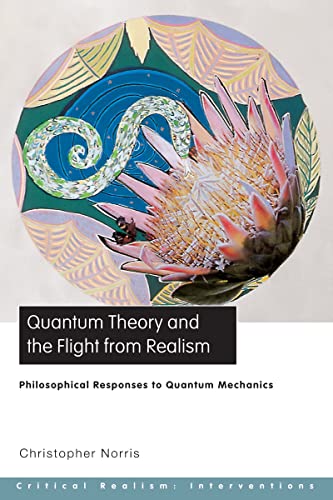
Ebook Info
- Published: 2002
- Number of pages: 280 pages
- Format: PDF
- File Size: 1.11 MB
- Authors: CHRISTOPHER NORRIS
Description
This book is a critical introduction to the long-standing debate concerning the conceptual foundations of quantum mechanics and the problems it has posed for physicists and philosophers from Einstein to the present. Quantum theory has been a major infulence on postmodernism, and presents significant problems for realists. Keeping his own realist position in check, Christopher Norris subjects a wide range of key opponents and supporters of realism to a high and equal level of scrutiny. With a characteristic combination of rigour and intellectual generosity, he draws out the merits and weaknesses from opposing arguments. In a sequence of closely argued chapters, Norris examines the premises of orthodox quantum theory, as developed most influentially by Bohr and Heisenberg, and its impact on varous philosophical developments. These include the ideas developed by W.V Quine, Thomas Kuhn, Michael Dummett, Bas van Fraassen, and Hilary Puttnam. In each case, Norris argues, these thinkers have been influenced by the orthodox construal of quantum mechanics as requiring drastic revision of principles which had hitherto defined the very nature of scientific method, causal explanati and rational enquiry. Putting the case for a realist approach which adheres to well-tried scientific principles of causal reasoning and inference to the best explanation, Christopher Norris clarifies these debates to a non-specialist readership and scholars of philosophy, science studies and the philosophy of science alike. Quantum Theory and the Flight From Realism suggests that philosophical reflection can contribute to a better understanding of these crucial, current issues.
User’s Reviews
Reviews from Amazon users which were colected at the time this book was published on the website:
⭐If the highly disturbing implications of quantum theory do not cause you to lose sleep or otherwise trouble you deeply, then you don’t understand them. The orthodox/Copenhagen view either blankly asserts the unreality of the quantum domain — and thus apparently the unreality of our own domain — or buries the issue under the rug with hopes that few will notice.This masterful work faces the ontological difficulties inherent in QM head on. It’s an excellent defense of the reality of nature, even at the smallest levels. While a certain familiarity with the basics of both ontology and quantum physics is necessary, it’s nevertheless accessible to the layman (with perhaps a little work).If you’re as troubled by the philosophical implications of QM as I am, this work will help keep you sane.
⭐Precisely tracks the arbitrary prohibition of uncomfortable questions in quantum theorizing, questions which imply the falsity of instrumentalist and other flavors of self-referentially contradictory anti-realism, beginning with Bohr. Einstein, Podolsky, and Rosen were not up to the task because they were philosophically deficient in their own realism. But the book explains exactly how as well as why science is now being shut down by the thought police. Even mathematicians are feeling the pressure at this point in the decay.And if you’re seriously interested in this issue, you should probably read everything Norris has written, especially to understand how all this spilled over into the humanities as postmodernism. Norris is one of our greatest living thinkers.
⭐Norris is admittedly motivated to defend a realist interpretation of Quantum Mechanics (QM) largely due to his own past as a literary cultural relativist type. Having seen the light, he is now concerned to show the rest of the constructivists out of the cave of their own making. (Of course, for them, EVERYTHING is of one’s own making.) Surely this is an admirable task. Where Norris differs from many with the same agenda vis-à-vis strong relativism is in the sincerity of the attempt to treat with sympathy his opponent’s anti-realism, and not simply write it off as so much obscurantist mumbo-jumbo, as others are want to do. Of course, Norris has a strong agenda- to preserve the basic physicalist concepts that seem to underlie all actual (and perhaps possible) human understanding of the natural world, like determinate position/ trajectory, causality, observer and mind-independence, and the like. His exposition of the Bohr/Einstein debates is particularly illuminating. Although history has clearly viewed Bohr and his Copenhagen acolytes as the victors, Norris presents interesting arguments that expose certain “sociological” and philosophical prejudices of the “judges”, coupled with a brand of realism peculiar to Einstein as causes of Einstein’s having “lost” the debate. Norris is equally astute a critic when pointing to manifold inadequacies or confusions in the thinking of Bohr and Heisenberg. Norris is clearly a skilled critic and expositor of very complicated subject matter, which he renders clear and understandable. He is certainly adept at identifying the major issues at hand, and for anti-realists of various stripes, this is a book to be reckoned with. However, I must admit I find his main thesis unconvincing. Norris constantly relies on the notion that a “Bohm type of `hidden variables’ theory,” (a phrase found perhaps on every page,) would restore the classical physicalist picture and (dis)solve the so called “quantum paradoxes.” Yet Norris does not satisfactorily explain what this amounts to, or give (let alone argue for) any general principle of what the connection between ontology and mathematical formalism is, such that similar if not identical formalism may permit divergent ontological commitments. (Although I’m not sure I’ve seen this anywhere.) Moreover, and perhaps most importantly for Norris’ project, if such a theory as Bohm’s is entirely scientifically/observationally tenable, surely Norris must explain why more physicists and philosophers are not jumping at the opportunity to reinstate the good ol’ one world, determinate causality and observer-independence picture. After all, wouldn’t scientists love to end this embarrassing phase in our history when physics can so easily be aligned with the holism of Eastern mystics? And to the extent to which Norris is concerned with “sociological” factors in considering why, historically, the Copenhagen interpretation wound up the victor, surely the fact that a putatively tenable “realist” alternative continues to fail to this day (now 70 years removed from the EPR debates) to gain acceptance is a fact requiring both “sociological” and strong philosophical explanation. In the same vein, he must explain why, and not simply that, great philosophers (not just scientists qua philosophers,) like Putnam have been so influenced by the `bizarre’ considerations presented by orthodox QM theory (which I think Norris ultimately fails to do even in his book on Putnam, Hilary Putnam: Realism, Reason and the Uses of Uncertainty.) Norris provides little in the way of these arguments, but rather just seems to assume that one can simply take the de Broglie pilot wave or Bohm `hidden variables’ theory and use it to ward off the allegedly unwarranted global anti-realistic interpretation that has been, rightly or wrong, interpreted to be constitutive of the Copenhagen interpretation. So in the end, Norris is just another table-thumping realist who insists that no amount of empirical knowledge could ever possibly undermine the classic realist notion of mind-independence, for the simple reason that no matter what we come to know, the world is already out there waiting to be known. Nonetheless, this book is fascinating, and a must-read for those interested in issues of realism and anti-realism as they pertain to the history and philosophy of 20th century physics.
⭐I have to agree with the term “table thumping” I found the book interesting but repetitious. It reminds me of the old TV series “Car 54 where are you” when Maldun describes Toody as “the only man he knows who can talk all day about how he used to wear suspenders and now he wears a belt.” Good review of the issues at hand but I found it tedious in the end. Should have been half the length.
⭐Norris’ book on interpretations of quantum physics is, to my mind, both thoroughly readable and illuminating, and I have found it to be an invaluable guide to the realism/anti-realism debate in the philosophy of science. He examines the theories of thinkers such as van Fraassen, Michael Dummett, Hilary Putnam et al, all of whom have been fortified by the orthodox interpretation of quantum mechanics in their anti-realism, and in each case he exposes the weaknesses and non-sequiturs underlying their arguments.It is curious that the Copenhagen Interpretation, despite the opposition of such giants as Einstein, de Broglie and Schrodinger, has become the scientific orthodoxy. For a start, it really implies a form of subjective idealism, an outcome surely more incredible than anything implied by any Bohmian-type `hidden variables’ theory.Bohr himself seemed to allow that a particle/wave had some sort of existence even when not measured, but he held that it had no definite position, momentum or other physical property until a measurement collapsed the wavefunction into an appropriate `eigenstate’. But can we really conceive of an object (the quantum particle/wave prior to observation) which nevertheless lacks any specific physical properties (position, momentum, etc)? Given this difficulty, it is not surprising that, in practice, the orthodox interpretation has tended to merge with instrumentalism. A further difficulty is that the Copenhagen interpretation does not really determine when a wavefunction collapses, since it is unclear what precisely constitutes `measurement’. (Is, for example, a `consciousness’ necessary?)Norris seeks to cut the Gordian knot by adopting a thoroughgoing `realist’ interpretation of quantum mechanics. After all, the progress of science has hitherto depended on enquirers *not* supposing that their theories were merely `heuristic’ devices. When Leucippus of Miletus proposed the atomic theory of matter 2400 years ago – not as an `heuristic’ device but as a description of reality – it was a piece of pure speculative `metaphysics’. But what is idle metaphysics in one era may turn out to be hardheaded testable science in another. It is a piece of extraordinary historical parochialism (not to mention anthropocentrism) to suppose that reality can extend no further than the limits of our current best understanding.Christopher Norris has performed a signal service to philosophy of science by exposing the weaknesses and curiously circular and question-begging reasoning behind many of the philosophical defences of orthodox quantum theory. For this reason `Quantum Theory and the Flight From Realism’ is, I believe, a very important work which deserves to be read both by philosophers of science and also by physicists (and students of physics) interested in the philosophical implications of their study.
⭐This must be one of the most misleading books on the realism/antirealismdebate in quantum mechanics ever published. The author repeats some of the usual criticisms against the so called copenhagen interpretation of quantum mechanics and favours David Bohm’s allegedly realist interpretation as a counterbalance. He reminds me of Chicken Licken who claims that abandoning a so called realist interpretation of science menas that the sky is going to fall in. Admittedly he is not the only author to make this claim. What Norris refuses to address in his endorsement of Bohm’s quantum mechanics is the fact that it implies the existence of a 3N dimensional configuration space, if we take the wavefunction of quantum mechanics literally of which our 3 dimensional world is only one projection. This means that the so called realism of Bohm is committed to something even more bizarre than seeing the wave function as a heuristic device for calculating probabilities associated with quantum events.Finally his treatment of the Bell inequalities is misleading, the Aspect experiment does not imply that particles send signals to each other faster than the speed of light. It is only if one accepts a realist interpretation that one is forced into such lines of thought. He can’t have it both ways if he wants to have a realist interpretation of quantum mechanics he is forced to abandon a realist interpretation of relativity which would undermine the very thesis he wants to defend namely that physics supports a realist interpretation.It is clear that this book is only written to defend an ideology rather than any serious attempt to engage in the real problems about the relationship between our ideas of the world and the world as it really is that quantum mechanics raises.
Keywords
Free Download Quantum Theory and the Flight from Realism: Philosophical Responses to Quantum Mechanics (Critical Realism: Interventions) 1st Edition in PDF format
Quantum Theory and the Flight from Realism: Philosophical Responses to Quantum Mechanics (Critical Realism: Interventions) 1st Edition PDF Free Download
Download Quantum Theory and the Flight from Realism: Philosophical Responses to Quantum Mechanics (Critical Realism: Interventions) 1st Edition 2002 PDF Free
Quantum Theory and the Flight from Realism: Philosophical Responses to Quantum Mechanics (Critical Realism: Interventions) 1st Edition 2002 PDF Free Download
Download Quantum Theory and the Flight from Realism: Philosophical Responses to Quantum Mechanics (Critical Realism: Interventions) 1st Edition PDF
Free Download Ebook Quantum Theory and the Flight from Realism: Philosophical Responses to Quantum Mechanics (Critical Realism: Interventions) 1st Edition