Ebook Info
- Published: 2008
- Number of pages: 488 pages
- Format: PDF
- File Size: 7.19 MB
- Authors: David C. Lindberg
Description
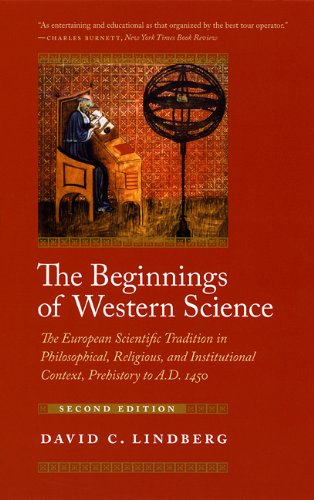
When it was first published in 1992, The Beginnings of Western Science was lauded as the first successful attempt ever to present a unified account of both ancient and medieval science in a single volume. Chronicling the development of scientific ideas, practices, and institutions from pre-Socratic Greek philosophy to late-Medieval scholasticism, David C. Lindberg surveyed all the most important themes in the history of science, including developments in cosmology, astronomy, mechanics, optics, alchemy, natural history, and medicine. In addition, he offered an illuminating account of the transmission of Greek science to medieval Islam and subsequently to medieval Europe. The Beginnings of Western Science was, and remains, a landmark in the history of science, shaping the way students and scholars understand these critically formative periods of scientific development. It reemerges here in a second edition that includes revisions on nearly every page, as well as several sections that have been completely rewritten. For example, the section on Islamic science has been thoroughly retooled to reveal the magnitude and sophistication of medieval Muslim scientific achievement. And the book now reflects a sharper awareness of the importance of Mesopotamian science for the development of Greek astronomy. In all, the second edition of The Beginnings of Western Science captures the current state of our understanding of more than two millennia of science and promises to continue to inspire both students and general readers.
User’s Reviews
Editorial Reviews: Review “The value of Lindberg’s book as an introductory text for students is clear, but it will also serve as an excellent resource for non-specialists, particularly those teaching comprehensive survey courses. . . . [The book] offers a concise, highly accessible introduction to the essential elements of western knowledge about the natural world that will help guide instructors in developing curricula. . . . The possibilities presented to enrich and enliven a general history course abound.. . . . This second edition of The Beginnings of Western Science will remain a fundamental and reliable resource for many years to come.” — Angela Smith ― H-Net Review”This is a fine book, the culmination of a century of distinguished research on premodern European science. And it tells an important story that . . . needs to be read not only by undergraduates but by professional historians and anyone seeking to understand the origins of modern science.” — F. Jamil Ragep ― Isis About the Author David C. Lindberg is the Hilldale Professor Emeritus of the History of Science at the University of Wisconsin–Madison and past-president of the History of Science Society. He is the author or editor of many books, including, with coeditor Ronald L. Numbers, When Science and Christianity Meet, also published by the University of Chicago Press.
Reviews from Amazon users which were colected at the time this book was published on the website:
⭐This book (2nd ed.) was written by David Lindberg, a well-known professor of the history of sciencewho taught at the U. of Wisconsin (Madison). The book covers pre-Greek (Egyptian, Mesopotomian),Greek, Roman, Islamic, and Medieval science in 14 chapters (367 pp. + notes and bibliog.). The bookincludes nearly a hundred black&white figures and illustrations, but only 6 maps. I boughtthe book for personal reading but it has also been used as a text in history of science classes.It includes a chapter on medieval medicine (anatomy, surgery, early hospitals). The book isnon-technical (no math equations) but polished and scholarly, and is aimed at general readerswho have an interest in both science and history. The bibliography is extensive (48 pages!),providing a wealth of information for those who want to further explore specific topics.Highly recommended as a broad introduction to the history of science up to medieval times.For those interested in medieval science, I also recommend Science in the Middle Ages,edited by Lindberg.
⭐This is one of several books that serve as a corrective to the popular myth that the fall of Rome was followed by the “Dark Ages.” In this book, the development of modern science is traced from pre-history through the classical period (Greece and Rome) and afterward. Discoveries and the transmission of learning after the fall of Rome in Islamic lands and in the West is covered in readable detail.Unlike similar books, the author does not wish to address why science withered away in Islam, instead wanting to end that section on a positive note (something to the effect that we should instead be amazed at how long it lasted). It is also rather more detailed tour on the thought and discoveries of the “ancients”.For anyone who has been steeped in the mythology that the history of scientific progress was Greece/Rome, the Dark Ages, the Renaissance, and the Enlightenment, this book (and/or the others listed below) should be required reading. That would cover mostly anyone educated in our colleges and high schools in the last fifty years.Other books in this vein worth reading:
⭐,
⭐,
⭐.
⭐Lindberg does an excellent job of tracing the history of the sciences (broadly construed) from prehistory to the late Middle Ages. He covers, physics, optics, medicine, biology, chemistry (in the form of alchemy), astronomy, and astrology with very good contextualization of the knowledge. You learn why smart people in the past would think that astrology makes sense.The author is very careful about explaining why medieval “scientists” thought as they did, and I find this method much more illuminating than comparing against modern ideas directly (although understanding them from the lens of modernity can be useful). I found the writing quite good and witty with plenty of authorial style shining through.If you want to know the history of science until the Scientific Revolution beginning in the 1600s (the title says to 1450), then this is a great book to introduce you to all relevant aspects of philosophy.
⭐I was preparing a lecture on the Interface of Science and Religion from the Renaissance to the 20th century and found the work to have been just what I needed as a resource.
⭐So far (I’m only half-way through) this book is very clear and direct. It covers the BEGINNINGS of science, so don’t expect any discussion of Newton or anything recent. It only goes up to the 1500s. Obviously, then, a lot of the “science” is not very accurate. But the point of this book is not to learn science, but to learn the history of the study of science. If you’re a PROFESSOR reading this review and considering using this book as a textbook, I suggest that you do what my professor did and give supplementary readings of primary sources (actual passages from Aristotle, Galen, etc.)
⭐Good
⭐Very interesting history of science and philosophy through the Middle ages.
⭐as expected
⭐Das Buch ist eine sehr gute Ideengeschichte zur Entstehung abendlaendischer Wissenschaft, wie es mir in der deutschsprachigen Literatur selten begegnete. Mit Kindle sind englischsprachige Buecher leichter zu deutsche Leser zu lesen. Das ist fuer mich der Hauptvorteil von Kindle.
⭐
Keywords
Free Download The Beginnings of Western Science: The European Scientific Tradition in Philosophical, Religious, and Institutional Context, Prehistory to A.D. 1450 in PDF format
The Beginnings of Western Science: The European Scientific Tradition in Philosophical, Religious, and Institutional Context, Prehistory to A.D. 1450 PDF Free Download
Download The Beginnings of Western Science: The European Scientific Tradition in Philosophical, Religious, and Institutional Context, Prehistory to A.D. 1450 2008 PDF Free
The Beginnings of Western Science: The European Scientific Tradition in Philosophical, Religious, and Institutional Context, Prehistory to A.D. 1450 2008 PDF Free Download
Download The Beginnings of Western Science: The European Scientific Tradition in Philosophical, Religious, and Institutional Context, Prehistory to A.D. 1450 PDF
Free Download Ebook The Beginnings of Western Science: The European Scientific Tradition in Philosophical, Religious, and Institutional Context, Prehistory to A.D. 1450