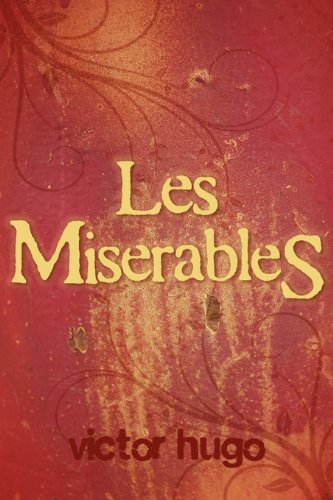
Ebook Info
- Published: 2012
- Number of pages: 1042 pages
- Format: Epub
- File Size: 8.42 MB
- Authors: Victor Hugo
Description
Set in the Parisian underworld and plotted like a detective story, the work follows Jean Valjean, a victim of society who has been imprisoned for 19 years for stealing a loaf of bread. A hardened criminal upon his release, he eventually reforms, becoming a successful industrialist and mayor of a northern town. Despite this he is haunted by an impulsive, regretted former crime and is pursued relentlessly by the police inspector Javert. Valjean eventually gives himself up for the sake of his adopted daughter, Cosette, and her husband, Marius. ‘Les Miserables’ is a vast panorama of Parisian society and its underworld, and it contains many famous episodes and passages.
User’s Reviews
There is no Editorial Review for this book
Reviews from Amazon users, collected at the time the book is getting published on UniedVRG. It can be related to shiping or paper quality instead of the book content:
⭐ All of the reviews for all of the versions available on Amazon seem to be collected in one batch and then applied to each and every edition. I mistakenly ordered a version that had a couple of excellent translation reviews that turned out not to be for the edition I got.I only noticed this as I got into the book and realized that the typos were going to make it impossible for me to finish — although I was enjoying the translation I have, whichever one it might be. In the rendition I received, at least once per line the space between words has been omitted. You get used to “inthe” instead of “in the” but it gets a lot harder when the the two words joined need you to stop and spend time to figure them out — if only briefly.I came back to Amazon to see if a different edition would work for me, and that’s when I discovered that the reviews are all applied to all of the editions.I am stymied. I am determined to read this book but I don’t read French. I don’t want to keep shelling out my Kindle budget on sub-par translations or versions riddled with typographical mine-fields. I don’t know where I’ll go from here.
⭐ The canon is under attack, and yet many of us continue to read the classics. Of course we do not read them the way people did in the nineteenth century. We look for irony, parody and sarcasm; we fit them into our post-postmodern frame; we read between the lines; we mock the godlike narrator; we read ourselves into the texts. And needless to say, we complain: these novels are too long, they include too many digressions, they are implausible as stories, and most of them were written by white men. I wonder what will be said, one hundred years from now, of the contemporary books we revere. If something is said at all. Will people even read them? It seems to me that the proverbial fifteen minutes of fame keep getting shorter.The phrase I chose as the title for this review is an excellent summary of _Les Misérables_, or at least, of the philosophy behind it. Humanity as a whole may look rotten, the author seems to say, but millions of individual men and women persevere, show true goodness, and emerge victorious from the struggle we call life. This victory, it must be pointed out, is not always apparent; it often looks more like utter defeat. The victory that Victor Hugo is talking about is that of the soul. Just in case the reader needs clarification, the author/narrator makes his point more explicit in part 5, chapter 1.20: “The book which the reader has under his eye at this moment is, from one end to the other, as a whole and in detail, whatever may be its intermittences, exceptions and faults, the march from evil to good, from the unjust to the just, from night to day, from appetite to conscience, from rottenness to life, from hell to heaven, from nothingness to God. Point of departure: matter; point of arrival: the soul. The hydra at the beginning, the angel at the end.”The hero of this Romantic novel is Jean Valjean, who at the beginning of the novel has finished serving a prison sentence. He is, to put it simply, one of the most pure, benevolent characters in the history of the novel. As a virtuous criminal, he shatters society’s binaries: he is proof that an apparently evil person may in fact be good, despite his faults. (_Les Misérables_ is, among many other things, a liberal statement against the inhumane treatment of convicts, who are often more humane than so-called upright citizens.) Valjean’s nemesis is the inspector Javert, who after spotting him dedicates his life to catching this (in his view) despicable man. Fate will lead Valjean to Fantine, an innocent young woman who has fallen from grace in the eyes of society as a result of a single mistake. Throughout most of the novel, Valjean will take care of Fantine’s daughter Cosette, who becomes his raison d’être, as he escapes from Javert. Finally, there’s the young Marius, who lives with his grandfather M. Gillenormand, and whose father died fighting with Napoleon in the battle of Waterloo. His life changes when he lays eyes on a beautiful young woman… The lives of these characters are intertwined with that of the innkeeper Thénardier and his family. He and his wife “adopt” and exploit Cosette. Their daughter Eponine will prove that evil does not necessarily engender evil; their son Gavroche, who lives in the streets, is one of the novel’s most colorful characters. _Les Misérables_ is divided into five parts. We follow Jean Valjean, who encounters Javert, Fantine, and Cosette. Then we learn about Marius, who encounters Valjean and Cosette. The novel’s climax describes the Paris Uprising of 1832, in which the characters find themselves participating._Les Misérables_ (1862) is, like Tolstoy’s _War and Peace_, like Dickens’ _Bleak House_, like Melville’s _Moby Dick, like Cervantes’ _Don Quixote_, a literary monument and a literary monster. Descriptions are long and exhaustive, sometimes even exhausting. Digressions abound. The reader will wonder at times if what he/she is reading is a “novel” at all. What is a novel, anyway? Camilo José Cela (that Spanish Nobel Laureate few people read) famously answered, “A book that bears the description ‘a novel’ below its title.”Another important issue to consider: _Les Misérables_ has been turned into a successful musical and has been adapted for the screen numerous times, most recently in 1998 (directed by Bille August), 2012 (directed by Tom Hooper), and 2018 (the BBC mini-series, directed by Tom Shankland). These very good adaptations will give you the story. You won’t have to “put up” with the long descriptions and digressions. Why read the 1,260-page book?We expect a novel to be primarily a story. Of course, a novel should tell a story, but it may be many other things too. We may complain of the digressions in _Les Misérables_, but remember the encyclopedic _Moby Dick_ with its essays on the different aspects of whaling. Or _Don Quixote_ with its unrelated novellas within the novel. Or _War and Peace_ with its analysis of Napoleon, its philosophical considerations about “exceptional” men, and its comments on what it takes to win a war. Philosophy was an important component of the nineteenth-century novel. There was no fear of preaching back then. The author/narrator was a colossal, godlike figure (let’s remember that, by etymology, a poet is a creator), and he, for most of the time it was a he, did not absent himself from his fictional world. With the “death of the author,” proclaimed by Roland Barthes et al, the text becomes the focus. Now, after postmodernism, we are seeing a return of the figure of the author through autofiction. Even during postmodernism, there were reactions against literary artifice; think of the work of Richard Yates, Raymond Carver, and Alice Munro.You may watch the screen adaptations or read an abridged version of _Les Misérables_, and you will be able to discuss the story with people who have devoted 17 days of their lives (in my case, but I believe in slow reading) to the complete novel. I, for my part, celebrate the long descriptions and the digressions. Is it necessary to dedicate 50 pages to a description of the battle of Waterloo just because one of the character’s *father* fought in the battle? Of course not. What about the 40-page description of monastic life, which includes Hugo’s personal views on this lifestyle? It is excessive, unnecessary. But during these digressions and descriptions you feel the enthusiasm of the author, who has in a sense lost control of his text. I love the story told in _Les Misérables_, but my favorite chapter, and I’m not trying to be funny here, is the second one of part 5, which offers a fascinating history, analysis and interpretation of the Paris sewer system. “The sewer is the conscience of the city,” Victor Hugo says. “The sewer, indeed, receives all the impulsions of the growth of Paris. It is, in the earth, a species of dark polyp with a thousand antennae which grows beneath at the same time that the city grows above.” The chapter is a great example of cultural studies, and this is something none of the screen adaptations will give you.Regarding translations, the free Kindle version gives you the one made by Isabel Hapgood in 1887. This version sounds a bit archaic, as one may expect, but it is readable. The Modern Library edition (see my picture) presents the first translation of _Les Misérables_ into English, done by Charles Wilbour. It is, interestingly, smoother than the Hapgood version. It was only after I finished the book that I learned the translation was over 150 years old. Penguin offers a more modern translation, by Norman Denny, first published in 1976. Here’s a comparison, based on the first “philosophical” observation in the novel:Original: Vrai ou faux, ce qu’on dit des hommes tient souvent autant de place dans leur vie et surtout dans leur destinée que ce qu’ils font.Hapgood: True or false, that which is said of men often occupies as important a place in their lives, and above all in their destinies, as that which they do.Wilbour: Be it true or false, what is said about men often has as much influence upon their lives, and especially upon their destinies, as what they do.Denny: What is reported of men, whether it be true or false, may play as large a part in their lives, and above all in their destiny, as the things they do.This sample shows how wordy and awkward the Hapgood translation may sound, at times, to modern ears. The Wilbour version has the advantage of being both faithful to the original and pleasant in the target language. Denny, finally, takes some liberties with structure, but reads quite well.Bottom line: I recommend reading _Les Misérables_. It is about life, death, the human, the divine, love, hate, obsession, crime, redemption, fate, light, darkness, freedom, revolution, victory, defeat. You know, those things some readers still care about. From most nineteenth century classics, and _Les Misérables_ is a great example, the reader simply emerges a different person. Some novels one loves the way a person should be loved: with all their virtues and their defects. That is how I feel about _Les Misérables_.My next long novel will be Thomas Mann’s _The Magic Mountain_.Thanks for reading, and enjoy the book!
⭐ The book is missing the entire part of the story where fantine lost her job, fell to prostitution, became ill, attacked Jean Val Jean, and was taken in by him. It doesn’t have the part where he debated over whether to go to save champmathieau. Very disappointing that it’s missing such vital parts of the story!
⭐ The digital version came through to my reader with flaws that make it almost impossible to read. On almost every page multiple words are printed together (i.e. multiplewordsareprintedtogether). It is so hard to read I have given up trying. I cannot find anyplace on the Amazon digital order site to ask for a better copy or to even get a refund. I would not recommend this version of the book to anyone.
⭐ I have seen the Broadway show, and the movies. I’m familiar with the beautiful, soul searching music, the passion of the story, and the relentless pursuit of blind justice. But I wanted to get the full story as told by Victor Hugo and I’m so glad I did. I learned many things that I did not get from performances I’d seen and I came to admire the character of Jean Valjean at an even deeper level than I had. Outstanding read!
⭐ THIS IS THE HAPGOOD TRANSLATION and the rating is for the translation, not the novel. Amazon doesn’t seem to like to list the translators but it can make a huge difference. I just got a Kindle, and having read Hunchback several years ago and having the Signet Classics Les Mis waiting on my shelf for a while, I decided this would be a good first hurdle for the Kindle. The hardcopy is so huge! Along the way I wondered why I seemed to be reading so slowly and having to re-read sections — was I not adapting to the Kindle? — and then I finally came across a phrase in this translation that really didn’t make any sense at all. Maybe a word-for-word translation rather than an interpretation? – “…the great art: to make a little render to success the sound of a catastrophe…” I had another free download of the book, and found exactly the same translation. In the Signet Classics Fahenstock/MacAfee translation, however, it was in perfectly good English: “…the great art, to give a success something of the sound of a catastrophe…” Here’s what’s annoying: if I pull up the Signet Classics version on Amazon, it has link to buy it in Kindle edition, but the LINK’S TO THIS COMPLETELY INFERIOR TRANSLATION! Amazon doesn’t offer a Kindle version of the Signet Classics translation so I’m looking elsewhere and using conversion software if I need to, then picking up where I left off in the Hapgood translation. Free is fine for public domain English-language books (Dickens, Twain) but I’ve learned my lesson with translations and will pay for premium.
⭐ Quite frankly, this novels tries too hard. About 25% of it is awesome and the other 75% gets in the way, or at least that’s how the first 10% of the book went, and that was more than enough for me.Of what I did read and enjoy, there was some good stuff in there. I really liked the convict’s interactions with the priest, how that scene came to a head, and the twist when the priest let the convict walk away. The problem is that this novel is like wading through a pile of coal for flakes of gold. For that one scene, I had to wade through pages and pages and pages of double, triple, quadruple repeated telling’s of a single character’s single point of usefulness to the story. I’m not even sure if that makes sense, but to put it briefly, I had to endure some 50 odd examples of the priest’s “goodliness” when really 10 was more than enough.Then I hit the next flock of characters and I realized I was skimming entire chapters. Not even skimming, just thumbing through them because I knew there was nothing worth reading that I hadn’t already read in the first two lines of the chapter heading.So yeah, I get why I’ve never heard of this novel until they made a movie out of it. I read the summary. That was enough for me. No need to kill 50 hours of my life thumbing through re-worded examples of things I already understand.2 Stars, because I’m feeling generous. It’s not like I hated it. I liked some parts in there, but I just didn’t feel like it was worth its weight in time.
⭐ I haven’t written a book report in almost 50 years, so bear with me a bit. Actually, I’m hardly qualified to review a book that’s universally considered a classic, but I can make some comments.Of course there’s the play and movies, but obviously they couldn’t have stuffed this long a book in two or three hours, so you should know:Hugo relates a lot of history from the end of Napoleon to the 1830s, and a good deal of philosophy as well (reminded me a bit of War and Peace in that regard). Also makes many references to historic to (then) current philosophers and world movers; he also presents scientific analyses at times.The story relies on a great deal of unlikely coincidences. Not uncommon in 19th century literature (I hated when Hardy did it, but did not mind when Dickens did). It did get to the point where I was starting to make some up myself.This free translation is at least a little dated (it too is from the 19th century). The ‘you’ and thou’ usage might take a little while to understand for a reader with absolutely no French background, especially as thou now seems more formal. There’s also a product-of-the-times antisemitic reference, and gay is commonly used in the older sense. There were also some French passages that were only translated in footnotes (which I found a nuisance to go back and forth from). It might be worth ponying up the 99 cents to get a more modern translation.
⭐ The text ever edited. Many words were combined making it very difficult to read. When French was quoted by the characters, no translation was provided. Instead of illustrations, instructions to insert the illustrations were provided.The Kindle edition was only 98 cents. I should have spent some more for this classic.
⭐ What can I say that has not already been said?Les Miserables by Victor Hugo is one of the greatest novels of the nineteenth century.I purchased this Kindle version in 2013 but did not start reading it until January, 2019 and finished in October, 2019. A group of volunteers translated into English, and for the most part, I thought the translation was very good. And the best part is that the price was $0.00.For those who are not familiar with the book, the story takes place in France, and primarily in Paris. Valjean is the protagonist. He steals a loaf of bread near the beginning of the book to feed his poor sister’s family. He is sentenced to five years in prison, but that is extended to a total of nineteen years after several escape attempts. He becomes bitter. When he is eventually set free he commits a few senseless crimes because of his bitterness and later becomes remorseful. He decides to lead a good life.Rather than me writing a lengthy review, I would advise you to google “Les Miserables by Victor Hugo”. The Wikipedia review of the book is much better than anything I could ever write. Read the Wikipedia review to get a thorough overview, but read the entire book for yourself and wallow in the magnificent prose. I hope you enjoy it as much as I did.
Keywords
Free Download Les Miserables in Epub format
Les Miserables Epub Free Download
Download Les Miserables 2012 Epub Free
Les Miserables 2012 Epub Free Download
Download Les Miserables Epub
Free Download Ebook Les Miserables