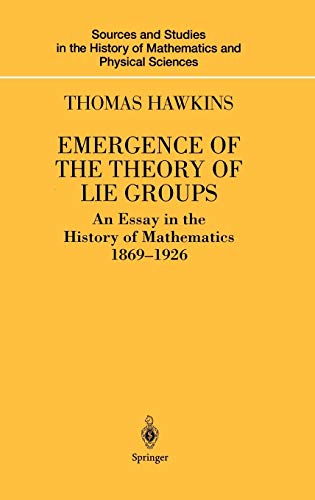
Ebook Info
- Published: 2000
- Number of pages: 579 pages
- Format: PDF
- File Size: 64.18 MB
- Authors: Thomas Hawkins
Description
The great Norwegian mathematician Sophus Lie developed the general theory of transformations in the 1870s, and the first part of the book properly focuses on his work. In the second part the central figure is Wilhelm Killing, who developed structure and classification of semisimple Lie algebras. The third part focuses on the developments of the representation of Lie algebras, in particular the work of Elie Cartan. The book concludes with the work of Hermann Weyl and his contemporaries on the structure and representation of Lie groups which serves to bring together much of the earlier work into a coherent theory while at the same time opening up significant avenues for further work.
User’s Reviews
Editorial Reviews: Review “….this study is just as clearly a stunning achievement. Few historians of mathematics have made a serious attempt to cross the bridge joining the nineteenth and twentieth centuries, and those who have made the journey have tended to avert their eyes from the mainstream traffic….the single greatest merit of Hawkins’ book is that the author tries to place the reader in the middle of the action, offering a close up look at how mathematics gets made…Hawkins’ account of this strange but wonderful saga resurrects a heroic chapter in the history of mathematics. For anyone with a serious interest in the rich background developments that led to modern Lie theory, this book should be browsed, read, savored, and read again.”-Notices of the AMS From the Back Cover Written by the recipient of the 1997 MAA Chauvenet Prize for mathematical exposition, this book tells how the theory of Lie groups emerged from a fascinating cross fertilization of many strains of 19th and early 20th century geometry, analysis, mathematical physics, algebra and topology. The reader will meet a host of mathematicians from the period and become acquainted with the major mathematical schools. The first part describes the geometrical and analytical considerations that initiated the theory at the hands of the Norwegian mathematician, Sophus Lie. The main figure in the second part is Weierstrass’student Wilhelm Killing, whose interest in the foundations of non-Euclidean geometry led to his discovery of almost all the central concepts and theorems on the structure and classification of semisimple Lie algebras. The scene then shifts to the Paris mathematical community and Elie Cartans work on the representation of Lie algebras. The final part describes the influential, unifying contributions of Hermann Weyl and their context: Hilberts Göttingen, general relativity and the Frobenius-Schur theory of characters. The book is written with the conviction that mathematical understanding is deepened by familiarity with underlying motivations and the less formal, more intuitive manner of original conception. The human side of the story is evoked through extensive use of correspondence between mathematicians. The book should prove enlightening to a broad range of readers, including prospective students of Lie theory, mathematicians, physicists and historians and philosophers of science.
Reviews from Amazon users which were colected at the time this book was published on the website:
⭐I can’t think of a better book on math history that I’ve read. At a nice 500 pages, it’s loaded with historical detail but also streamlined enough to be engaging for a general mathematical audience. This book is ostensibly about the historical development of Lie theory, its four parts in turn describing the work of Sophus Lie, Wilhelm Killing, Elie Cartan, and Hermann Weyl. However, the actual scope of the book is far greater, and perhaps the subtitle “History of Mathematics 1869-1926” is a more accurate description than the title itself. Hawkins describes on a general level such important figures as Jacobi, Frobenius, Schur, Klein, Cayley, Hurwitz, Weierstrass, Poincare, Hilbert, Koebe, and Einstein–their work and its immediate context, their personal lives, and their influence. Hawkins also describes the various geographic centers such as Paris, Berlin, Leipzig, Erlangen, Göttingen, and so on, highlighting the different mathematical cultures they produced. One comes away with a detailed mental image of the mathematical world of a century ago.A major complaint I have of math textbooks generally is that, while most authors can give a clean, efficient technical presentation of their subject, they do not include many historical details. This is unfortunate because any math field is the end result of decades of gradual development motivated by concrete problems, and it’s hard to both grasp and appreciate the subject without knowing this context. While textbook authors may not change their habits, Hawkins’s book is perfect to fill the gap for the interested student–especially given that a very large portion of today’s standard graduate-level mathematics curriculum was developed during this time period covered by this book. (And by the way, the author also has a book on the history of Lebesgue’s theory of integration that is very similar in spirit to this one–that’s also worth checking out!)
⭐I can’t remember the last time I purchased a book that I have enjoyed so thoroughly. The day it arrived I read sixty pages in different parts of the book, mostly in the section on Hilbert and Weyl. There are so many branches of advanced mathematics that are tied together here in one place. These different branches, most developed since 1850, are taught as separate subjects nowadays. But in their development they were driven by a small group of scholars and geniuses in a few cities in Europe. I feel as though I’m in Berlin and Paris and Göttingen listening to these great minds as they share ideas, and as one branch of mathematics nourishes and stimulates another. One of the great ideas of Riemann and Hilbert and Weyl is the unity of mathematics, and also physics. This book recaptures that mystical and beautiful unity. I felt like all my Christmases came at once. It was so difficult to choose a section to read that I read many, and have now settled down to read the whole book carefully from cover to cover.
⭐
Keywords
Free Download Emergence of the Theory of Lie Groups: An Essay in the History of Mathematics 1869–1926 (Sources and Studies in the History of Mathematics and Physical Sciences) 2000th Edition in PDF format
Emergence of the Theory of Lie Groups: An Essay in the History of Mathematics 1869–1926 (Sources and Studies in the History of Mathematics and Physical Sciences) 2000th Edition PDF Free Download
Download Emergence of the Theory of Lie Groups: An Essay in the History of Mathematics 1869–1926 (Sources and Studies in the History of Mathematics and Physical Sciences) 2000th Edition 2000 PDF Free
Emergence of the Theory of Lie Groups: An Essay in the History of Mathematics 1869–1926 (Sources and Studies in the History of Mathematics and Physical Sciences) 2000th Edition 2000 PDF Free Download
Download Emergence of the Theory of Lie Groups: An Essay in the History of Mathematics 1869–1926 (Sources and Studies in the History of Mathematics and Physical Sciences) 2000th Edition PDF
Free Download Ebook Emergence of the Theory of Lie Groups: An Essay in the History of Mathematics 1869–1926 (Sources and Studies in the History of Mathematics and Physical Sciences) 2000th Edition