

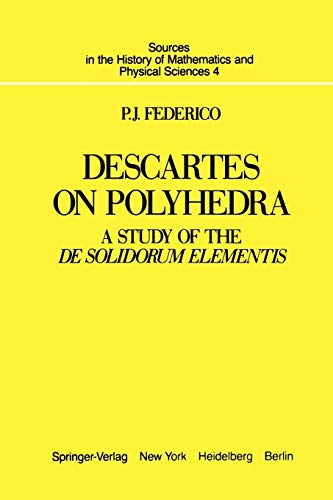
Ebook Info
- Published: 2011
- Number of pages: 154 pages
- Format: PDF
- File Size: 4.52 MB
- Authors: P. J. Federico
Description
The present essay stems from a history of polyhedra from 1750 to 1866 written several years ago (as part of a more general work, not published). So many contradictory statements regarding a Descartes manuscript and Euler, by various mathematicians and historians of mathematics, were encountered that it was decided to write a separate study of the relevant part of the Descartes manuscript on polyhedra. The contemplated short paper grew in size, as only a detailed treatment could be of any value. After it was completed it became evident that the entire manuscript should be treated and the work grew some more. The result presented here is, I hope, a complete, accurate, and fair treatment of the entire manuscript. While some views and conclusions are expressed, this is only done with the facts before the reader, who may draw his or her own conclusions. I would like to express my appreciation to Professors H. S. M. Coxeter, Branko Griinbaum, Morris Kline, and Dr. Heinz-Jiirgen Hess for reading the manuscript and for their encouragement and suggestions. I am especially indebted to Dr. Hess, of the Leibniz-Archiv, for his assistance in connection with the manuscript. I have been greatly helped in preparing the translation ofthe manuscript by the collaboration of a Latin scholar, Mr. Alfredo DeBarbieri. The aid of librarians is indispensable, and I am indebted to a number of them, in this country and abroad, for locating material and supplying copies.
User’s Reviews
Reviews from Amazon users which were colected at the time this book was published on the website:
⭐This is a transcription and translation of a short manuscript by Descartes on polyhedra with historical and mathematical commentary. Federico’s estimate is that the manuscript was written around 1630 (others have guessed 1620). It was still among Descartes’s papers when he died in Stockholm in 1650. His belongings were then shipped to Paris but “when it reached Paris the boat was wrecked; the box of manuscripts fell into the river and was not recovered until three days later … the papers had to be separated and hung to dry on chords in various rooms about the house”. The manuscript was later lost, but Leibnitz had seen it and made copy (facsimiles included here) which was found and published in 1860.The first part of the manuscript gives a few equations relating basic properties of polyhedra (number of vertices, faces, and plane angles, and the sum of all the plane angles). There is one application: since any polyhedron must obey these equations, one can deduce the nonexistence of impossible polyhedra. Thus Descartes proves that there are only five regular polyhedra. We also look briefly at Euler’s work on polyhedra (from 1750 when Descartes’s text was unknown and unpublished). Euler recognised that the three basic polyhedral data was the number of vertices, edges and faces. Since Descartes neglected to count edges he missed out on Euler’s formula v-e+f=2.The second part of the manuscript deals with polyhedral figurate numbers. The Greeks studied plane polygonal numbers, but even though the regular polyhedra were their pet objects they did not study polyhedral numbers. As the polygonal numbers, the polyhedral numbers may be regarded as built up layer by layer. In this way Descartes calculates formulas for the figurate numbers in the cases of the regular polyhedra and many semi-regular polyhedra.
⭐
⭐
Keywords
Free Download Descartes on Polyhedra: A Study of the De Solidorum Elementis (Sources in the History of Mathematics and Physical Sciences, 4) in PDF format
Descartes on Polyhedra: A Study of the De Solidorum Elementis (Sources in the History of Mathematics and Physical Sciences, 4) PDF Free Download
Download Descartes on Polyhedra: A Study of the De Solidorum Elementis (Sources in the History of Mathematics and Physical Sciences, 4) 2011 PDF Free
Descartes on Polyhedra: A Study of the De Solidorum Elementis (Sources in the History of Mathematics and Physical Sciences, 4) 2011 PDF Free Download
Download Descartes on Polyhedra: A Study of the De Solidorum Elementis (Sources in the History of Mathematics and Physical Sciences, 4) PDF
Free Download Ebook Descartes on Polyhedra: A Study of the De Solidorum Elementis (Sources in the History of Mathematics and Physical Sciences, 4)