

Ebook Info
- Published: 2002
- Number of pages: 368 pages
- Format: PDF
- File Size: 1.40 MB
- Authors: Lee Nichol
Description
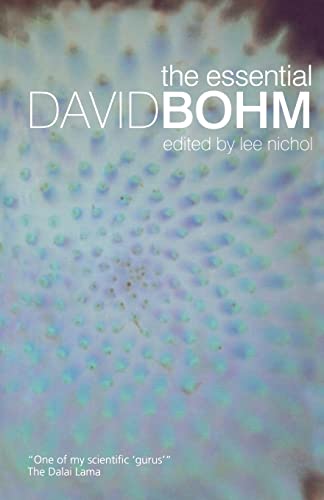
There are few scientists of the twentieth century whose life’s work has created more excitement and controversy than that of physicist David Bohm (1917-1992). For the first time in a single volume, The Essential David Bohm offers a comprehensive overview of Bohm’s original works from a non-technical perspective. Including three chapters of previously unpublished material, each reading has been selected to highlight some aspect of the implicate order process, and to provide an introduction to one of the most provocative thinkers of our time.
User’s Reviews
Editorial Reviews: Review ‘One of my scientific “gurus”.’ – The Dalai Lama About the Author The late David Bohm, one of the greatest physicists and foremost thinkers this century, was Fellow of the Royal Society and Emeritus Professor of Physics at Birkbeck College, University of London. Lee Nichol is a freelance writer and edited two works by David Bohm, On Dialogue (1996) and On Creativity (1998), both published by Routledge.
Reviews from Amazon users which were colected at the time this book was published on the website:
⭐Edited by Lee Nichol, this book is the quintessential introduction to the genius that was David Bohm, a prominent physicist who nonetheless lost out to Einstein in terms of popularity. The fervent synthesis of science and philosophy during the latter half of his career did not sit well with the scientific community at the time: As such, his most marvelous accomplishments were relegated to the sidelines of scientific inquiry. However, Bohm did succeed in securing a slew of open-minded followers who have carried his theories through the decades in an undercurrent that has been gaining momentum in recent years. In the last decade alone, hundreds of best-selling books by “New Age” authors have cited his works as substantially contributing to their ideas and postulations. After reading a large selection of these books myself, I thought it was time to go straight to the source and this book fit the bill. Nichol has flawlessly and intelligently compiled a series of articles, essays, dialogues, interviews and correspondence penned by Bohm throughout the years into a logical reading sequence where each chapter builds up our understanding for the next.The first part of the book covers Bohm’s views on “Universal Orders”. Here, we are presented with a series of chapters elaborating the relative and unsubstantial nature of human perception and its inadequacies in accessing any form of “truth” through scientific inquiry alone. Science (that hinges on quantifiable and testable hypotheses) without philosophy (that hinges on qualitative analyses) inevitably leads to a misleading mechanistic view of reality that has already been shown to be severely “limited” in lieu of quantum physics on one end of the spectrum and Einstein’s theory of relativity on the other. Furthermore, certain inexplicable experimental results (such as “non-local” qualities expressed by entangled particles) in Quantum Physics have underscored the inadequacy of modern science and has thus highlighted the urgent “need” for a new and more open-minded dogma of scientific inquiry. It is here that Bohm proposes his landmark theory of the Implicate Order. Using the “ink spot in the glycerine cylinder” analogy and principles of holography as examples, Bohm demonstrates the idea of an infinite and implicit level of true reality (the Implicate and Super-Implicate Order) that gives rise to our universe (the Explicate Order) in a process of enfoldments and “unfoldments” called the “Holomovement”. Here, time, space, thought, consciousness, and matter are all elements that unfold from the implicate order, which may also contain in it other “orders” that ultimately do not manifest in our domain of experience. What does manifest however, are certain patterns of “causality” that we have taken for granted as permanent scientific laws when in fact these laws are nothing more than tiny derivative subsets “abstracted” from a larger cornucopia of non-linear relationships that may exist in the super implicate order (which “informs” the implicate order on what and how to manifest into the explicate.) Bohm also puts to rest the notion of separation between “mind” and “matter” in the treatment of a subject he coins as “Soma-Significance”. Here, mind is but a subtle process (or has a “significance” as it were) that arises from lower-level interactions of matter (nerves, pulses, cells, glands, etc.), or “soma”. This somatic structure, in turn, is a subtle expression of yet another level of matter/soma (chemicals, cellular structures, organic compounds, molecules, etc.) In this way, matter (also soma, structure, content, or manifest) and meaning (also significance, mind, context, or subtle) comprise the various levels of reality that mutually interact with and modify one another ad infinitum, all of which are enfolded in the implicate order.The second part of the book stresses on the human Ego. Bohm ventures to explain the structure-process of the ego as nothing more than a mechanical process (once again, from a soma-significant standpoint) that deprives us of a wholesome existence by creating a constant state of crisis, conflict and contradiction. At the core of our psychological conditioning is the “I”-“me” dichotomy that seems to establish our sense of “self” (or ego) as a concrete entity separate from the immediate environment that we perceive. Where as our past, memories, experiences, conditioning, and values compose the content of the “I”, the “me” is essentially the interactive process of perception of our present surroundings (as in “this [or that] is happening to me”). As long as the ego-content categorizes these present situations according to past criteria, we will always be in a state of conflict and confusion that does not allow us to “understand” the truth of what we perceive. At the heart of the ego process is what Bohm calls the “Pleasure Principle”, a mechanical yearning in our brain’s cortex to create thoughts and illusions from our memory banks so as to stimulate the thalamus into producing the emotion of pleasure. This reflex distorts that which we perceive and generates “false” emotions based on what we “think” is happening. If these emotions happen to be undesirable, our cortex goes into a tailspin and generates more illusions to appease our distraught thalamus that was misled by the ego-process of the cortex in the first place! This creates a tangled mess of illusions and false knowledge that prevent us from seeing the “mechanicalness” of our own minds. To understand a present situation in its totality (and hence, true knowledge), we ourselves must be whole, a state of true “individuality” that does not separate the perceiver from the act of perception, the “I” from the “me”. We must also be attentive of the fact that “thought” and “emotions” are the same thing: there is no thought without emotion and vice versa. This is yet another division we impose that seems to cause us even more confusion. Furthermore, our sense of ego is continually strengthened by thoughts and illusions that result from incessantly reliving our “memory scratches” in order to artificially simulate pleasure that, in fact, should only come from true perception in the “now”.To dismantle our egos and experience true conflict-free individuality, Bohm suggests that we must engage in a process called “suspension”. This is a process by which we must seek to become aware of our thoughts, both explicit and implicit (our immediate value judgments), and the emotions that arise in response to them. It is called suspension precisely because we must allow these sensations to physiologically “play out” without acting upon them or thinking even more thoughts to change or subdue them (which would just be more smoke and mirrors by the ego). Engaging in such an unobtrusive mode of awareness of our mental machinations will automatically deprive it of energy and expose the mechanical nature of it all. Only then, in a true act of “free will”, would we be able to respond to actual information, where our possible courses of action are not determined by self-deceiving false knowledge (ignorance) but by what is actually true or false. Bohm also proposes that the “insights” we gain from this act of “preprioception” is a “creative” process by which we “catch a glimpse” of the implicate order. The third part of this book carries the aforementioned principles of the ego-process to a larger context of human societies and demonstrates how the internal conflicts in our minds are but a microcosm of the tragic conditions that plague the human race as a whole (warfare, terrorism, etc.). In accordance to soma-significance, if enough of us can attain indivisibility within our psyches, it would serve as a potent impetus to gradually “solve” the divisions and conflicts confronted by the human race. This can be done through the encouragement of collective dialogue and discourse.There are two common themes running throughout the course of Bohm’s works: The methodical limitations of science as it currently stands (i.e. in the chronic need for experimental results or “pay-offs”) and the undivided wholeness of the universe. As such, there is no differentiation of the “I” from the “me”, “mind” from “matter”, “effect” from “cause”, “soma” from “significance”, “time” from “space”, “past” from “future”, “meaning” from “intention”, “perceiver” from “perception”, and definitely no “relative experience” from “concrete reality”. Everything is relative to everything else and all are enfolded in the implicate and super-implicate orders. Furthermore, the implicate order may be considered as the “ultimate” soma and the super-implicate order, the “ultimate” significance. That could possibly imply a self aware and intelligent universe: what many of us call “God” perhaps? The content of this book is beyond review in my opinion. It is like trying to review Shakespeare, whose works have become the backbone of English literature: Any attempt at constructive criticism on my part would be ill-developed or naïve at best. However, what I can review is Lee Nichol’s style of compilation, which is superbly executed in its own right and requires no more discussion. What becomes clear upon reading this masterpiece, are the hordes of new age authors that have been eager to “borrow” only relevant portions of Bohm’s theories to corroborate and validate their own musings. This has led to much distortion and misrepresentation of Bohm’s ideas. If you want to intimately understand David Bohm’s awesome theoretical achievements, this would be “the essential” starting point.
⭐Excellent book. Bohm is just as relevant today, and, in my opinion, still more cogent than today’s leading physicists.
⭐I would not have bought this book if I had viewed it prior to purchase. This book has a paucity of equations.
⭐Although the writing is a bit heavy on the jargon, the gems in each chapter are well worth the mining effort. Lee Nichol offers easy to understand summaries of each chapter too. David Bohm was a great mind and man whose work deserves a good read by anyone who believes that what we do with our life matters. Bohm’s writing gets easier to read too in his later works in this book.
⭐Breathtaking and brilliant in ways that continue to unfold upon reflection and experience. Bohm is onto something VERY BIG about the nature of human consciousness in relationship to “The Whole” that is the Universe itself and our oneness with it all. He seems to be plugging into Another Intelligence altogether that begins to “explain” our own. Bohm delivers a “kind” of “insight” for the Ages.
⭐I’ve enjoyed reading this book. David Bohm’s dialogues with Krishnamurti inspired me to read more and more from him and made me practice his dialogues. Part 2 with the more personal records gave a good vieuw on his extraordinairy wide vision.
⭐I am a fan of David Bohm. Unfortunately I never met him. This book make it possible for me to meet him through his ideas an action. The parts in the book make it easy to find my way to the pieces I am looking for based on my interest in the moment.
⭐Excellent book with essential writings of David Bohm
⭐A very good introduction to David Bohm and his legacy of what it means to be a polymath. I don’t mean this in the way that say, Goethe or Darcy Thomson was a polymath but rather that David Bohm’s character was such that he was interested in almost everything that concerned the human condition. This means anything that shows what it is to be a human being whether this means an interest in philosophy, science, sociology, psychology to name a few. However, it means much more than this, Bohm not only studied these areas of human endeavour but also wanted to know how he could make a contribution to the difficulties faced by humanity as a whole e.g. the proliferation of atomic weapons, how conflict arises, the human ego, the ideas of meaning and so on.This book introduces a reader to Bohm’s works including his seminal “Wholeness and the Implicate Order” as well as “Science, Order and Creativity”, “Unfolding Meaning” and “On Dialogue”. In some sense his original ideas on the implicate order and the influence of Krishnamurti opened doors to other ideas which have affected all of his works from that time on. His works span the times from 1957 to near his death in 1989. It is seen how his ideas developed especially how the initial ideas of the qualitative infinity of nature (1957), through the physics of perception (1967), led gradually to the concept of the implicate order (1980). These ideas were expanded to study how seemingly disparate subjects such as matter and mind could be related to each other when centuries of thought had insurmountable difficulties doing so. This led to his ideas of soma-significance and signa-somatic affects in his remarkable work “Unfolding Meaning”.It is clear that Bohm did not shirk a study of such ideas as a physicist when most scientists won’t touch them as they appear to be so completely different from what they work on. In some ways most scientists are confined by what is expected of them by other scientists and parts of society. This means you are allowed to have plenty of good ideas provided they don’t clash with the ways things are, I mean this both in terms of science and society. In other words don’t rock the boat or else you’ll end up like Bohm who never got another job in the US after his refusal to denounce others in the Macarthy hearings of the ’50s and whose physics was ignored to be too far outside the norm. But Bohm knew that to be a human being you must live in a world which contains all of these phenomena, in addition he knew that since science was supposed to be designed to search out the truth it must also find ways to understand these phenomena without leading to contradictions or paradoxes which is still the case today.David Bohm started the ball rolling and hopefully it will be taken up by those brave souls willing to risk their carreers and reputations on seemingly “crazy” ideas in order to find the truth and stop the current tendency by most people to stay ignorant and blind. Afterall, today’s monalithic structures of society virtually force this way of life on us. What else could be the reason for the decay of the joy in learning and life that the child possesses and its gradual eradication by adulthood.
⭐We live inside a hologram, which is inside a hologram, which is inside another hologram.For me that is “his theory” in 1 sentence. Didn’t need to read an entire book to get that message.
⭐A book that is personal and clear. It contains a lovely correspondence with his family and general observations of this famous Physiker. Especially his remarks on the construct of a dialog is essential for understanding of consciousness. His general idea is that to find the best answers there must be an ongoing discourse of opinions, settled by an authority. Wished he had done more with application of physics in this field.Clear language, good collection of thoughts.
⭐An extremely important read for anyone who loves science but still wants to nurture his soul. If you are an intelligent and compassionate person, you will love this book.
Keywords
Free Download The Essential David Bohm in PDF format
The Essential David Bohm PDF Free Download
Download The Essential David Bohm 2002 PDF Free
The Essential David Bohm 2002 PDF Free Download
Download The Essential David Bohm PDF
Free Download Ebook The Essential David Bohm