

Ebook Info
- Published: 1997
- Number of pages: 608 pages
- Format: PDF
- File Size: 34.55 MB
- Authors: Professor Paul R. Gross
Description
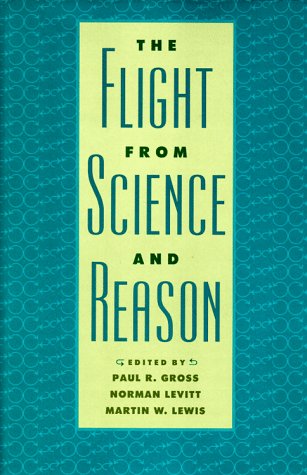
“Evidence of a flight from reason is as old as human record-keeping: the fact of it certainly goes back an even longer way. Flight from science specifically, among the forms of rational inquiry, goes back as far as science itself… But rejection of reason is now a pattern to be found in most branches of scholarship and in all the learned professions.”–from the introductionIn the widely acclaimed Higher Superstition: The Academic Left and Its Quarrels with Science, Paul R. Gross and Norman Levitt offered a spirited response to the “science bashers”, raising serious questions about the growing criticism of scientific practice from humanists and social scientists on the academic left. Now, in The Flight from Science and Reason, Gross and Levitt are joined by Martin W. Lewis to bring together a diverse and distinguished group of scholars, scientists, and experts to engage these questions from a wide variety of perspectives.The authors take on critics of science whose views range from moderate to extreme, from social constructivists to deconstructionists, from creationists and feminists to Afro-centrists. They discuss the rise of “alternative medicine” and radical environmentalism (here skewered as “ecosentimentalism”). They explain why the “uncertainty principle” does not work as a metaphor for ambiguity, and why “chaos theory” cannot be invoked without an understanding of mathematics. Throughout, they grapple with the paradox inherent in arguing with opponents who contend that reason itself, and thus logic, is suspect. Distributed for the New York Academy of Sciences
User’s Reviews
Editorial Reviews: Review “”[This book] reflects the views of 40 scholars, scientists, adn other experts… Each author speaks strongly to critics of the scientific methods and to those who acquiesce to mystics, radical environmentalists, and creationists. They also issue a powerful exhonaration to turn back this trend and revert to reliance on reason and logic.” — Science News Book Description The authors of Higher Superstition and others take on critics of science from social constructivists to deconstructionists, from creationists and feminists to Afro-centrists. About the Author Paul R. Gross, former director of the Woods Hole Marine Biological Laboratory, is University Professor of Life Sciences and director of the Center for Advanced Studies at the University of Virginia. Norman Levitt is professor of mathematics at Rutgers University and the author of Grassmannians and Gauss Maps in Piecewise-Linear Topology. Martin W. Lewis is professor of geography at Duke University and the author of Green Delusions: An Environmentalist Critique of Radical Environmentalism. Read more
Reviews from Amazon users which were colected at the time this book was published on the website:
⭐purchased for a “Role of the Scientist” class for graduate schoolvery thought provoking articles with some great materials for discussionsome classic discussion points are presented
⭐Those looking for some more (well deserved) bashing of the postmodernist academic left, such as that found in Gross and Levitt’s previous book “Higher Superstition” may be disappointed. This book is a collection of papers delivered at a conference held under the auspices of the New York Academy of Sciences, organized by the authors. The papers vary both in quality and in thrust depending on the author.The book is divided into 11 sections, each containing three to five papers that fit into the general category. Categories include “The Public Image of Science”, “The Foundations of Physics”, “Health”, “Environment”, “Feminism”, “Humanities”, “Religion” and “Education”, among others.It being proceedings from a conference, few papers actually delve into particular examples of bad science. Notable exceptions are “Building bridges to Afrocentrism” by Ann Macy Roth and “Whatever happened to historical evidence?” by Mary Lefkowitz, both of which contain criticisms of many afrocentrist claims regarding the egyptians, among a handful of others. Other papers talk about the philosophical underpinnings of the postmodernist movement, or survey some of the literature, or encourage scientist to speak up in defense of science against the attacks by those championing the irrational. Many authors try not to get into discussions of validity in order to not be seen as “preaching to the choir”, which can leave the lay reader looking for more postmodernist howlers feeling ill-served.On the other hand, the articles contain a wealth of information in the form of references, and mark trends both of the anti-science academic left and her critics. Not recommended to non-scientist (read Gross and Levitt’s other book instead), but those with a keen interest in the debates what what science “is” will find it an interesting and thought provoking read.
⭐To write a review of this book is actually to exercise the very constructivist principles which the Enlightenment bestowed on the humanities. Most of what passes for criticism these days is so de-constructivist that one wonders exactly what qualitative judgement is being passed, and exactly on what subject. These are writings by academics, and so what? They remind me of the early-Christian monks in Ireland, transcribing the surviving wisdom of the ancients and periodically fleeing from barbarian hordes farther and farther West. Well, this is as far West as we can go, folks. It’s time to turn and face the barbarians. Unless you’re one of those bored citizens who’re looking forward to them, like the ones in Cavafy’s “Waiting for the Barbarians.”
⭐A broad but restrained look at various aspects of the irrationalist fad. The lectures put forward clear and calm arguments exposing the disturbing trends in academia that are hopefully losing popularity as their lack of substance is revealed. This was never meant to be a popular book, but for anyone with an interest or a stake in the pursuit of knowledge, or the standard of our education system, it is a useful reference.
⭐I gave this book “3 stars” because there are some helpful thoughts. David Goodstein in “Conduct and Misconduct in Science,” points out that there are flaws in the system of peer reviewing. He wrote about selection of referees: “They are also never called to account for their choice of referees, who in any case always have the proper credentials. Since the referees perform a professional service, almost always without pay, the primary responsibility of the editor or pro¬gram officer is to protect the referee. Thus, referees are never called to account for what they write in their reviews. As a result, referees are able, with relative impunity, to delay or deny funding or publication to their rivals. When mis¬conduct of this kind occurs, it is the referee who is guilty; but it is the editors and program officers who are responsible for perpetuating a corrupt system that makes misconduct almost inevitable” (p 37). On the very next paragraph, he wrote: “This is the kind of misconduct that is, I fear, rampant in all fields of science, not only biomedical science. Recently, as part of a talk to a large audience of mostly young researchers at an extremely prestigious university, I outlined this analysis of the crisis of peer review. The moderator, a famous senior sci¬entist, was incredulous. He asked the audience how many disagreed with my heresy. No one responded. Then he asked how many agreed. Every hand in the house went up. Many of us in my generation wish to believe that nothing important has changed in the way we conduct the business of doing science. We are wrong. Business as usual is no longer a real option for how we conduct the enterprise of science.” He concluded with “scientists are not disinterested truth seekers; they are more like players in an intense, winner-take-all com¬petition for scientific prestige, or perhaps merchants in a no-holds-barred mar¬ketplace of ideas. The sooner we learn to admit to those facts, and to distin¬guish carefully between serious scientific misconduct and common human conduct by scientists, the better off we all will be.” In another chapter, James Alcock offered this excellent sentence: “The brain and nervous system are `hardwired’ to learn about the world, to learn about associations among objects and actions and events.” The author may not have agreed with what I am about to write, but the One who “hardwired” our brains is our Maker, the Lord Jesus, aka Creator Christ! See my
⭐
Keywords
Free Download The Flight from Science and Reason (Annals of the New York Academy of Sciences) in PDF format
The Flight from Science and Reason (Annals of the New York Academy of Sciences) PDF Free Download
Download The Flight from Science and Reason (Annals of the New York Academy of Sciences) 1997 PDF Free
The Flight from Science and Reason (Annals of the New York Academy of Sciences) 1997 PDF Free Download
Download The Flight from Science and Reason (Annals of the New York Academy of Sciences) PDF
Free Download Ebook The Flight from Science and Reason (Annals of the New York Academy of Sciences)