Ebook Info
- Published: 1994
- Number of pages: 576 pages
- Format: PDF
- File Size: 34.92 MB
- Authors: Roland Omnès
Description
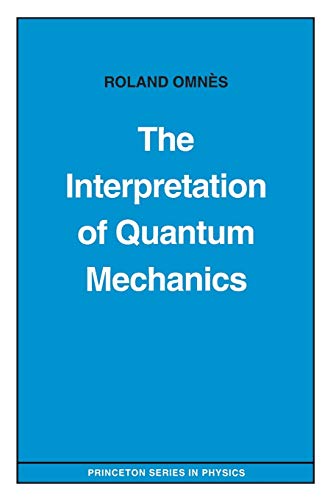
The interpretation of quantum mechanics has been controversial since the introduction of quantum theory in the 1920s. Although the Copenhagen interpretation is commonly accepted, its usual formulation suffers from some serious drawbacks. Based mainly on Bohr’s concepts, the formulation assumes an independent and essential validity of classical concepts running in parallel with quantum ones, and leaves open the possibility of their ultimate conflict. In this book, Roland Omnès examines a number of recent advances, which, combined, lead to a consistent revision of the Copenhagen interpretation. His aim is to show how this interpretation can fit all present experiments, to weed out unnecessary or questionable assumptions, and to assess the domain of validity where the older statements apply. Drawing on the new contributions, The Interpretation of Quantum Mechanics offers a complete and self-contained treatment of interpretation (in nonrelativistic physics) in a manner accessible to both physicists and students. Although some “hard” results are included, the concepts and mathematical developments are maintained at an undergraduate level. This book enables readers to check every step, apply the techniques to new problems, and make sure that no paradox or obscurity can arise in the theory. In the conclusion, the author discusses various philosophical implications pertinent to the study of quantum mechanics.
User’s Reviews
Editorial Reviews: Review “This book gives an excellent account of the modern interpretation of quantum mechanics from the Copenhagen point of view. It is a seminal work that should be bought and studied by everyone interested in the field.” ― Physics World About the Author Roland Omnès is Professor of Physics at the University of Paris XI.
Reviews from Amazon users which were colected at the time this book was published on the website:
⭐This is a beautifully written book ! Roland Omnes writes with clarity as he skillfully supports his thesis.His thesis: of consistency and completeness “…consistent as being explicitly free from any logical self-contradiction or paradox, complete as providing a definite prediction for every experimental situation.” (preface). I was reluctant to secure a copy of this book, as I feared forays into “philosophy,” a word which I abhor for reasons which would fall outside the scope of my review. Happily, this book falls squarely within the confines of physics. Happily, it is a joy to read. I heartily recommend its perusal to all.Already, in the appendix to chapter one (elementary quantum mechanics) a student is offered a careful description of the energy-time uncertainty relations (page 56). Let us read from Omnes:(1) “The status of probability theory in quantum mechanics is therefore very different from what it is in classical physics, not so much when it comes to their use, but rather when one considers their conceptual nature.” (Page 10).(2) Experimental devices, Second Chapter: Photographic detection, photomultipliers, bubble chambers and Stern-Gerlach. We read: ” In measurement theory, an experiment first made by Stern and Gerlach to measure a component of an atomic magnetic moment is such a paradigm. It played a crucial role in confirming the existence of spin and it still remains one of the best and clearest examples in measurement theory.” (Page 68). This segues to Von Neumann’s formal theory of measurements, presented in as elementary a manner as is feasible !(3) ” Physics proceeds by a theoretical synthesis based upon experimental data, but goes out of their realm when using mathematics. Each one of these two aspects is expressed in a different language, each one being inescapable so that they have to be reconciled.” (Page 97).(4) Third chapter: foundation and principles. Here presented: basics of Hilbert Space and dynamics of quantum mechanics. Read: “We shall define an observable as being any self-adjoint operator acting in the Hilbert Space of the physical system.” (Page 114) and “To define the State of a quantum system is a touchy problem.” From there learn of Gleason’s Theorem: “the existence of a density operator and a specific form for the probabilities,” its proof being presented in the Appendix. (Page 121).(5) Fourth chapter, Histories. “…a series of properties occurring at different times.” Roland Omnes pointing out connections with Feynman’s “histories.”(6) Logic, next. Roland Omnes reiterates the connection to actual experimental devices: neutron interferometers alongside radioactive decay.(Page 166). And, connection to Feynman’s Path Integrals given brief comment (Page 181). The chapter concludes with more formal aspects of logic.(7) Next, recovering classical physics, read: “The simplest properties of a classical system state that the coordinates and momentum are in a cell in phase space. Such a property does not involve time…our goal will be to associate it with a projector in the collective Hilbert Space. Is this possible ? We shall try to answer this question by using a few elementary considerations.” (Page 216). An appendix presents elementary discussion of pseudo-differential operators ( “remarkably well-suited to a study of the correspondence between classical and quantum mechanics” ).(8) Onward to decoherence: “…it destroys quantum interferences at a macroscopic level…is far from trivial, and will be taken up in several steps.” Those steps: intuitive , models and examples, generalities (reiterating connection to Feynman Path Integrals–Page 291). We conclude with explication of the so-called “direction of time,” and brief section entitled “Are observables observable ? ” (Page 319).(9) Chapter Nine, Measurement Theory: What is a measurement ? Wave function reduction ( “… a recipe allowing the erasure of irrelevant information…”) We read: ” Reduction is not itself a physical effect, but a convenient way of speaking.” (Page 340). Beautifully written.(10) Next, Questioning Quantum Mechanics. Here you meet the infamous EPR experiment. Of David Bohm, of hidden variables, of Bell’s Inequalities. And much, much, more. Chapter Eleven, Experiments: what a delight, physics and mathematics, from symbols to numbers. We started with experiments and we ended with experiments. Along the way utilizing mathematics to tie it all together. A wonderful mix !(11) Concluding: Beautifully written, with an eye on both physics and mathematics. Also, exercises for the student to complete. This book should be required reading for all students after a first course of quantum mechanics. Even allowing for differences of opinion, I greatly enjoyed this book. Highly recommended !
⭐A hard to read book, requires dedication and hard work to go through but pays back.
⭐Quantum mechanics (QM) is a fundamental (and very successful) theory of physics which so far has not been contradicted by experiments. The problem with QM, however, lies in the interpretation of the outcome of a measurement performed with a classical, macroscopic apparatus. The so called Copenhagen interpretation, proposed by Bohr and Heisenberg in the 1930s, represents the interpretation of QM widely accepted by most physicists. However, it has been subjected to serious criticisms and alternative interpretations (e.g. many worlds interpretation) have been proposed in the last 80 years or so.Omnes’ book (500+ pages, 12 chapters) discusses the Copenhagen interpretation (p. 81) in great detail and proposes a modification of the theory so as to remove several of its contradictions. After almost 20 years since the publication of Omnes’ book (1994), the discussion about the interpretation of QM is more lively than ever (a recent review can be found in Rev. Mod. Phys. 85, 471–527 (2013), Models of wave-function collapse, underlying theories, and experimental tests). Omnes has penned a second book, Understanding Quantum Mechanics (1999), which is less technical and slimmer than the present one thereby intended for a wider audience.
⭐The Copenhagen interpretation of quantum mechanics seems to be the dominant point of view (at least implicitly) for both undergraduate and graduate quantum mechanics courses. This is certainly adequate for understanding a tremendous amount of quantum mechanics and doing pretty much any calculations one would want to do. However, this approach suffers some shortcomings and cannot be the last word. Among these shortcomings are the postulated existence of an external classical world, the fundamental role of measurement and the collapse of the wavefunction. Obviously any classical world is just an approximation of a quantum one and when considering the universe as a whole there is no external observer of any kind. Also, there can’t be anything fundamentally special about a measurement.From a practical point of view perhaps the main limitation of this is probably the study of quantum cosmology, which surely requires something beyond the Copenhagen interpretation. There is one additional additional problem this can lead to. It’s not so much a problem for physics students or other serious scholars, but rather for those only engaging in casual thought about quantum mechanics. The problem is that elevating external observers and measurement to fundamental roles seems to lead to a lot of nonsense ideas, for example consious observers defining reality.This book presents a thorough discussion that will help one to develop a more satisfying perspective of quantum mechanics. The level of the quantum mechanics assumed isn’t high, mainly basic undergraduate quantum mechanics. The material in the book varies in difficulty from simple to fairly challenging. The material includes discussions of consistent histories, quantum logic, decoherence and many of the quantum mechanics paradoxes (EPR, Wigner’s friend and of course the ubiquitous Schrodinger’s cat). It’s pretty clear that the last word on this subject hasn’t been said, but this book contributes a lot to the discussion. I think quantum mechanical paradoxes in general are harder to resolve than the ones from relativity, but this book does a nice job of describing them and showing how they often arise from asking questions one isn’t allowed to ask in the quantum framework (although these questions are perfectly sensible in the classical world).This kind of material might not be absolutely required for physics students. However, in my opinion students (especially specialists in theoretical physics) should at least be familiar with most of the ideas, especially the consistent histories approach and decoherence. This book is very comprehensive and might be overkill for some who might prefer something more condensed, but I liked it a lot and found it well worth reading.
Keywords
Free Download The Interpretation of Quantum Mechanics in PDF format
The Interpretation of Quantum Mechanics PDF Free Download
Download The Interpretation of Quantum Mechanics 1994 PDF Free
The Interpretation of Quantum Mechanics 1994 PDF Free Download
Download The Interpretation of Quantum Mechanics PDF
Free Download Ebook The Interpretation of Quantum Mechanics