

Ebook Info
- Published: 2001
- Number of pages: 365 pages
- Format: PDF
- File Size: 29.09 MB
- Authors: Mara Beller
Description
“Science is rooted in conversations,” wrote Werner Heisenberg, one of the twentieth century’s great physicists. In Quantum Dialogue, Mara Beller shows that science is rooted not just in conversation but in disagreement, doubt, and uncertainty. She argues that it is precisely this culture of dialogue and controversy within the scientific community that fuels creativity.Beller draws her argument from her radical new reading of the history of the quantum revolution, especially the development of the Copenhagen interpretation. One of several competing approaches, this version succeeded largely due to the rhetorical skills of Niels Bohr and his colleagues. Using extensive archival research, Beller shows how Bohr and others marketed their views, misrepresenting and dismissing their opponents as “unreasonable” and championing their own not always coherent or well-supported position as “inevitable.”Quantum Dialogue, winner of the 1999 Morris D. Forkosch Prize of the Journal of the History of Ideas, will fascinate everyone interested in how stories of “scientific revolutions” are constructed and “scientific consensus” achieved.
User’s Reviews
Editorial Reviews: From the Inside Flap Winner of the Morris D. Forkosch Prize of the Journal of the History of Ideas for Best Book on Intellectual History, 1999″Science is rooted in conversations,” wrote Werner Heisenberg, one of the twentieth century’s great physicists; Quantum Dialogue shows us how often science is rooted not just in conversation but in disagreement, a culture that fuels scientific creativity. Using original correspondence, notebooks, and drafts of talks and published papers, Beller reveals how world-famous scientists promoted their views by dismissing their opponents as “unreasonable” and championing their own not-always-coherent positions as “inevitable.” Quantum Dialogue provides a revision of the accepted history of the quantum revolution, proposes a new approach to the history and philosophy of science, and will surely fascinate anyone interested in how “scientific revolutions” are constructed and “scientific consensus” is achieved. From the Back Cover Winner of the Morris D. Forkosch Prize of the Journal of the History of Ideas for Best Book on Intellectual History, 1999″Science is rooted in conversations,” wrote Werner Heisenberg, one of the twentieth century’s great physicists; Quantum Dialogue shows us how often science is rooted not just in conversation but in disagreement, a culture that fuels scientific creativity. Using original correspondence, notebooks, and drafts of talks and published papers, Beller reveals how world-famous scientists promoted their views by dismissing their opponents as “unreasonable” and championing their own not-always-coherent positions as “inevitable.” Quantum Dialogue provides a revision of the accepted history of the quantum revolution, proposes a new approach to the history and philosophy of science, and will surely fascinate anyone interested in how “scientific revolutions” are constructed and “scientific consensus” is achieved. About the Author Mara Beller is the Barbara Druss Dibner Professor of History and Philosophy of Science at the Hebrew University of Jerusalem. Read more
Reviews from Amazon users which were colected at the time this book was published on the website:
⭐In this book, Mara Beller takes aim at the Copenhagen interpretation of Quantum Mechanics and its seeming acceptence as normative following the tumultous events of 1925 to 1927. What she establishes beyond much doubt is that the interpretation was constructed ex post facto to support Bohr, Heisenberg, Pauli, and Born against the interpretations of Schrodinger and Einstein which were seen as competing. By close textual analysis of the original papers and various letters she makes clear that the Copenhagen-Gottingen group constructed their view of quantum mechanics as part of a dialogical process involving competing,complementary and contradictory views between themselves and with their professional competitors. Under the powerful personality of Bohr, who combined mathematical inadequacy and explantory obscurity with a strong vision of reality (Beller’s picture), the Copenhagen interpretation became an orthodox dogma founded on a questionable philosphical foundation which Beller relentlessly exposes.At the end of the book, Beller takes a well aimed, and in my view quite justified, shot at the Thomas Kuhn work Stucture of Scientific Revolution which used the development of quantum mechanics as an expample to create the paradigm shift view of revolutionary change in scientific progress.Finally, Beller proposes a dialogical philosophy and historiography of science which emphasis the communication of multiple individuals creating a synthesis by cooperation and conflict.Yet at the end of the day, I found myself thinking – why did I read 325 pages of dense, though not unclear, academic prose to make what seems like a simple enough point that I would have believed from a much shorter essay? The answer is that this book was written in dialogue with other professionals in the history and philosophy of science and every reference had to be cited, every blind alley followed, and so on. Assuming that the professionals in this field do not go to Amazon to read reviews of a 14 year old book, I have to rate this book for the average layperson with an interest in science and some knowledge of what quantum mechanics is and how it developed. So the three stars means you may or may not really want to read this all the way through as I did but it does have a point of view that really should be carefully and thoughtfully considered especially since that view is not fully consistent with much of popular history on the subject.
⭐A good book reading in conjunction with the book by K Camilleri (Heisenberg and the Interpretation of QM ….as a Philosopher ) which I think is an excellent book (which seems not to referenced enough in the recent QM literature but then I am a amateur !
⭐A major sociological question is: how can we make a revolution?.This question is adressed by Mara Beller in “Quantum Dialogue”, which can be seen as a new way to look at the problem of social change beyond Kuhn’s “Structure”. Indeed, it is well written, informative and, sometimes, technical. But I believe technicalities are at the heart of physics, so, it is necessary to grasp them.I recommend this reading for all physicists, sociologists and anarchists.
⭐This is the book to read all about the development of Quantum Theory day by day with quotations from individuals, excerpts from theor correspondances. It is shocking to read those geniousess vacciliatting on some concepts. I trust the author is providing actual data but most interesting was to read that Bohr was thinking about the factor on his Energy states factor and his decision to make it one half to match zero state energy. Mr. Heisenberg through out concepts not knowing what he was saying. This is the impression I got from the readings.Author has ceratinly knows a lot about the theory itself and makes clarifications to the arguments that they were shooting to each other.This book is a gem. This book is not for someone who does not know at least a littel about the theory itself otherwise you miss the story behind the correspondances.Recommend to all who is interested in the development of modern physics.
⭐This book brings you closer to the processes of discovery and change. By reading it you really get a better understanding on what context were all of this discoveries possible. But if you can, really study the math behind it to feel what it’s made of and what they argued about.
⭐found her analyses of the situation as it evolved between the two different viewpoints held by followers of the Copenhagen interpretation v. those of the Schroedinger wave function absolutely great.
⭐In der Geschichte der Wissenschaft lernen wir eindeutige Zuordnungen: Die Quantenphysik wurde am 14. 9. 1900 von Planck ins Leben gerufen, und E=mc² stammt von Einstein. Auch wenn die Sache stimmt, so eindeutig ist sie nie. Mara Bellers Verdienst liegt in der Aufdeckung der Zusammenhänge, der gegenseitigen geistigen Befruchtung, der Herausarbeitung des Ursprungs wichtiger Ideen der modernen Physik. Dabei konzentriert sie sich auf ein wichtiges Kapitel in der Entstehung der Quantenphysik, nämlich die Festlegung philosophischer Konzepte. Was ist Wirklichkeit? Verändert eine Beobachtung die Welt? Existieren Dinge, die wir nicht messen können? Und was bedeutet die Heisenbergsche Unschärfe-Unbestimmtheit-Unsicherheit?Beller geht den Ursprüngen dieser Idee äußerst gründlich nach, zitiert Briefe, zeigt den Einfluss von Wissenschaftlern, deren Namen heute vergessen sind, deckt auf, dass unsere Vorstellungen von einer klaren, zielgerichteten, eindeutigen Ideen-Entwicklung Mythen sind. Ihr Hauptverdienst liegt auch in der Darstellung – oder, soll ich sagen: Bloßstellung – der pseudophilosophischen Ansichten von Bohr, Born und (weniger ausgeprägt) von Heisenberg, die versuchten, ihre Vorstellungen der Grundlagen der neuen Physik als eine Art orthodoxe Wissenschaftstheologie in aller Welt zu verbreiten – was ihnen leider auch gelungen ist.Einziger kleiner Mangel: Frau Beller wiederholt sich, sowohl innerhalb eines Kapitels als auch zwischen den Kapiteln. Eine Straffung des Stoffes hätte dem Lesefluss gut getan. Aber wer weiß, was dann an wichtigen Informationen verloren gegangen wäre.
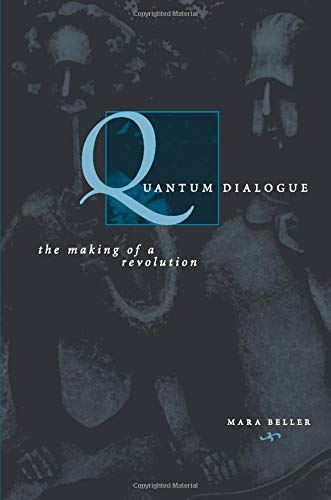
⭐L’immagine in copertina suggerirebbe che il libro tratti delle varie dispute tra Einstein e Bohr, sul tema dell’interpretazione della MQ. In realtà Mara Beller (autore purtroppo scomparso) ricostruisce minutamente, e impeccabilmente da un punto di vista storico rigoroso, l’intrecciarsi delle varie scoperte teoriche, delle moltissime congetture, delle varie soluzioni interpretative, non escluso il famoso “entanglement” e la conseguente “inseparabilità”. Il libro è un ottimo complemento per chi già possiede i classici volumi di Max Jammer, tanto per citare un altro autore famoso.
⭐マラベラーによる本書『量子の対話』は、ピーターギャリソンの『イメージとロジック』と並ぶポストクーン時代の代表的著作と呼ばれるようになるのではないかと思う。クーンの提起した「パラダイム」「通約不可能性」、そしてハンソンに遡る「観察の理論負荷性」といった一連の概念群の科学史記述上の妥当性をめぐる批判的分析は数多くありますが、マラベラーの研究は、その戦略が実に巧妙で思わずハッとします。クーンの概念群誕生のインスピレーションの源泉となった歴史的事例である「量子革命」の歴史解釈は、単にボーア、ハイゼンベルクらコペンハーゲン学派の作り出したある種の神話なのではなかったか。とすれば、クーンの『科学革命の構造』の構想の屋台骨が揺らぐことになるはずだ。これがベラーの分析戦略です。古典物理学との断絶=通約不可能性を強調する「量子革命」の歴史観は、アインシュタイン、ドブロイ、シュレーディンガーらへの対抗上、ボーアやハイゼンベルクらによって作り出された、自分たちに都合の良い歴史像にすぎないとし、ベラーは「量子革命」のシンボルたる不確定性原理の誕生プロセスにメスを入れ、コペンハーゲン解釈の確立プロセスをたどり直します。科学史プロパーの作品なため、独自性をアピールすべく構成主義=科学社会学を仮想敵に置いているのですが、彼女のいう「対話的アプローチ」は読めば読むほど科学社会学的分析そのものであるとしか思えません。一致を重視する科学社会学に対して不一致を重視する対話的アプローチという対比をしておられますが、科学社会学ほど不一致を重視した研究伝統もないというのが真実かと。ベラーもまた自分に都合の良い歴史像を作りあげたというわけですね(笑)
⭐
Keywords
Free Download Quantum Dialogue: The Making of a Revolution (Science and Its Conceptual Foundations series) 1st Edition in PDF format
Quantum Dialogue: The Making of a Revolution (Science and Its Conceptual Foundations series) 1st Edition PDF Free Download
Download Quantum Dialogue: The Making of a Revolution (Science and Its Conceptual Foundations series) 1st Edition 2001 PDF Free
Quantum Dialogue: The Making of a Revolution (Science and Its Conceptual Foundations series) 1st Edition 2001 PDF Free Download
Download Quantum Dialogue: The Making of a Revolution (Science and Its Conceptual Foundations series) 1st Edition PDF
Free Download Ebook Quantum Dialogue: The Making of a Revolution (Science and Its Conceptual Foundations series) 1st Edition