Ebook Info
- Published: 2004
- Number of pages: 308 pages
- Format: PDF
- File Size: 2.64 MB
- Authors: Hasok Chang
Description
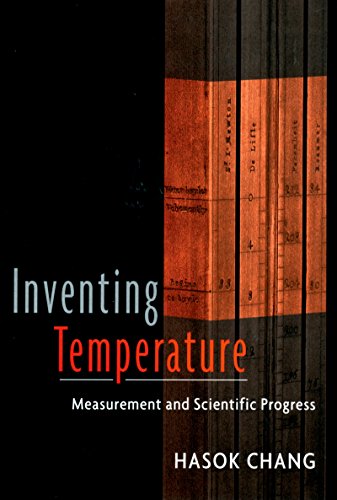
What is temperature, and how can we measure it correctly? These may seem like simple questions, but the most renowned scientists struggled with them throughout the 18th and 19th centuries. In Inventing Temperature, Chang examines how scientists first created thermometers; how they measured temperature beyond the reach of standard thermometers; and how they managed to assess the reliability and accuracy of these instruments without a circular reliance on the instruments themselves.In a discussion that brings together the history of science with the philosophy of science, Chang presents the simple eet challenging epistemic and technical questions about these instruments, and the complex web of abstract philosophical issues surrounding them. Chang’s book shows that many items of knowledge that we take for granted now are in fact spectacular achievements, obtained only after a great deal of innovative thinking, painstaking experiments, bold conjectures, and controversy. Lurking behind these achievements are some very important philosophical questions about how and when people accept the authority of science.
User’s Reviews
Reviews from Amazon users which were colected at the time this book was published on the website:
⭐Absolutely wonderful book for those with an interest in the philosophy of science. Historians of science, scientists interested in the history and philosophy of their enterprise, and philosophers would all benefit from the work. Chang picks a wonderful example to study, temperature ‘measurement’. Development of techniques for measuring temperature involved a host of problems including figuring out which ‘thermometers’ were correct, or closest to correct, measurers of temperature. Any given thermometer has a range of deployability, so questions and problems arose concerning how to extend measurements to hotter and colder temperatures beyond the capabilities of ‘ordinary’ thermometers. And even the standard ‘definitions’ of some points of temperature scales, such as ‘the boiling point of water (at standard pressure)’ and ‘the freezing point of water’ both are much more problematic and ill-defined than most scientists are aware. Further, how any of this development of ‘thermometry’ relates to some more fundamental theory of temperature introduces further perplexity. All in all a tour de force, the most interesting work in the history and philosophy of science I have ever read.
⭐Inventing Temperature tells the long and intriguing history of thermometry, the science of the measurement of temperature. First, thermometers had to be invented, followed by methods to calibrate them. But to calibrate a thermometer at least one reproducible phenomenon that always took place at the same temperature was needed. But how would one know that something, say the boiling of water, always took place at the same temperature if one didn’t have a calibrated thermometer? This circularity was behind most of the hurdles the pioneering thermometrists had to overcome. Finally, temperature scales, a multitude of them, were devised–almost one by each independent thermometer maker.I learned quite a bit from this book. Among the more interesting episodes were a series of experiments by Marc-Auguste Pictet in the late 18th century that demonstrated quite puzzlingly that cold, like heat, could be reflected from a mirror and Charles Darwin’s grandfather potter Josiah Wedgwood’s almost contemporaneous invention of a pyrometer to measure very high temperatures–it used small pieces of clay, the amount of shrinkage of which at a given temperature were supposed to have been reproducible.I wish Chang’s prose were a bit more straight and readable and the contents of the book a bit more uniform. The first 4 of the 6 chapters have 2 parts each: a historical narrative followed by an analysis that dwells into philosophical issues that I thought were boring and not always relevant. I confess I skipped most of the analyses.Chang ends his book with a chapter on “complementary science”, his provocative research program that intends, by utilizing the historical and philosophical aspects of a particular scientific area, physics, in his case, to “generate scientific knowledge in places where science itself fails to do so.”
⭐Hansok Chang is hugely talented, and conveys beautifully the feeling of what it is like _not_ to know something before it is figured out, an essential aid to understanding intellectual history. He also has an eye for both telling detail and the big picture, and is very much his own undogmatic man when trying to make sense of complex and often haphazard historical sequences. Read this book and you will feel a lot of respect for people like Fahrenheit and Amontons who did the”simple” [but very hard] things on which our science today rests.
⭐Perfect condition!
⭐Several years ago, the science fiction author Isaac Asimov wrote a short story set in the far future. He depicted a time so advanced that the simplest arithmetic was done by computers, and forgotten by humans. And so it goes here, in Chang’s book. He has done us a service by revisiting solved problems that have been solved for so long that their basic importance is no longer appreciated by practising scientists.Consider your typical undergraduate textbooks that discuss heat and temperature. Very little mention is given about the bootstrapping problem. Without modern instrumentation, how do you define a temperature scale that is consistently reproducible? One might wonder why it took scientists of an earlier age so long to strive over such a simple problem. Were they stupid back then?Not so. Chang shows that the problem is divided into two closely related parts. One experimental and one conceptual. The former relates to the search for fixed points, like the freezing and boiling points of water. Not as straightforward as it might first seem. And no, it was not the dependence of these on the atmospheric pressure. That was quickly discovered and accomodated. But other phenomenon like the supercooling of liquid water, which can push it below the normal freezing point, were harder to understand.It turned out that the key conceptual problem is just as serious, if not more so. One runs into a circular pattern of logic. One way out is to follow Euclid’s approach by starting with a small set of axioms that everyone accepts, and build from them. Anyway, the core of Chang’s book is how this problem was tackled and solved. It took some of the most prominent scientists of the 18th and 19th centuries to tie this down. And that is the merit of this book. Chang helps us appreciate one of the foundations of our science.
⭐Excellent overview of this topic by an outstanding science philosopher
⭐Flawed in the writing but clear enough in drumming down its key points, this book argues that scientific knowledge moves through an iterative process. Path dependence matters in the way scientific consensus develops. In particular focusing on measurement of temperature, the author shows that absolute precision is impossible but refinements in the way measurement is achieved are possible, indeed have occurred over the last four centuries. In making this argument the author successfully knits together philosophy, history, and the evolving state of scientific thinking since the Renaissance.
Keywords
Free Download Inventing Temperature: Measurement and Scientific Progress (Oxford Studies in Philosophy of Science) in PDF format
Inventing Temperature: Measurement and Scientific Progress (Oxford Studies in Philosophy of Science) PDF Free Download
Download Inventing Temperature: Measurement and Scientific Progress (Oxford Studies in Philosophy of Science) 2004 PDF Free
Inventing Temperature: Measurement and Scientific Progress (Oxford Studies in Philosophy of Science) 2004 PDF Free Download
Download Inventing Temperature: Measurement and Scientific Progress (Oxford Studies in Philosophy of Science) PDF
Free Download Ebook Inventing Temperature: Measurement and Scientific Progress (Oxford Studies in Philosophy of Science)