

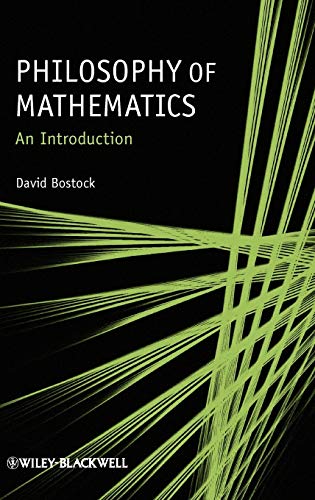
Ebook Info
- Published: 2009
- Number of pages: 344 pages
- Format: PDF
- File Size: 2.71 MB
- Authors: David Bostock
Description
Philosophy of Mathematics: An Introduction provides a critical analysis of the major philosophical issues and viewpoints in the concepts and methods of mathematics – from antiquity to the modern era. Offers beginning readers a critical appraisal of philosophical viewpoints throughout history Gives a separate chapter to predicativism, which is often (but wrongly) treated as if it were a part of logicism Provides readers with a non-partisan discussion until the final chapter, which gives the author’s personal opinion on where the truth lies Designed to be accessible to both undergraduates and graduate students, and at the same time to be of interest to professionals
User’s Reviews
Editorial Reviews: Review “Given this caveat, Bostock’s new book is highly recommendable as a text for undergraduate seminars in the philosophy of mathematics and also for individual study. It covers all the essentials and more. It should appeal not only to students who have already developed a preference for the general approach and style of contemporary analytic philosophy, but also to a broader audience of students and to people with a non-professional interest in philosophy and mathematics.” (Erkenn, 2011) “This is a concise as well as comprehensive presentation of core topics in the philosophy of mathematics, written in a clear and engaged manner, hence well readable.” (Zentralblatt MATH, 2011) Review “The best textbook on the philosophy of mathematics bar none” –Alexander Paseau, University of Oxford “Bostock’s ‘Philosophy of Mathematics’ is remarkably comprehensive compared to other surveys of philosophy of mathematics. The writing is engaging and clear, and it treats a wide range of issues in considerable depth, including issues that are often ignored or downplayed in more general discussions.” –Alan Baker, Swarthmore College From the Inside Flap In this new introduction to the philosophy of mathematics, David Bostock guides the reader through the basic ideas on the nature of mathematics that have played a major part in the development of philosophy from antiquity to the present. The chapters proceed historically, beginning with the earliest serious views on the interpretation of mathematics, due to Plato and Aristotle. They then move quickly through the middle ages and the early moderns, but continue with extended discussions of Kant, Mill, and Frege. Later chapters explore the main schools of thought at the start of the twentieth century, i.e. the movements known as logicism, formalism, intuitionism, and what may be called predicativism. These chapters also discuss more modern variations on the same basic themes. Finally the book concludes with a discussion of the most recent debates between realists and nominalists. The emphasis throughout is not simply to describe, but to offer a critical appraisal of, the views discussed. The result is an engaging, clear, and remarkably comprehensive panorama of the major issues in the field. The book assumes no prior knowledge of mathematics, beyond what is commonly taught in schools, and only a minimal exposure to standard philosophical terminology. It is aimed at undergraduates in philosophy and mathematics, but will also provide an important new perspective on the subject for more experienced readers. From the Back Cover In this new introduction to the philosophy of mathematics, David Bostock guides the reader through the basic ideas on the nature of mathematics that have played a major part in the development of philosophy from antiquity to the present. The chapters proceed historically, beginning with the earliest serious views on the interpretation of mathematics, due to Plato and Aristotle. They then move quickly through the middle ages and the early moderns, but continue with extended discussions of Kant, Mill, and Frege. Later chapters explore the main schools of thought at the start of the twentieth century, i.e. the movements known as logicism, formalism, intuitionism, and what may be called predicativism. These chapters also discuss more modern variations on the same basic themes. Finally the book concludes with a discussion of the most recent debates between realists and nominalists. The emphasis throughout is not simply to describe, but to offer a critical appraisal of, the views discussed. The result is an engaging, clear, and remarkably comprehensive panorama of the major issues in the field. The book assumes no prior knowledge of mathematics, beyond what is commonly taught in schools, and only a minimal exposure to standard philosophical terminology. It is aimed at undergraduates in philosophy and mathematics, but will also provide an important new perspective on the subject for more experienced readers. About the Author David Bostock has been a Fellow and Tutor in Philosophy at Merton College, and Lecturer in Philosophy at the University of Oxford. His recent publications include Intermediate Logic (1997), Aristotle’s Ethics (2000), and Space, Time, Matter, and Form: Essays on Aristotle’s Physics (2006). Read more
Reviews from Amazon users which were colected at the time this book was published on the website:
⭐David Bostock provides us with a comprehensive statement and critique of historical and contemporary thought on mathematics, but one which is only comprehensible to the small group of academics who already understand it. It’s a rehearsal for the initiated, not an introduction for the newcomer. This is a general problem with academic work which is only subject to `peer review’ and not to intelligent generalist review. The result of this process, as exemplified in Bostock’s book, is the creation of self authenticating groups of academics who determine amongst themselves how they define and practice important subjects. Students are cloned into the group by a didactic process, whilst wider communities find their interests are excluded.After the first 100 pages, which are written in intelligible English with occasional use of simple high school algebra, Bostock switches to the use of logic symbols to communicate core ideas, which will be incomprehensible to the majority of intelligent readers. If you expect to read in English, and don’t understand writing in squiggles (which I tried to include an example of, but, just to prove my point, Amazon’s review font doesn’t recognise), then you will be unable to understand this `introduction’ and should not buy the book. Bostock’s preface statement that `I presuppose an elementary knowledge of modern logic, for without this the subject cannot be understood’ is insufficient as a warning that he will write in symbols, and is also untrue. He presents Hume’s Principle, Frege’s theorem, Russell’s paradox, and Gödel’s incompleteness theorem, only in this notation, whilst they are perfectly capable of being stated clearly and rigorously in English.Bostock doesn’t define what he means by `mathematics’. When he uses the term, is he talking about one or all of : numbers, arithmetic, geometry, algebra, the calculus, linear programming, heuristic algorithms, proof, theorems, set theory, ‘pure’ or ‘applied’ mathematics? It’s nowhere made clear, although the majority of references when they occur, seem to refer to numbers, and occasionally to arithmetic and geometry. Bostock, and his fellow practitioners of this obscure art, need to state a typology of mathematics, and make it clear which elements they are discussing at any one time, and how their analysis may bear differentially on each element.The treatment only rates as `philosophy’ to those who so define it, as intensive detailed technicality. The great philosophical questions about mathematics must surely bei) whether mathematics is objective, or empirical, expressed in the question of whether mathematics is invented or discoveredii) whether an insistence on consistency can be justified in determining mathematical systems, in which case how are paradoxes explained, and what about the existence of true contradictions addressed by Graham Priest, whose work Bostock completely ignores?iii) how abstraction operates in human perception and in mathematics, eg how two real chairs can be represented as 1 1 or as 2 or as x, and how such abstractions can be fed through the process of mathematics to yield an additional truth statement which can later be calibrated against the reality of physical chairs, ie whether and how this process is reliable, how abstract entities can be considered to exist etciv) how quantification of units works in human perceptionThese questions have philosophical implications, although the second two questions are more about perception and psychology. If mathematics is discovered, then how come? The same question applies to deductive logic. How is it that nature appears to contain and obey mathematics and deductive logic? How far can we validly work with abstractions? Do we live in a consistent world, and if so where does consistency come from? Or can we really show that these are all human devices? Bostock hints at these issues but fails to address them centrally as the core of what the philosophy of mathematics should be. Rather we are told what Plato, Descartes, Kant, Peano, Zermelo, Frege, Cantor, Russell, Hilbert, Gödel, Benacerraf, Putnam, Quine, Dummett, Chihara, Field, et al thought/think. This is undoubtedly a valid intellectual exercise, but it ends up presenting a history of ideas, without stating an original driving set of questions. The reference when it occurs is almost always back to a theory of numbers, or sometimes to the problem of infinity – nothing more meaningful than this. If you are one of the few able to read this book, you may very well be impressed with the range of answers it offers, but then left asking yourself what the question is. Philosophers of mathematics should do better.Geoff Crocker Author ‘A Managerial Philosophy of Technology : Technology and Humanity in Symbiosis’ (Palgrave Macmillan 2012)
⭐This is a fairly detailed book on its topic for readers prepared for its type of philosophical rumination and who are not expecting more than philosophers are typically inclined to give. As is characteristic of introductions to the philosophy of mathematics, Bostock’s book does not assume acquaintance with undergraduate level mathematics, although he does briefly refer to convergence, limits, and differentiation. He does, however, assume acquaintance with the basics of logic and set theory. He also assumes the reader is not new to philosophical analysis. The end result, however, is another earnest, niggling book on the philosophical investigation of elementary school mathematics.Bostock begins with Plato and Aristotle (chp.1), moves on to Descartes, Locke, Berkeley and Hume (chp.2), spends some time on Kant (chp.2), moves on to Mill with a first look at Frege (chp.3), then gives a quick overview of the concerns for a justifiable foundation for mathematics (chp.4). Once he’s gone through these topics, he begins his discussion of the classic positions on the foundation of mathematics: Logicism (chp.5), Formalism (chp.6), and Intuitionism (chp.7). He follows this with a chapter on Predicativism (chp.8), and finishes with Realism and Nominalism (chp.9).At some point in reading the seventh chapter, I lost interest in Bostock’s version of critical analysis and his egregious disregard for actual mathematics. Skimming through the remainder of the chapter, and giving him a second chance with several pages into chapter eight relieved me of any desire to give the book more of my time.This book has not persuaded me that contemporary philosophers have anything to tell me of interest about mathematics. Their perpetual mystification about the ontology of numbers and sets gets tiresome. Philosophers seem to see mathematics as a never-ending metaphysical mystery, the very existence of which as an intellectual endeavor baffles them. They’re like the centipede Russell mentions somewhere that is lying distracted and belly up in a ditch, immobilized because it’s unable to convince itself that it’s possible to walk. Consequently, it never gets anywhere. As it lies there bewildered with its self-imposed disability it shouts out to the centipedes walking adroitly past that walking is more than a mere conundrum, it may even be a veritable misperception; and besides that, the road is arduous, convoluted and labyrinthine – and it surely doesn’t lead anywhere more interesting than what can be found right there in the ditch.Biographical note – My explicit interest in mathematics arose initially in my late teens after I’d discovered epistemology and, after that, Russell’s view of mathematics arising from logic. I saw mathematics as a logical and structured mental configuration within human cognition, and this seemed to me to be the key to epistemology. Cognitive structures were mathematical, I believed. Logic and mathematical structures were interwoven with the human intellect, and so the study of mathematics was a study of the intellect of the cognitive mind. The philosophy of mathematics was therefore part of cognitive science.
⭐
Keywords
Free Download Philosophy of Mathematics: An Introduction 1st Edition in PDF format
Philosophy of Mathematics: An Introduction 1st Edition PDF Free Download
Download Philosophy of Mathematics: An Introduction 1st Edition 2009 PDF Free
Philosophy of Mathematics: An Introduction 1st Edition 2009 PDF Free Download
Download Philosophy of Mathematics: An Introduction 1st Edition PDF
Free Download Ebook Philosophy of Mathematics: An Introduction 1st Edition