Ebook Info
- Published: 2010
- Number of pages: 539 pages
- Format: PDF
- File Size: 6.59 MB
- Authors: John L. Heilbron
Description
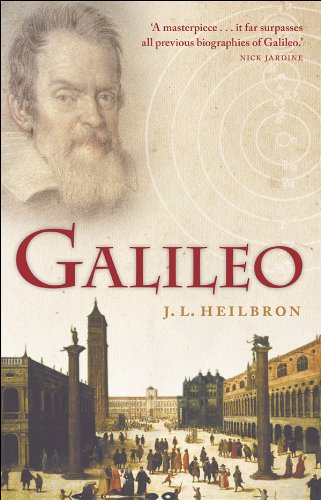
Just over four hundred years ago, in 1610, Galileo published the Siderius nuncius, or Starry Messenger, a ‘hurried little masterpiece’ in John Heilbron’s words. Presenting to the world his remarkable observations using the recently invented telescope – of the craters of the moon, and the satellites of Jupiter, observations that forced changes to perceptions of the perfection of the heavens and the centrality of the Earth – the appearance of the little bookis regarded as one of the greatest moments in the history of science. It was also a point of change in the life of Galileo himself, propelling him from professor to prophet.But this is not the biography of a mathematician. Certainly he spent the first half of his career as a professor of mathematics and has been called ‘the divine mathematician’. Yet he was no more (or less) a mathematician than he was a musician, artist, writer, philosopher, or gadgeteer. This fresh lively new biography of the ‘father of science’ paints a rounded picture of Galileo, and places him firmly within the rich texture of late Renaissance Florence, Pisa, and Padua, amid debates on themerits of Ariosto and Tasso, and the geometry of Dante’s Inferno – debates in which the young Galileo played an active role.Galileo’s character and career followed complex paths, moving from the creative but cautious humanist professor to a ‘knight errant, quixotic and fearless’, with increasing enemies, and leading ultimately and inevitably to a clash with a pope who was a former friend.
User’s Reviews
Reviews from Amazon users which were colected at the time this book was published on the website:
⭐Fascinating study of Galileo and his times. Builds a wonderful picture of the complexity associated with how Aristotle’s philosophy was embedded in Church dogma and how the political shenanigans involved brought about the stresses associated with the new science. Pope Urban turns out to be the smartest guy in this story and closer to contemporary Model Dependent Realists than Galileo who is the traditional hero. In this biography he turns out to be more of the blundering ox that insists on his interpretation regardless of the hurt feelings he causes. Ego is a major factor. Very interesting read.
⭐I read primarily historical biography. I enjoy seeing historical/political context to a subject and how that subject related to that environment. I liked this book, but found so much of the scientific detailed explanations excessive for my interests as a general reader. I thoroughly enjoyed reading of the conclusions made by clergy and others who hung onto tradition. I liked understanding Galileo’s personality. But I really wanted to see more of the geo-politics of that period, the transitions into Renaissance, etc. I am glad I read this book. It was enlightening. But it was a chore.
⭐An erudite, witty tour of the times, life, and meaning of Galileo. Heilbron brings a career’s worth of knowledge and insight to the task, and we get a richly evoked picture of a pivotal time in the early modern era. Readers unfamiliar with the science may find themselves skipping diagrams and explication, but they will not be missing the author’s fundamental points. It’s not a beginner’s introduction to history, but anyone appreciative of serious research and good writing will enjoy this book.
⭐This is a well researched and long review (366 pages) of Galileo’s life and accomplishments. The book requires the reader to be well grounded in history as well as science to appreciate the detail discussed. Not for the faint of heart. The New York Times Book Review calls it “An awesome command of the vast Galileo literature”.
⭐Bought this after reading a bio of Johannes Kepler. They were contemporaries. The Kepler book was excellent. This one, however, was more academic and not an enjoyable read.
⭐i was shocked at some of the careless typos in the book. here are two egregious examples…1. “from the conception of virginia in 1599 to that of vincenzo in 1506″…clearly they mean 1606. the third child couldn’t have been before the first by 93 years!2. “virginia, born 1600, now famous as ‘galileo’s daughter’; livia, born 1601; and vincenzo, born 1606.”…i know the difference between conception (see number 1 above) and birth, but please be consistent. this type of writing irks me, trying to be too clever and then tripping over your untied shoes.these two typos occurred over pages 84 and 89. shouldn’t the expert publishers at oxford university press have caught this?there were a couple of others which i am too lazy to go flipping back to point out. after catching these two i had to stop and point them out.
⭐I read mostly non-fiction and history and biographies are two of my favorite topics. I have read many books about Galileo, Newton, Einstein, various American presidents, and many other famous people. What I love about these books is what I learn about each of the people and am amazed how each new biography manages to uncover previously unpublished facts or perspectives. They are informative. This book was a disappointment. The author seems most interested in proving his intellectual prowess with digressions into irrelevant material and frankly uninteresting material. The tone is pedantic – not instructive. I put the book down after less than 100 pages.
⭐I’m going to weigh in with a short one. First Heilbron has a very engaging writing style, with about one dry, droll irony per page. Second, the book is about half math. The math is about at algebra or geometry level, so even if you’re not a math person, you can get the point of most of it with a little work. Yes, toward the end I was skipping most of it. Still it gives one the satisfaction of feeling you’ve gotten a bit of a handle on Galeleo’s real intellectual life. The plethora of Italian names will probably be as confusing to many as it was to me, but Heilbron supplies a who’s who at the back. There’s definitly not a lot of colorful description of sunny Tuscany or rich palace interiors. It’s truly what we’d call an intellectual biography, not beach reading. But for an educated scientifically oriented reader or even old philosophy major like me. I’d really recommend it.(From a philosophy of science perspective, I was taken with Heilbron’s stessing that it was the implied atomic theory in Galileo’s thinking rather than the heliocentric theory that was the danger to orthodoxy. Rightfully so, as Berkeley emphasized a century later!)
⭐This is a fine book, but this is not for anyone without solid mathematics background or has a deep understanding of old physics….I will complete the book (currently 150+ pages in wooo) but IT….IS….A….CHORE, previously read Stephen Hawkins A Brief History of time and although that was brain cell creating work I enjoyed it and most certainly learned a hell of a lot..also digested a Newton book with relative ease..this one I am sure is a wonderful book but really feel the author has not aimed this at people like me which is why I really am struggling, learning bits here and there but looking forward to just getting it out of the way. Maybe it is just Galileo and his side of things that are not as engaging as the other fathers of science I do not know, but if anyone can point me to a Galileo book that is less equation flooded then that would be great!
⭐I needed to know about the man and now I do. Not an easy read and very scholarly throughout; Heilbron clearly knows the man and his times as if he lived in renaissance Italy. It is worth mentioning that it is very witty and downright funny in parts.
⭐If your interest in Galileo is in his science rather than his character and life then this is the book for you. Exhaustive explanations of the scientific work that he achieved. I would’ve preferred more detail on his life and character as that would’ve served my current needs better.One for the scholar rather than the dilettante.
⭐Very interesting book about a very interesting person.
⭐In 1610 Galileo published his little masterpiece “Sidereus nuncius”. The 400th anniversary of this book has resulted in a large amount of books on Galileo, of which 2 biographies were selected as the best and reviewed in a Dutch newspaper by Dirk van Delft, Director of Museum Boerhaave at Leiden. These books are the one by Wootton, Alpha oriented and this book by Heilbron, Beta oriented and considered slightly better. Therefore I selected this book and was not at all disappointed with the choice. Heilbron describes Galileo as a “Critic”, not as mathematician or philosopher and places him rightly within the context of that period. Much space is devoted to his struggle with the Roman Church and the Jesuits on Copernicanism, but his live and findings are well told and explained in an understandable manner. The last chapter tells the story of the heretical status of Copernicanism and Galileo over the last 400 years and ends with the prediction that Galileo will be made saint by the Roman Church within the next 400 years. The book is well written and intelligible for a large audience, therefore a must for all those interested in the History of Science or in the Scientific Revolution, as Galileo is a central figure in the history of Modern Science. In this respect it is of interest to compare the views of Floris Cohen (author of How Modern Science came into the World, see part II on Galileo) and those of Heilbron. Cohen describes Galileo foremost as a “Realist”, while Heibron sees him as a “Critic”. Personally I feel more for the unique combination of both aspects which brought forward the birth of Modern Science in Europe.
Keywords
Free Download Galileo in PDF format
Galileo PDF Free Download
Download Galileo 2010 PDF Free
Galileo 2010 PDF Free Download
Download Galileo PDF
Free Download Ebook Galileo