Ebook Info
- Published: 2009
- Number of pages: 164 pages
- Format: PDF
- File Size: 0.00 MB
- Authors: Lee C. McIntyre
Description
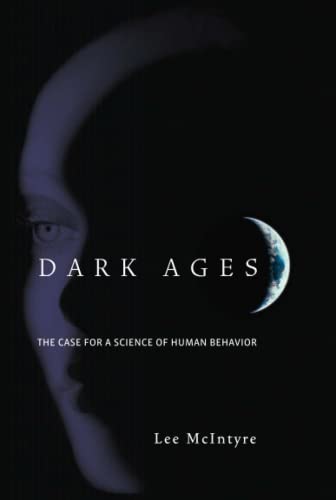
Why the prejudice against adopting a scientific attitude in the social sciences is creating a new ‘Dark Ages’ and preventing us from solving the perennial problems of crime, war, and poverty.
User’s Reviews
Editorial Reviews: Review “At a time when many social scientists have allowed themselves to be cowed by political and religious ideology, Dark Ages reminds us that we have a moral and intellectual obligation to seek the fullest possible understanding of the roots of human behavior. McIntyre has written a beautiful and timely ode to scientific rationality.”–Sam Harris, author of The End of Faith and Letter to a Christian Nation”Dark Ages is a compact, urgent, and brutally frank challenge to ideologues left and right to drop their resistance to learning scientific truths about human behavior and apply the scientific method to social science. Given current signs of deterioration in the human race’s ability to assure its own survival, the long-standing hostility to sometimes unwelcome knowledge must end, and Lee McIntyre”s powerful voice is timely and welcome. It will be instructive to see how his bold message is received, especially on university campuses, where the politicization of social science is in full flower and where some questions remain too hot to ask, much less answer.”–Harvey A. Silverglate, civil liberties lawyer and writer, and coauthor of The Shadow University: The Betrayal of Liberty on America”s Campuses”It takes a lot of nerve to insist that a scientific understand of human behavior should guide our approach to social problems—especially when the alternatives are religion, politics left and right, gut instinct, and every other values guidepost around. Lee McIntyre has that nerve, and makes a clear case for the value of value-free science. This book will make waves.”–Daniel M. Wegner, Professor of Psychology, Harvard University, and author of The Illusion of Conscious Will Review It takes a lot of nerve to insist that a scientific understand of human behavior should guide our approach to social problems―especially when the alternatives are religion, politics left and right, gut instinct, and every other values guidepost around. Lee McIntyre has that nerve, and makes a clear case for the value of value-free science. This book will make waves.―Daniel M. Wegner, Professor of Psychology, Harvard University, and author of The Illusion of Conscious Will About the Author Lee McIntyre is a Research Fellow at the Center for Philosophy and History of Science at Boston University. He is the author of Dark Ages: The Case for a Science of Human Behavior and Post-Truth, both published by the MIT Press. Read more
Reviews from Amazon users which were colected at the time this book was published on the website:
⭐I am finding this book to be an interesting reading about the human behaviors and some issues addressed are familiar to me. I most certainly agree with the third chapter: “Resistance to knowledge” where one’s bias is forcing that person away from true knowledge of things in ourselves. We often find ourselves to resist any knowledge that is not congenial to ourselves. That is most certainly true, even in today’s world, of how we always indulge in fantasy and dissociating our mind and thoughts away from Reality. McIntrye has pointed out that we are ruled unshakably by our ideologies, both religious and political, and both are impediments to the understanding the true science of human behavior. Ridding ourselves of these ideologies can lead us to the road of self-knowledge and the knowledge of human nature in general.As for the rest of the book, there are some areas that I felt that needed to be addressed more and less point-repeating, and this book feels limited to certain understandings, I think. Nevertheless, it’s a great book on the subject and challenge one’s thinking about our behaviors and attitudes.
⭐Really loved the wink at the academic community at the end of the intro, “I have tried to write this book in am accessible style with…virtually no professional jargon.” If you want to make your ideas accessible to people to deem inferior for the sincere intention of educating them in something to improve their quality of life, MAKE IT INTO A FREE PODCAST and realize that you’ve already excluded the audience you’d like to reach by publishing in print.
⭐Dark Ages is a brave and energetic polemic about a dirty little secret that is little talked about, and that is that the science of human behavior is actually nothing of the sort.Whilst the scientific method has been applied with vigor and determination to the rest of the natural world, it has been used in a very odd way to explain social behavior. Instead of the application of falsifiable hypotheses, the explanations for human behaviors are rooted more in ideology than science. Lee McIntyre contends that the majority of philosophers and social scientists do not have the courage to make an empirical inquiry into the causes of human action. They often cite a number of reasons why the scientific method cannot be applied to understanding such tragedies as terrorism and starvation. Lee expertly demolishes each of these major objections.Obviously tens of thousands of social scientists have not been sitting on their hands. But Lee suggest that their work needs to be sharpened, the focus changed, and above all, the assumptions of their work need to be challenged. This is always hard. However hard-nosed we may think that we are, every time that we do an experiment or responds to something in the news, we bring a lot of baggage with us. There are many practical problems with any attempt to challenge or change the status quo. Not the least of which is grant support. Stories abound of people failing to get grant support because their work flew in the face of “received wisdom.”This is a highly readable book of only 144 pages, excluding an eight-page introduction. And those 144 pages include some notes, a short bibliography and an index. I am no speed-reader, but I still finished the book in an hour or so, and thoroughly enjoyed the experience.After the introduction, there are five chapters:1. Diagnosing the human condition2. A science of human behavior3. Resistance to knowledge4. A lesson from the history of science5. What is to be done?Although polemic in style, it is also an optimistic book with some highly practical suggestions for applying scientific rigor to the understanding of some of the most fundamental problems facing us today.As he says in closing, “A science of human behavior can lead the way out of the current mess of unreason and tragedy that hangs over human affairs. The application of our highest form of reason, science, to the study of our social problems is our best hope for salvation. Even in a dark age, our reason can see us through. Our future may well be brighter that we have imagined it, for scientific inquiry is well equipped to answer the questions that have been put by human misery. The word awaits our response.”I am quite certain that science is not the only road to understanding, but it is an extraordinarily powerful one.This is an important book that deserves a wide readership. We have to try and understand some of the apparently illogical things happening in our world, or we are all going to be submerged by them.Highly recommended.
⭐This timely and engaging book addresses one of the most important issues that we as a species face. Devastating social, economic, and political ills grow out of our vast ignorance of human nature, yet to date, we lack the resolve to adopt a rigorously scientific attitude toward the human animal. Can we overcome our resistance to self-knowledge, and tame the forces that threaten to undo our civilization? Can we emerge from the “dark ages” of our self-understanding in time to avoid a second millenium-long descent into ignorance and misery?McIntyre has penned an eloquent polemic for embracing a thoroughgoing science of human behavior–one that deserves to be read by all, and reflected upon for years to come. Highly recommended!
⭐Is it possible to live in a world without murder or rape? In a world where poverty has been eliminated? Where suffering is a thing of the past?Dark Ages: The Case for a Science of Human Behavior is a wonderful, clearly written book that argues we should not give up on these causes. The problem, argues author Lee McIntrye, is that social scientists, who are theoretically equipped to solve these problems, are too invested in their own ideologies to do good science. McIntyre says we need to transform the social sciences by subjecting them up to the same standards of rigor that we have come to expect in the natural sciences.This book is a provocative call to action to change our attitude about the goals of the social sciences. Although the title suggests something ominous, McIntyre is optimistic that we have the know-how to improve our world.But this book is not just a polemic. It is also quite entertaining. The field of the philosophy of science is plagued by jargon, but McIntyre writes with the elegance of a popular writer. The author uses numerous examples throughout the text that leap off the page. McIntyre’s rich sense of science and subtle arguments come across effortlessly.If you have ever wondered why there is still war and suffering, then I highly recommend this book, which offers a provocative answer written in refreshingly down-to-earth prose.
⭐I desperately wanted this book to provide a way forward; to show how social science might one day be able to accurately predict human behaviour. After finishing this book in 4 days however, I can confidently say that I have never felt so disappointed after reading a book. Let me explain…The author starts by slating contemporary social science in all its forms, arguing that it should be more like the natural sciences in every conceivable way. Of course, this would be fantastic if it were possible, but at no point whatsoever does he provide any evidence as to how this would be achieved. Instead, he relies on abstract notions of how this can be done such as ‘sociologists should be less politically biased’, or ‘social scientists need to be more empirically minded’.The contradictions in this book are laughable, with arguments against current interpretivist sociology frequent but entirely unfounded and unsubstantial. Indeed, after providing a ‘critique’, the author then turns his hand to ‘solutions’ which include the following (this is no joke):- ‘We must watch out for resistance to knowledge’ (in this paragraph he actually means ‘resistance to anyone questioning positivist methodologies’);-‘We must draw strength from the analogy with natural science’ (at one point he argues that there exist no good reasons why society cannot be studied in the same way as natural science. The complexities of society, with its hidden number of unpredictable, historically-informed and culturally driven influences, are simply batted away in 6 pages of unbelievably simplistic ‘counter-arguments’);I don’t think I even need to provide an explanation beneath the next two – the vague simplicity is almost insulting:-‘We must pursue a methodology of inquiry that will help us learn from our data’;-‘We must never lose sight of our ultimate goal: to discover the causal factors behind human action’.Having such high hopes for this book I am bitterly disappointed. After finishing it, the best way I can describe it would be as basic, reductory, short, vague, uninformed and a complete waste of money.If you want to better understand social behaviour have a read of
⭐Criminal Identities and Consumer Culture
⭐. It provides a far more digestible and comprehensive explanation to societal issues, covering the complex intersection of economics, politics, sociology and psychology. It completely overshadows this dreadful excuse for an academic text.
Keywords
Free Download Dark Ages: The Case for a Science of Human Behavior (A Bradford Book) in PDF format
Dark Ages: The Case for a Science of Human Behavior (A Bradford Book) PDF Free Download
Download Dark Ages: The Case for a Science of Human Behavior (A Bradford Book) 2009 PDF Free
Dark Ages: The Case for a Science of Human Behavior (A Bradford Book) 2009 PDF Free Download
Download Dark Ages: The Case for a Science of Human Behavior (A Bradford Book) PDF
Free Download Ebook Dark Ages: The Case for a Science of Human Behavior (A Bradford Book)