Ebook Info
- Published: 2008
- Number of pages: 240 pages
- Format: PDF
- File Size: 0.00 MB
- Authors: Gregory Chaitin
Description
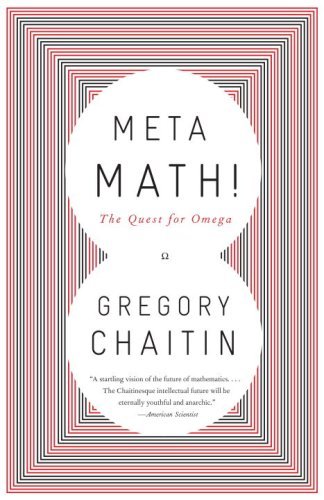
Gregory Chaitin, one of the world’s foremost mathematicians, leads us on a spellbinding journey, illuminating the process by which he arrived at his groundbreaking theory.Chaitin’s revolutionary discovery, the Omega number, is an exquisitely complex representation of unknowability in mathematics. His investigations shed light on what we can ultimately know about the universe and the very nature of life. In an infectious and enthusiastic narrative, Chaitin delineates the specific intellectual and intuitive steps he took toward the discovery. He takes us to the very frontiers of scientific thinking, and helps us to appreciate the art—and the sheer beauty—in the science of math.
User’s Reviews
Reviews from Amazon users which were colected at the time this book was published on the website:
⭐You kind of have to read this book if you have any interest in the subject – due to the importance of the material covered and the importance of the authors contributions.( Defining randomness and plotting its presence in mathematics. There are though other ways of addressing the incompleteness of a wide range of FASs. Always keep in mind it is the tools/languages that are (necessarily) incomplete not the ‘mathematics’ itself. But the author is one of those who is most comfortable with the finite or at least discrete and therefore concludes that is the way it is. Bits. But maybe this is just a failure of the imagination. )Anyway that being said actually reading the book is far from being a pleasure. The text is fluffy and scattered. The authors constant self-stroking is tedious and boring. Oh I did this when I was 12 or I did this when I was 10. Or I thought of this at 15 – but had no idea that X, Y, or Z thought of it first. Get over yourself. His occasional references to sex are just completely out of place, gratuitous and frankly a bit sleazy.
⭐Rather than writing a full review as I intended to do, I see that other readers have stated very clearly my problem with this book. I wish I had read those reviews prior to ordering… It is very sloppily written, and should have been much better edited. (Or rather, much better edited!! as he would have written it.) In fact it is one of the poorest written popular science books I’ve read among the dozens I’ve accumulated over the years. Although his thesis is very convincing, and the concept of omega is very fascinating with regards to incompleteness and noncomputable numbers, etc., the actual informational content is larded with numerous references to how brilliant the writer is, what a genius he was as a child, how important his work is, how well he compares with Turing and Godel (how reasonable is that?), and multiple comments that are just downright weird, as when he talks about the information content of having sex with a woman (in terms of genetic transfer of information, that is). So the earlier reviewer who mentioned that he seems to be hiding low self-esteem with self-aggrandizement seems to me to be right on the mark. Either that, or the author is living on a planet of his own where he doesn’t understand how embarassing and unsuitable this sort of heavy-handed arrogance is for this kind of book. Eventually I gave up reading it because of the odd writing style. Another minor drawback is that the content is very repetitive, particularly in comparison with other popular science books which appear dense with information.
⭐Chaitin takes you on an energetic, idiosyncratic Grand Tour of the major metamathematical milestones associated with luminaries like Hilbert, Gödel and Turing. The reader will not only get a sense of the “meta” approach to mathematics — the exploration of its limits — but also an appreciation of author’s use of complexity (AKA irreducibility) to approach those topics from an alternative and frequently illuminating perspective.For example, it took Kurt Gödel many many pages of dense, exotic symbolism to set out his famous result, the incompleteness (if not inconsistency) of ordinary arithmetic. Viz., there are “theorems” which cannot be derived from the axioms of arithmetic, but which we can nonetheless see to be true because they state, in effect, their own non-derivability. That proof is profoundly complex in part because, as Chaitin points out, Gödel has to concoct a sort of programming language to get his result: this (1931) five years before there was any good idea of what a computer might be (Turing, 1936).Using that notion of a computer, and more particularly the “elegance” of a computer program — its being the simplest to generate a particular output — Chaitin can convince you of the same result by a much simpler route.Axiomatic theories can be represented as computer programs capable of generating, one by one, all the possible valid theorems; and of course a program can be represented as a string of bits, “1”s and “0”s. Bits also measure information, à la Claude Shannon, so we immediately have a measure of the amount of information contained in that axiomatic theory. So, what if we construct a statement that contains more information than that (which, pretty much, is what Gödel did)? You cannot gain information via transmission, you can only lose it (the information-theoretic incarnation of the Second Law of Thermodynamics) — you cannot get more information from less. So obviously, that statement cannot be derived in that axiomatic system, whatever it says!Chaitin has his faults. His prose can be off-puttingly gung-ho: he is inordinately fond of exclamation points. And he can be very full of himself and his discoveries, somewhat mitigated by the free acknowledgement of others’ contributions and influences (he is also inordinately fond of Leibniz). But he does not go quite so far as to proclaim himself a great lover, and when he supposes one has a greater understanding of a mathematical proof when one has derived it oneself, he is only echoing his hero Leibniz: “the sources of invention … are, in my opinion, more interesting than the inventions themselves” (p. 56).I could hardly praise this book more than to say it would be a great read for any numerately-inclined high school or college student, or indeed any inquisitive person with a taste for philosophically-infused mathematics. You can find scholarly criticisms of Chaitin and his approach, e.g. in his Wikipedia entry. But if you get that far, he has already accomplished a major goal of his little book: to get you engaged in these intriguing metamathematical issues of Infinity And Beyond.(Thanks to Steve Schwartz for correcting some oversights.)
⭐Hay un dicho que dice que un libro puede cambiar la vida….ésta majestuosa obra de matemáticas puras, filosofía y creatividad cambió mi vida dramáticamente! El Sr. Gregory Chaitin es un genio y su obra claramente demuestra los límites del razonamiento humano y la forma de presentar los conceptos más abastarctos los presenta de una manera fascinante a través de su teoría algoritmica de la información. Su demostración de la incompletitud es reveladora, sencilla y atómica. Es un deleite leer las obras de éste gran pensador de nuestra actualidad.
⭐Gregory Chaitin ist emeritierter Professor der Universität Rio de Janeiro, davor arbeitete er lange Zeit am IBM T.J. Watson Research Center, er leistete bedeutende Beiträge zur Algorithmischen Informationstheorie, die Ideen von Andrei Kolmogorov und Ray Solomonoff fortführt.Chaitins wohl berühmteste Entdeckung ist die mathematische Konstante Qmega, die die Haltewahrscheinlichkeit von Programmen beschreibt, und die – in einem gewissen Sinn – die Inkarnation von Unberechenbarkeit darstellt. Der Autor beschreibt im vorliegenden Buch, wie der Untertitel erwarten lässt, die Geschichte seiner Entdeckung von Omega, es geht ihm dabei nicht nur um reine Mathematik, sondern er erläutert auch seine damit in Zusammenhing stehenden philosophischen Ideen.Zum Beginn des 20. Jahrhunderts entwickle David Hilbert sein Programm zur Formalisierung der Mathematik, er bediente sich dabei der axiomatische Methode, die bereits Euklid in seinen Elementen benutzt hatte, er formalisierte aber sein Verfahren soweit, dass die Überprüfungen des Beweises, eines aus den Axiomen abgeleiteten Theorems, zu einer – im Prinzip — rein mechanischen Aufgabe wird. Hilbert wollte damit ein für alle Mal die Mathematik auf solide, unangreifbare Fundamente stellen, so dass die Antinomien, die etwa in Cantors (naiver) Mengenlehre auftauchten, ausgemerzt werden könnten. Dieses Programm gedieh zunächst durch die Ideen und Ergebnisse von Peano, Zermelo, Faenkel, Russel, Withehead, v. Neumann u.a. prächtig, dann aber erschütterten Kurt Gödel 1931 und Alan Turing 1936 dieses Weltbild durch die Entdeckung ihrer Unvollständigkeits- und Nicht- Berechenbarkeits- Resultate.Chaitin untersucht u.a. die Frage der Bestimmung des Informationsgehalts einer Zeichenkette, er verwendet als Maß die Länge des kleinsten Programms, das die Folge als Output erzeugen kann, und stellt fest, dass damit auf gänzlich neue Art und Weise Unvollständigkeitsresultate erhalten werden können. Das einfachste solche Resulat hängt mit dem Begriff des eleganten Programms zusammen, einem Programm von minimaler Lägen unter allen Programmen, die den selben Output erzeugen. Es zeigt sich, dass ein Formales Systems nicht in der Lange ist, Beweise für die Eleganz von Programmen zu erbringen, wenn die Länge der Programme eine bestimmte Größe übersteigt. Aus diesen Betrachtungen lässt sich Turings Ergebnis der Nichtentscheidbarkeit des Halteproblems für Programme reproduzieren.In diesem Zusammenhang steht schließlich auch die Haltewahrscheinlichkeit Omega, diese wohl definierte reelle Zahl ist, nicht nur nicht berechenbar ist, es sind überhaupt nur endliche viele Bits der Binärbruchentwicklung von Omega berechenbar, schließlich ist die Bitfolge sogar algorithmisch irreduzibel.Der Begriff der algorithmischen Komplexität und Omega haben eine lange Geschichte, die Ideen gehen u.a. auf Leibniz und Borel zurück, wie Chaitin immer wieder betont, dem es ein wichtiges Anliegen ist, diese zum Teil philosophischen Querverbindungen klar heraus zu arbeiten, letztendlich gehörte es zu den Hauptbestrebungen des Autors, die ‘Ursachen’ für die von Gödel festgestellte Unvollständigkeit aufzudecken.Als Konsequenz dieser Resultate sieht Chaitin es als erwiesen an, dass die Mathematik nicht ‘statisch’ ist – EIN Formales System kann nie all ihre Aspekte abbilden – statt dessen werden die Mathematiker künftig verschieden Axiome quasi- empirisch ausprobieren müssen; dazu werden, nach Ansicht Chaitins, Computer, als Mittel des Erkenntnisgewinns, in zunehmenden Maße eine Rolle spielen, Chaitin selbst verwendet einen modifizieren LISP Dialekt, um seine Algorithmen auf realen Computern zu programmieren – er räumt aber ein, dass seine Ansichten zumindest kontrovers sind. Und in der Tat gibt es ja bereits zahlreiche Paper, die unter der Voraussetzung der Kontinuums Hypothese, ihrer Negation oder der Riemannschen Vermutung, bestimmte Resultate ableiten. Andererseits sind Beweise, bei denen Computer dazu verwendet werden, eine möglicherweise riesig große, aber endliche Zahl von Fallunterscheidungen zu prüfen, seit geraumer Zeit bekannt – das prominenteste Beispiel ist der Beweis der Vierfarben Hypothese von K. Appel und W. Haken 1976; jüngst berichtete ‘Nature’ über einen Computerbeweis für ein Färbungsproblem für pythagoreische Zahlentripel, der nicht weniger als 200 Terabyte an ‘Beweismaterial’ produzierte. Wenn an solchen Beweisen durchaus interessant ist, dass sie überhaupt funktionieren, so vertiefen sie doch selten das Verständnis des jeweiligen Problems. Auf der anderen Seite gibt es auch in neuerer Zeit kein Mangel an (traditionellen) Beweisen von bedeutenden mathematischen Problemen: etwa Andrew Wiles Beweis von Fermats letzten Satzes oder die Beiträge von L. Lafforgue, V. Drinfeld u.v.a. zum Langlands Programm.Chaitin hat sein Buch für einen breiten Leserkreis verfasst, seine Ausführungen sind immer wieder durch historische Exkurse aufgelockert, leider sind gerade die Erläuterungen seiner eigenen Algorithmen oft unnötig vage. In ‘Grenzen der Mathematik’ gibt D. Hoffmann eine Zusammenfassung der Algorithmischen Informationstheorie in einem Kapitel mit präzisen Definitionen, Beweisskizzen aller wesentlicher Resultate und übersichtlichen Diagrammen für die wichtigsten Algorithmen, die wesentlich stringenter und nur eine wenig technischer ist.
⭐An outstanding book in meta mathematics, taking us from beginnings of meta mathematics with Hilbert and Godel through to the randomness embodied in omega, the halting probability.The trail moves through Leibniz, Godel’s incompleteness, Turing’s halting and incompleteness, to Algorithmic Information Theory which proves the key to finding Omega, the number whose bits show irreducible randomness in mathematics.The writer assumes no major existing knowledge, but leads you quickly into high ground.Some discussions also touch on philosophy and the history of ideas.His enthusiasm is infectious; a great read.
⭐Don’t buy the Kinlde edition! Essentially all the formulas (with the exception of some that were reproduced as image) are messed up through the typesetting. As for the content, I would have given more stars, as in principle the story is interesting and does give some insight into the progess into the foundations of math since Goedel, but I agree with other reviews that this is not very well written, jumping too much between different levels of difficulty, and showing off a bit too much of the author’s ego.
⭐2015年世界サイエンスフェスティヴァルにおいて、「The Limits of Understanding」というテーマでクルト・ゲーデルについてのディスカッションが開催され(ウェブサイトに各プログラムのビデオが全てアップされているので、ご興味のある方は是非どうぞ)、著者氏とマリオ・リヴィオ氏(理論物理学者)ともうお一方の物理学者とのやり取りが大変に面白かった。著者氏は「ゲーデルはアナタ方の言うことを喜んで聞かないでしょう」と言っていた。何故ならば、ゲーデルは現代人ではなく中世の人間だったからだと。ゲーデルの数学は中世神学だったのだと。「アナタ方は実に現代人だ」と物理学者たちに向かって言っておったのであった。現代人は神を語らない。ゲーデルはその数学でもって神を語った。だからアナタ方はゲーデルを理解出来ないのである、と。興味を持ったアタクシは本書とマリオ・リヴィオ氏の著書(『Is God a Mathematician?』)を買い求めて同時進行で読み出したのであるが、頭がアレなのと知的エネルギーが不足しているせいで、なかなか大変だった。著者のチェイティン氏は純粋数学者で、「真の乱数・オメガ」の発見者…いや、発見はしていないのか、その可能性を示唆したお方、らしい(突っ込まないように)。真の乱数とは「還元不可、演算不可、真にランダムなる実数」である。発見はしていない。探しているのである。たくさんあるらしいのである。数字で表せないほどにたくさん(突っ込まないように)。その「オメガ」にどの数学者よりも近づいた、その方向性を示した人、その可能性を「証明」した人らしい(突っ込まないで下さい)。キリリと自信を持って言うが、ほとんど分からない。しかし読んでいてやたらとワクワクしたのは嘘ではない。何だか壮大で凄いぞ。まあとにかく、馬鹿なのでよう分からないのだが、本書で語られる洞察は物凄く深いと感じるし、しばらくその余韻が脳味噌に残る(理解してなくとも残る)。ライプニッツ、ニュートン、チューリング、ゲーデル等々について語りつつ、数学者視点からの「数学的発見プロセス」を語り、数学者の意識を数学者として探求し、広い分野にわたって数学的光輝を感じさせる考察を開陳してくれる。文体は「!」が多様され、爽快なほど感情的で、熱気と情熱に満ちている。世界サイエンスフェスティヴァルのディスカッションでのナマのチェイティン氏のままの語り口だ。数学とは何か。それは「構築」の性質付けであり、表現である。宇宙は「数学的構築」によって生成されている。その構築そのものが「神の思考」だ。世界は数学という糸でもって編まれた織物だ。神は数学者なり。ナルホド。数学無能力者はどうしませう。ともあれ、この本はもう一度読んでみよう。
⭐
Keywords
Free Download Meta Math!: The Quest for Omega in PDF format
Meta Math!: The Quest for Omega PDF Free Download
Download Meta Math!: The Quest for Omega 2008 PDF Free
Meta Math!: The Quest for Omega 2008 PDF Free Download
Download Meta Math!: The Quest for Omega PDF
Free Download Ebook Meta Math!: The Quest for Omega