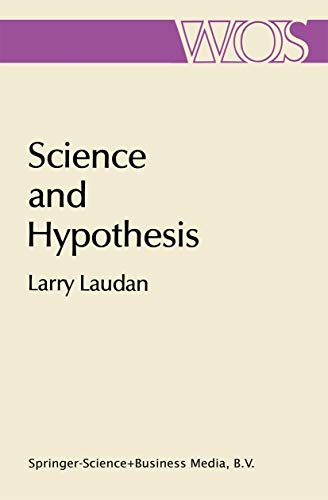
Ebook Info
- Published: 2013
- Number of pages: 260 pages
- Format: PDF
- File Size: 8.83 MB
- Authors: Larry Laudan
Description
This book consists of a collection of essays written between 1965 and 1981. Some have been published elsewhere; others appear here for the first time. Although dealing with different figures and different periods, they have a common theme: all are concerned with examining how the method of hy pothesis came to be the ruling orthodoxy in the philosophy of science and the quasi-official methodology of the scientific community. It might have been otherwise. Barely three centuries ago, hypothetico deduction was in both disfavor and disarray. Numerous rival methods for scientific inquiry – including eliminative and enumerative induction, analogy and derivation from first principles – were widely touted. The method of hypothesis, known since antiquity, found few proponents between 1700 and 1850. During the last century, of course, that ordering has been inverted and – despite an almost universal acknowledgement of its weaknesses – the method of hypothesis (usually under such descriptions as ‘hypothetico deduction’ or ‘conjectures and refutations’) has become the orthodoxy of the 20th century. Behind the waxing and waning of the method of hypothesis, embedded within the vicissitudes of its fortunes, there is a fascinating story to be told. It is a story that forms an integral part of modern science and its philosophy.
User’s Reviews
Reviews from Amazon users which were colected at the time this book was published on the website:
⭐Laudan’s overarching thesis is that classical philosophy of science was always subordinated to actual science: “New or innovative methodological ideas have generally not emerged, nor have old one been abandoned, as the result of internal, dialectical counterpoint between rival philosophical positions or schools; neither is it the case that the waxing and waning of methodological doctrines can be related neatly to their epistemic credentials. Rather, it is shifting _scientific_ beliefs which have been chiefly responsible for the major doctrinal shifts within the philosophy of science.” (p. 9).Laudan is thus rightly furious with philosophers who “set out to tell the history of the philosophy of science by asking the question: what have the great philosophers said about science?” (p. 1). Indeed Laudan successfully refutes many idiotic misconceptions of such ignoramuses, and he does so with considerable zeal.The must amusing case is the misguided reverence for “Hume’s problem of induction.” It will come as no surprise to anyone but self-absorbed philosophers that “one of the core problems in medieval, renaissance and early 17th-century epistemology was precisely this: to what degree, if at all, does a confirming instance of a theory contribute to the cognitive well-foundedness of that theory?” (p. 77). The contribution of Hume—“that dour scientific dilettante” with “almost unparallelled ignorance of the science of his day” (p. 83)—was to trivialise this important problem to childish instances such as “how do I know that this bread which nourished me today will nourish me tomorrow” (p. 75). “It is one of the wilder travesties of our age that we have allowed the myth to develop that 19th-century philosophers were as preoccupied with Hume as we are. As far as I have been able to determine, none of the classic figures of 19th-century methodology—neither Comte, Herschel, Whewell, Bernard, Mill, Jevons, nor Pierce—regard Hume’s arguments about induction as much more than the musings of an historian. This claim is borne out by the fact that in Pierce’s thirty-two papers on induction and scientific method—papers teeming with historical references—there is only one reference to Hume; and that is not in connection with the problem of induction but with the problem of miracles.” (p. 240).Another case of misguided reverence which Laudan corrects is that of Galileo. The revolution in scientific methodology was prompted by “the radical observational inaccessibility of the entities postulated by their theories,” which was “one of the most persistent, and philosophically disturbing, features of most sciences of the 17th century” (p. 22). Meanwhile, “Galilean mechanics could be (and sometimes was) regarded as posing no acute threat to the theory of scientific methodology advocated (say) in Aristotle’s Posterior Analytics. If the whole of 17th-century science had exhibited the largely phenomenological character of Galileo’s mechanics, there need have been no revolution in methodology” (p. 21).While I applaud Laudan’s crusade on ignorant philosophers, his own historical theses are not beyond criticism. Let us consider as an example the supposedly universal, categorical rejection of hypotheses in the post-Newtonian era, a “fact” which Laudan relies on again and again in his interpretations. “The half-century following the publication of the Principia was marked by a growing antipathy to hypotheses and speculation.” (p. 112). “Virtually every preface to major scientific works in this period included a condemnation of hypotheses and a panegyric for induction. … As a contemporary noted, ‘The [natural] philosophers of the present age hold hypotheses in vile esteem.’ Philosophers of science and epistemologists were, if anything, even more enthusiastic in their condemnation of hypothetical inference.” (p. 10). Laudan is doubtlessly correct so far as British philosophers are concerned (as we see in chapters 7 and 8).But the idea that the scientists themselves held hypotheses in “vile esteem” is in poor agreement with the facts. Euler, for example, supposedly one of the hard core inductivists, “maintain[ed] that the transmission of light depended upon vibrations in an imperceptible medium” (p. 113), which is an inexplicable inconsistency to Laudan. The only theories Laudan can point to that were rejected by what he takes to be the militant inductivist mob are wildly speculative ether theories of Hartley and LeSage. “The reactions to LeSage’s model was not only largely negative; the grounds for criticism were generally epistemological rather than substantive.” (p. 119). From what we see of the theories of Hartley and LeSage, however, they appear to be armchair speculations that were quite plainly void of scientific substance. It seems reasonable then that the real scientists used the inductivist argument against them not because they were devoted to banishing hypotheses from the face of the earth but rather as a shorthand method for politely dismissing these crackpot theories. If anything, it seems that LeSage was treated with more respect that his theories warranted. Euler even “wrote several encouraging letters to LeSage about the latter’s work” (p. 119), dismissing it only (as far as we see here) as an explanation of gravity (“explaining” gravity by various ethereal corpuscles or whatnot is of course quite easy; such explanations had been known to Newton and others, but they had chosen not to publish since such explanations are pointless).In Laudan’s story the dictatorship of the inductivists were in the end overthrown by a popular uprising: “By the 1760s, the scientific literature abounded with ethereal explanations of heat, light, magnetism, and virtually every other physical process.” (p. 113). Where did these theories come from, one wonders, if “virtually every” scientist despised hypotheses? Apparently the raving inductivist militia that ruled the scientific world with an iron hand for half a century, liquidating all dissidents without trial, had suddenly dissolved into a mist. Surely it makes more sense to ascribe militant inductivism only to a handful philosophers, whereas the scientists appear to have focused, quite sensibly, on induction for a while to try to emulate Newton’s success but then moved to hypotheses again as induction did not work as well as they had hoped. In other words, while Laudan succeeds in showing that the philosophy of science was always heavily influenced by actual science, his claims regarding dependence in the opposite direction are very poorly supported.
⭐
Keywords
Free Download Science and Hypothesis: Historical Essays on Scientific Methodology in PDF format
Science and Hypothesis: Historical Essays on Scientific Methodology PDF Free Download
Download Science and Hypothesis: Historical Essays on Scientific Methodology 2013 PDF Free
Science and Hypothesis: Historical Essays on Scientific Methodology 2013 PDF Free Download
Download Science and Hypothesis: Historical Essays on Scientific Methodology PDF
Free Download Ebook Science and Hypothesis: Historical Essays on Scientific Methodology