

Ebook Info
- Published: 2005
- Number of pages: 330 pages
- Format: PDF
- File Size: 1.92 MB
- Authors: Thomas Ryckman
Description
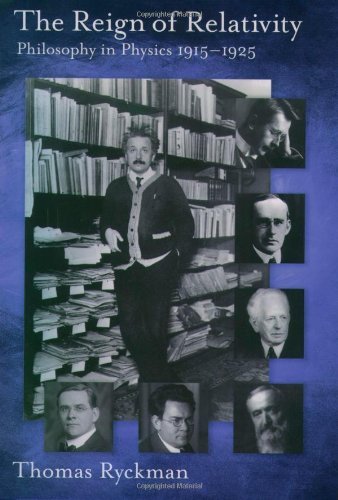
Universally recognized as bringing about a revolutionary transformation of the notions of space, time, and motion in physics, Einstein’s theory of gravitation, known as “general relativity,” was also a defining event for 20th century philosophy of science. During the decisive first ten years of the theory’s existence, two main tendencies dominated its philosophical reception. This book is an extended argument that the path actually taken, which became logical empiricist philosophy of science, greatly contributed to the current impasse over realism, whereas new possibilities are opened in revisiting and reviving the spirit of the more sophisticated tendency, a cluster of viewpoints broadly termed transcendental idealism, and furthering its articulation. It also emerges that Einstein, while paying lip service to the emerging philosophy of logical empiricism, ended up siding de facto with the latter tendency.Ryckman’s work speaks to several groups, among them philosophers of science and historians of relativity. Equations are displayed as necessary, but Ryckman gives the non-mathematical reader enough background to understand their occurrence in the context of his wider philosophical project.
User’s Reviews
Reviews from Amazon users which were colected at the time this book was published on the website:
⭐Ryckman’s book is an excellent work full of novel insights. Ryckman single-handedly revives the non-positivist “transcendental philosophy” insights of early discussions of General Relativity Theory. Much of this suggestive insight and interpretation was lost with the triumph of the logical positivist (later logical empiricist) appropriation of Einstein’s relativity theory as showing that Kant’s a priori and transcendental philosophy was overthrown by Einstein. Schlick and later Hans Reichenbach became the “standard” interpreters of General Relativity Theory by the end of the 1930s. Later American philosophers of science, such as Adolph Gruenbaum and Wesley Salmon, even where not agreeing with all claims of Reichenbach, very much followed his lead and tended to dismiss the neo-Kantian and phenomenological interpretations that were developed by European thinkers concerning relativity theory.Ryckman discusses the work on unified field theories of mathematician Herman Weyl and the physicist Arthur Eddington, as well as the philosophical interpretations of general relativity by Ernst Cassirer and Emile Meyerson among others. Ryckman’s grasp of both Husserl’s phenomenology and of the relevant differential geometry is superb.His long sections on Herman Weyl are tremendously informative and illuminating. I think Ryckman’s interpretations of Eddington as a “transcendental philosopher” in the traditional sense of Kant and Husserl are a bit of a stretch, however, as Eddington’s philosophical excursions were very much seat of the pants. Nevertheless Ryckman persuasively discredits those, like Susan Stebbing, who ridiculed Eddington’s philosophical interpretations without understanding the physics and mathematics that led him to them.A minor but significant weakness is Ryckman’s totally downplaying and dismissing the influence of the German romantic idealist Fichte on Weyl’s interpretation of field theory and matter, claiming that Weyl was interested only in Fichte religious thought. In fact Erhard Scholz has made a well documented case in various articles that not only Husserl but Fichte was a very strong influence on Weyl’s interpretations, and Weyl says so himself in his autobiographical reminiscences.Overall Ryckman’s work is an outstanding contribution and I hope it will revive interest in phenomenological philosophy of physics among physicists as well as Anglo-American philosophers.
⭐Its content is ambiguous and I think it is understandable only for expert in the field
⭐Ryckman writes an intricate history of the philosophy of relativity, rich with deep accounts of the intense discussion about the meaning of objectivity. He gives compelling descriptions of the exchanges between our favorite characters in the philosophy of physics such as Cassirer, Reichenbach, Weyl, Einstein, Eddington. In this history, Ryckman sees to rehabilitate the reception of Kant’s philosophy of space. As is well known, Kant’s notion of a priori principles was fiercely contested with the discovery of non-Euclidean geometries. In a case where history is told by the “victor,” the positivist annointed themselves as the standard bearers of science. Ryckman exposes this narrative as a pleasant fiction. Positivism was and still is a fascinating perspective on science, but it was not the only philosophy of physics, nor the most important at the beginning of the 20th century. That honor undeniably goes to the philosophy of Hermann Weyl, whose contributions are arguably only second to Einstein. Ryckman tracks Weyl’s philosophical inspiration for the gauge principle, now a cornerstone in modern physics, to the philosophy of Husserl. Husserl is a sterling figure in the philosophy of science but his relationship to analytic philosophy is complex. Weyl himself is an “original” in the philosophy of physics, striking a fine balance between realism and idealism in his worldview. His realism was his respect for the complexity of experience. His idealism the respect for mathematics. Ryckman writes the story of a philosopher trying to keep the two together. The fairest thing that can be said is that philosophy and physics is a tangled web, all inspiration is good inspiration, and let a 1000 flowers bloom.The main thesis of the book, as I understand it, extends Michael Friedman’s argument that the “two roads” led the unfortunate, artificial split between continental and analytic philosophy. This is illustrated by the delightful debate between Reichenbach and Weyl about the fate of rods and clocks in the theory of relativity. Einstein was withholding in his philosophical judgment, but Ryckman argues he drifted from positivism and toward a more fundamental mathematical approach to physical theory in the 1930s.Ryckman does give transcendental idealism the approving nod it deserves, but as a warning to the reader, his prose is dense, the argumentation complex. I have a degree in physics, and I had to take careful notes to keep up with the infusion of thorny concepts and vector calculus. This is not an introductory text for relativity, phenomenology, or the philosophy of physics. However, with the appropriate background, it deserves to be read by philosophers of physics.
Keywords
Free Download The Reign of Relativity: Philosophy in Physics 1915-1925 (Oxford Studies in Philosophy of Science) 1st Edition in PDF format
The Reign of Relativity: Philosophy in Physics 1915-1925 (Oxford Studies in Philosophy of Science) 1st Edition PDF Free Download
Download The Reign of Relativity: Philosophy in Physics 1915-1925 (Oxford Studies in Philosophy of Science) 1st Edition 2005 PDF Free
The Reign of Relativity: Philosophy in Physics 1915-1925 (Oxford Studies in Philosophy of Science) 1st Edition 2005 PDF Free Download
Download The Reign of Relativity: Philosophy in Physics 1915-1925 (Oxford Studies in Philosophy of Science) 1st Edition PDF
Free Download Ebook The Reign of Relativity: Philosophy in Physics 1915-1925 (Oxford Studies in Philosophy of Science) 1st Edition