Ebook Info
- Published: 2006
- Number of pages: 240 pages
- Format: PDF
- File Size: 0.00 MB
- Authors: Harvey R. Brown
Description
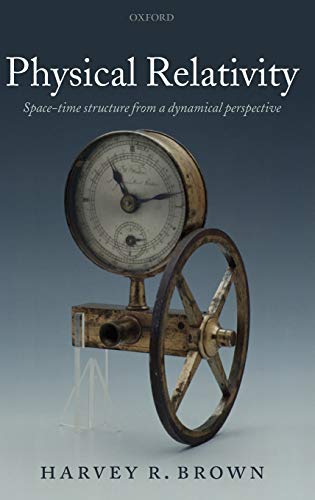
It is not widely known that Einstein had doubts, increasing with time, about the way he formulated his special theory of relativity in 1905. Physical Relativity examines the grounds of these doubts and related misgivings on the part of a handful of physicists and philosophers in the course of the twentieth century. Harvey Brown defends an interpretation of relativity theory, and hence of the nature of space and time, that combines Einstein’s insights with those of his immediate precursors, who today are widely regarded as having had the right ideas for the wrong reasons. Appearing in the centennial year of Einstein’s celebrated paper on special relativity, Physical Relativity is an unusual, critical examination of Einstein’s thinking that will be of great interest to philosophers of physics, physicists, and historians of science.
User’s Reviews
Editorial Reviews: Review `’a compact, deftly woven mixture of history and philosophy of physics. . . . Both historians and philosophers of physics (and physicists) will find much that is of interest in this book. I seriously recommend that anyone interested in the philosophical foundations of spacetime theories, and physics in general, add it to their collections: it is certainly a ‘must-have’ for philosophers of physics.’ ‘ ean Rickles, Mind`’a provocative and challenging book . . . It expertly synthesizes several analyses and generalizations of the Lorentz transformations. The historical sections are rich, concise and absorbing. Moreover, it includes worthwhile appendices on general covariance and on the relation between special relativity and quantum theory. The lively argumentation throughout thoroughly engages developments from decades of works in philosophy of space and time, and it deserves careful attention.’ ‘ Alberto A. Martinez, Studies in History and Philosophy of Modern Physics`’inspiring and thought-provoking content . . . an absolute must for physicists and philosophers’ ‘ Mauro Dorato, International Studies in the Philosophy of Science`’immensely stimulating’ ‘ Thomas Rickman, Metascience About the Author Harvey R. Brown is at University of Oxford.
Reviews from Amazon users which were colected at the time this book was published on the website:
⭐I am a physicist and I cannot analyse its philosophical merits. However, I strongly recommend the physicists to read this book, for it contains very insightful discussions on subtle issues usually absent from standard textbooks. This is not an introduction and for a better appreciation it is important the reader to be acquainted with a previous course in relativity. In the following I will comment some of the pearls which, in my opinion, distinguishes this book. It is well known that Lorentz and Fitzgerald tried to interpret the contraction that nowadays bare their names in terms of fundamental interactions among molecules. Since they also strongly advocate on the behalf of the ether concept, nowadays physicists tend to regard this debates as innocuous and the contraction as a manifestation of space itself. In chapter 5, Harvey Brown shows that the search of an atomistic comprehension of the contraction is independent from the existence of the ether and that Einstein himself saw in it a necessary step towards a complete theory. In this remarkable chapter, it is discussed how Einstein saw his theory as analogous to thermodynamics. Other highlights are the discussion of some unconventional views of the relativity theory (chapter 7) and the discussion in chapter 8, following Lévy-Leblond, that Lorentz covariance does not require that light moves with the invariant velocity c, and therefore that it is in principle possible to construct a consistent relativistic theory with a massive photon. Chapter 9 deals with general relativity and is very enlightening, addressing the fundamental question about the contingency of regard the tensor g as the metric of space-time. It is discussed also the sense in which space-time acts in the matter. To finish, let me add a personal remark. The search for quantum gravity and for a better understand of the physics of black-holes has presented clues that general relativity may not be the last word (for example, the prevision of singularities as proved by Penrose) and may be just an effective theory with outstanding results for length scales far larger than Planck’s length. This line of reasoning begs for a thorough study of the foundations of and alternative approaches to relativity. This books offer a valuable aid to this purpose.
⭐Harvey Brown beats round and round the bush to make some points about an approach to relativity which is more constructive than just “assuming” the principle of relativity. But in being politically correct and tiptoeing around the bush, the points manage to get a little obfuscated.
⭐I have not read the entire book but have read the extensive portions that relate to the development of relativity theory. TThis book contains interesting and useful information concerning the various developments that have ocurred in relativity theory over the past century, and would be useful to those interested in understanding how it evolved,
⭐If you want to be totally confused about relativity, then read that book.Brown tries to practice rational criticism of relativity, à la Popper… But he’s as close to Popper as to Alpha Centauri in terms of clarity of exposition and rationale : jumping from one historical review to another in total disorder and confusion, he leaves the reader wondering where all this is leading to… And soon comes a deep boredom.Fundamentally, this attempt at enriching the debate — as to whether length contraction and time dilation are only changes of coordinate measures when the velocity is constant in both magnitude and direction ; but are intrinsic/physical changes when there’s acceleration — was an excellent idea.Actually, that point was taken up, and brilliantly, by Ashok N. Katti ( The Mathematical Theory of Special and General Relativity)…And Katti’s approach is not incompatible with the theory defended by Brown, i.e. that such physical changes are of a quantum nature… a quite interesting prospect for future research… Noting, en passant, that even though Brown tells us that he’s dealing with SR, he almost always refers to situations where acceleration has crept in !!Brown’s book evidently being neither a first book nor a second one , if you’re really interested in relativity, see a proposed route in my review of Einstein’s, Lorentz’s, Weyl’s, Minkowski’s original papers ” The Principle of Relativity “.As for philosophy, well…
⭐This is masterly review of physical relativity from Harvey Brown has worked more than anyone on alternative Lorentz transformations for example and the precise assumptions underlying them, an immense amount of experience underlies such parts of this book, and an immenses ammount of thorough historical research. I would have been delighted if Harvey had said more about some things, e.g. the present fashion to avoid or deny the change of mass with speed; a subject strangely ignored. e.g. the definitions of and behaviour of standard lengths in general relativity. but perhaps a similarly definitive account of such are works in progress, I sincerely hope so.G E STEDMAN’An orthodox understanding of the Bible with Physical science’
⭐Great book
⭐dont like
Keywords
Free Download Physical Relativity: Space-time Structure from a Dynamical Perspective 1st Edition in PDF format
Physical Relativity: Space-time Structure from a Dynamical Perspective 1st Edition PDF Free Download
Download Physical Relativity: Space-time Structure from a Dynamical Perspective 1st Edition 2006 PDF Free
Physical Relativity: Space-time Structure from a Dynamical Perspective 1st Edition 2006 PDF Free Download
Download Physical Relativity: Space-time Structure from a Dynamical Perspective 1st Edition PDF
Free Download Ebook Physical Relativity: Space-time Structure from a Dynamical Perspective 1st Edition