Ebook Info
- Published: 2006
- Number of pages: 224 pages
- Format: PDF
- File Size: 33.85 MB
- Authors: Palle Yourgrau
Description
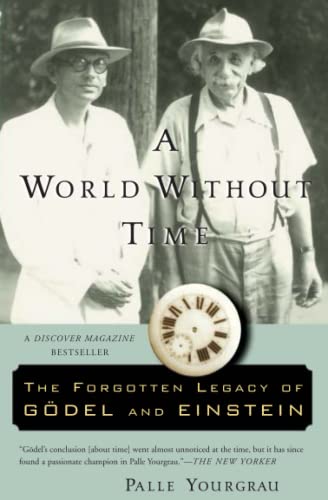
It is a widely known but little considered fact that Albert Einstein and Kurt Godel were best friends for the last decade and a half of Einstein’s life. The two walked home together from Princeton’s Institute for Advanced Study every day; they shared ideas about physics, philosophy, politics, and the lost world of German science in which they had grown up. By 1949, Godel had produced a remarkable proof: In any universe described by the Theory of Relativity, time cannot exist . Einstein endorsed this result-reluctantly, since it decisively overthrew the classical world-view to which he was committed. But he could find no way to refute it, and in the half-century since then, neither has anyone else. Even more remarkable than this stunning discovery, however, was what happened afterward: nothing. Cosmologists and philosophers alike have proceeded with their work as if Godel’s proof never existed -one of the greatest scandals of modern intellectual history. A World Without Time is a sweeping, ambitious book, and yet poignant and intimate. It tells the story of two magnificent minds put on the shelf by the scientific fashions of their day, and attempts to rescue from undeserved obscurity the brilliant work they did together.
User’s Reviews
Editorial Reviews: About the Author Palle Yourgrau is a Professor of Philosophy at Brandeis University. His 1999 monograph Gödel Meets Einstein, the only book-length work on Gödel’s cosmological ideas, has caused a resurgence of interest among philosophers in Gödel’s ideas about time and relativity. He lives in Cambridge, Massachusetts.
Reviews from Amazon users which were colected at the time this book was published on the website:
⭐This book gives the importance of the back-grpund of the Godel philosophyl for having posed important questions about the Einstein model. The sense of all that is an hard critics about the definition of time in according to the Einstein point of view, reconsidering the old definition which the Greeks posed with Plato and Aristotile. Godel is for talking about the time just in this sense, that is that of Greeks. The author of the book is very able to reconstructing this philosophical context in the past centuries, so we live those events for the strongness of the Godel positions. In according to Yourgrau Einstein considers a new paradigma, the relativity, against the notion of Newtonian time, but he was simply in error. So Godel had seen exactly the role of the time in a true context.
⭐Einstein and Godel were best friends for the last 15 years of Einstein’s life. Every day they walked home together from Princeton’s Institute for Advanced Study and shared ideas about physics, philosophy, politics and the lost world of German-Austrian science. No doubt they also discussed Nietzsche’s notion of eternal return. In 1949 Godel published a paper proving that there exist possible worlds described by the theory of relativity in which time, as we ordinarily understand it, does not exist. He went further; if time is absent in those theoretical universes, he showed, then time does not exist in our world either. Einstein’s great work has not explained time, as most physicists and philosophers think, but explained it completely away! Physicists since then have tried without success to find an error in Godel’s physics or a missing element in relativity itself that would rule out world models like Godel’s. Stephen Hawking went so far as to propose and ad-hoc modification of the laws of nature, a “chronology protection conjecture.” Godel’s famous “Incompleteness” ends with an elliptical image of cyclical time. Because of the homogeneity of the space-time and the mutual twisting of the family of time-like non Euclidean geometries of curved surfaces, it is more or less inevitable that the Godel space-time has closed time-like curves (CTC’s). Indeed, there are CTCs through every event in the Godel space-time. This causal anomaly seems to have been regarded as the whole point of the model by Godel himself, who was apparently striving to prove, and arguably succeeded in proving, that Einstein’s equations of space-time are not consistent with what we intuitively understand time to be (i.e. that it passes and the past no longer exists, the position philosophers call presentism, whereas Godel seems to have been arguing for something more like the philosophy of eternalism), much as he also succeeded with his Incompleteness Theorems in showing that intuitive mathematical concepts could not be completely described by formal mathematical systems of proof. It is further interesting to note that Godel used Riemann’s Elliptical Geometry which was recently, after 358 years of failed attempts, used to find the long awaited proof of Fermat’s last Theorem. This is a book which makes you re-consider what you always believed about time
⭐I’ve always been a math enthusiast trying to catch up with Wikipedia articles about different topics, but this book does a great job not only covering a nice spectrum of related topics but explaining them easily and showing all the interactions between all those famous dudes back on the beginning of the 20th century and their human sides.I found myself wowing quite often with the explanations and relationships explained on this book.Many of the topics were a bit above my head and required me to re-read them a couple of times until for some I had to be happy to be only informed and realize that it will take me much longer to fully digest them. At least now I got a small grasp on the existence of many of them.This book does not have formulas or charts of graphs to show explanations about time, unlike other books about time (Stephen Hawkins mostly) this book is much more centered on Godel than on time itself.
⭐Reviewed by: Stephen J. HageTwo of the twentieth century’s greatest thinkers, Kurt Gödel and Albert Einstein became friends in 1942. This book describes how intimate that friendship was and how they influenced each other’s thinking.For people interested in pure mathematics the name Kurt Gödel is as famous as Albert Einstein. His incompleteness theorem shattered the efforts of Bertrand Russell and Alfred North Whithead in their attempt to write the definitive tome to end all tomes on mathematics, the Principia Mathematica. The stated goal of the Principia was to tie together everything that was known about mathematics so that it would, once and for all, be complete. Gödel’s incompleteness theorem not only demonstrated but proved, mathematically, that such a task was not only folly, it was impossible.For people interested in physics and relativity, Yourgrau reveals how Gödel brought his formidable mathematical skills to bear on Einstein’s work to show that time, as we understand it simply doesn’t exist. He deals with the metaphysical and philosophical implications of that in ways that are both lucid and satisfying. But, more than that, he offers insight into the personal aspects of the two men in ways that humanize them by elucidating not only what they did but who they were. Here’s an example:”Physically they were opposites. Gödel, thin to the point of emaciation, hid his spectral body even in the heat of summer in overcoat and scarf. Gaunt, harrowed, and haunted, peering through thick glasses like an owl from another dimension, he could not fail to arouse suspicion. Early in life he had come to the conclusion that the less food one ate the better. This dubious insight he carried out with ruthless consistency, unencumbered by the excess baggage of common sense, a faculty he approached life without.Einstein, in contrast, whose sanity was never in question, was as satisfied by a good sausage as by a good theorem. He had a taste for solid German cooking, which he consumed with relish, topped off by his omnipresent pipe….Late in life he was the proud owner of a respectable professorial paunch.”Even more satisfying, Yourgaru offers four pages of archival photographs of Gödel with members of his family and other scientific luminaries like Albert Einstein, Rudolph Ladenburg, J. Robert Oppenheimer and Eugene Wigner.Gödel’s insights had philosophical implications that were and are deep and strong but he was vilified by the philosophical establishment.The book is valuable because it provides insight into the man, his friends and his thoughts on so many different levels.For people interested in such things this book is a must read.
⭐Excelente relato da amizade tardia entre Einstein e Gödel. Como seria esperado, o autor, um especialista na vida do Matemático, pendeu o texto, tanto qualitativa como quantitativamente, mais para o lado de Gödel e para sua tentativa de se inserir em algum esquema filosófico, ou criar um próprio, visando a esclarecer a natureza do tempo, com base na Relatividade Generalizada de Einstein, posicionamento que encontrou resistência por parte de alguns especialistas notáveis ligados à interpretação do conhecimento científico. É um ótimo texto que ilumina de maneira competente a atividade de dois dos maiores pensadores do século XX.
⭐Strangers to each other in Europe, it was not until 1942 that Godel ad Einstein, both exiled in America, began their lasting friendship that lasted right until Einstein’s death in 1955.Situated at the opposite ends of the human scale in character and approach, Godel and Einstein nevertheless completed each other and fed on each other thoughts and ideas to revolutionise forever the world of phisics and mathematics as we know it.An excellent book that explores their lives and their legacy.
⭐I find it very hard to take this book seriously. The first half of the book seems to be mostly a settling of scores – obviously Yourgrau has more than a few axes to grind, probably stemming from years of debate about Godel’s place in the scientific and philosophical pantheon – and the book is littered with examples of Yourgrau attempting to settle scores, some more subtle than others. He even resorts to that lowest of low arguments in any debate, a direct comparison with Nazism.Then when it comes to explaining Godel’s discovery, it basically boils down to Godel’s version of the ontological argument which Yourgrau states as being ‘complex and subtle’. Unfortunately there’s nothing complex or subtle about the ontological argument. There is much confusion and muddled thinking in it, however, and I fear that this is the main reason Godel’s expositions about time – or its non-existence – are not that popular. They’re simply not that good.Alas, Yourgrau believes otherwise and spends a great deal of time trying to convince the reader of that. In this, he failed utterly in my case. I came away from reading this book thinking Godel was a deeply flawed human being who made some notable contributions to logic and mathematics, but who was ridiculously out of his depth in many other areas of intellectual pursuit. That is probably the exact opposite of what the author intended.In short, this book is a great example of why philosophers shouldn’t write about science.
⭐A most enjoyable and informative read. The author has offers insights into the views of these two intellectual giants, sets their beliefs in the broader context of science and philosophy in the 20th century, and gives good account of the unresolved issue of the reality of time. Knowing little of philosophy, I am unable to gauge the significance of Godel’s philosophical views but get a clear sense of
⭐A World Without Time’ is a scattered, somewhat unfocussed but cheerfully-embracing biographical account of Gödel’s early life and work coupled to his richer days as a philosophical-thinking scientist who enjoyed a sociable friendship with Einstein whilst at Princeton. It is occasionally erratically and unintelligibly written, although it does remain addictive. Paradoxically it is also an over-generalised focussing upon Gödel’s thinking behind his 1949 essay ‘A Remark About The Relationship Between Relativity Theory And Idealistic Philosophy.’Palle Yourgrau writes sympathetically concerning Gödel’s philosophical thoughts – essentially that they have remained largely unrecognised by a scientific community who, in Gödel’s own mind, demonstrated a consistent aversion in embracing creatively ground-breaking scientific ideas. Running parallel is Gödel’s assertion that philosophical thinkers remained loathe to propound scientific thought at all, even when their philosophical thinking contained valuable logical merit that would have empowered the scientific community by providing a birth-point of pseudo provenance for their own scientific theories – especially those describing the potential physical realities of time itself.Whether or not the title of the book is designed to entice either a scientific or general readership to explore further; I believe the contents, regrettably, slightly dampen the quest for both – largely due to an obtuse writing style. No science contained here, especially Gödel’s attempt to demonstrate that the earthly component itself of space-time theoretical science is, or is not, a separate, usable spatial dimension, or that time itself is nothing more than an illusion, is ever satisfactorily established. Nor does the book find itself any nearer to normalising any of this so-called reality by way of valid, physical science. Indeed, how could anyone? Therefore any inferred cerebral implications, either by Einstein or Gödel, of actual travel within this pseudo-medium that we call ‘time’ (energised as a topic by Gödel’s thinking), must remain the stuff of popular literary invention and entertainment. The general reader who is untutored in advanced physics will almost certainly find the scientific conjecture wearing and convoluted. This is not to say that Gödel was not possessed of a brilliantly neurotic and searching mind, but the author, Palle Yourgrau states his case diffidently, and I believe, uses flawed reasoning. During the 20th century far too much fantastical scientific thinking has centred on Einstein’s own labyrinthine and, in real physical terms, scientifically unproven theories concerning time as a so-called ‘4th Dimension.’ For myself, I happen to firmly believe that there is no such extant physical entity or matter as time. The earth spins on its axis, and as it spins it travels elliptically within our solar system around the sun. It travels in a real direction, on a real physical journey (that is hopefully continuous). Exactly as an intelligent Creator God caused it to so act. The years we count are little more than a measurement of the number of physical revolutions which our world has accomplished on its physical journey. I believe that Gödel probably understood this perfectly well and used his own philosophical thoughts to express the rather obvious truth that time, in point of fact, does not actually exist at all. In regard to this, at least, the author has done mankind a greater service than Gödel could ever have hoped for. With more clarity of writing style applied to a better-focussed conclusion, (within such a complex series of conjectured thinking) I would have given the book 5 Stars but nevertheless Palle Yourgrau deserves praise for what he has given us – a book’s title that contains a more-than-obvious-truth, although he has done so by way of unnecessary scientific conjecture and artificial reasoning.
Keywords
Free Download A World Without Time: The Forgotten Legacy of Godel and Einstein in PDF format
A World Without Time: The Forgotten Legacy of Godel and Einstein PDF Free Download
Download A World Without Time: The Forgotten Legacy of Godel and Einstein 2006 PDF Free
A World Without Time: The Forgotten Legacy of Godel and Einstein 2006 PDF Free Download
Download A World Without Time: The Forgotten Legacy of Godel and Einstein PDF
Free Download Ebook A World Without Time: The Forgotten Legacy of Godel and Einstein