Ebook Info
- Published: 2015
- Number of pages: 245 pages
- Format: PDF
- File Size: 7.28 MB
- Authors: John L. Heilbron
Description
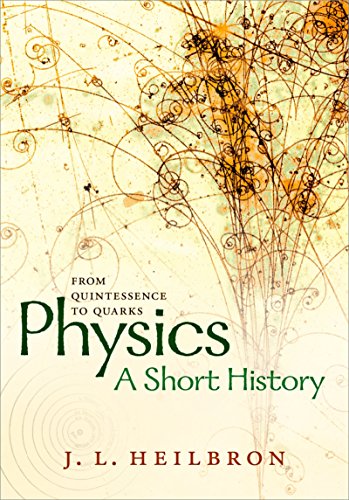
How does the physics we know today – a highly professionalised enterprise, inextricably linked to government and industry – link back to its origins as a liberal art in Ancient Greece? What is the path that leads from the old philosophy of nature and its concern with humankind’s place in the universe to modern massive international projects that hunt down fundamental particles and industrial laboratories that manufacture marvels?John Heilbron’s fascinating history of physics introduces us to Islamic astronomers and mathematicians, calculating the size of the earth whilst their caliphs conquered much of it; to medieval scholar-theologians investigating light; to Galileo, Copernicus, Kepler, and Newton, measuring, and trying to explain, the universe. We visit the ‘House of Wisdom’ in 9th-century Baghdad; Europe’s first universities; the courts of the Renaissance; the Scientific Revolution and the academies of the 18thcentury; the increasingly specialised world of 20th and 21st century science.Highlighting the shifting relationship between physics, philosophy, mathematics, and technology — and the implications for humankind’s self-understanding — Heilbron explores the changing place and purpose of physics in the cultures and societies that have nurtured it over the centuries.
User’s Reviews
Reviews from Amazon users which were colected at the time this book was published on the website:
⭐A well written summary of the history of physics. It needs a timeline summary of dates for easy access. It also needs a compilation of the definitions of less commonly used words. There are some which are in no dictionary which I have.
⭐J.L. Heilbron, much like Mitch Romney’s recent articulate defense of the Republican status quo, says a great deal about nothing very well. The brief and I stress, brief history of physics, is cast as an agnostic’s presentation. Anyone who would quote the morally clueless Nobel Laureate, Steven Weinberg, who claims that understanding the universe is “one of the very few things that lifts human life above the level of farce” is not to be trusted to present a history of physics with any sort of imaginative drama. Lots of interesting bits but in the end, much ado about nothing.
⭐Subtitled ‘From Quintessence to Quarks’ the title cold be ‘From Euclid to Higgs’ as it expostulates the historical relationship of physics with philosophy, religion and especially mathematics. The book traces development through Greeks, Arabs, European and American eras, showing preservation and extensions from each era to the next. The detailed exposition incorporates Euclid, Democritus, Eratosthenes, Avecinna Omar Khayyam, Copernicus, Galileo, Newton and dozens of other contributors. It’s very educational in that I was generally unfamiliar with the Muslim contributors. Among other presentations of scientific principles, there’s a wonderfully explicit theory of tides in about a half a page.Science now delves into religion with both Bohr and Einstein rejecting the concept of a personal deity. Heilbron shows the politicization of science with government subsidies to the SETI investigation and environmental studies and to a large extent the Nobel prize. He ends with the assumption that physics now takes responsibility for outcome of the human story. Is that a reference to the only physical phenomena not mentioned in the book, DNA which has a heavy physics component?Relating modern particle physics to Greek concepts is a bit fanciful, albeit a very interesting presentation. Recent eras have emphasized practical applications, e.g. nuclear energy as well as the search for the TOE and GUTs. There is opportunity for the reader as super symmetry and string theory are not fully understood.Physics today has moved away from individual geniuses to the large subsidized endeavor involving dozens of contributors. It seems the full employment syndrome is alive and well among scientists as with less skilled occupations.
⭐Physics: a short history from quintessence to quarks is a science book meant for both science geeks and layman who want to learn the origins of science. The author takes you back to the Greeks and then on to modern times exploring various great thinkers/scholars/mathematicians/scientists and how they came up with their ideas that changes the man’s relationship the world but also how this knowledge changed the culture and society. It described how this knowledge was built up over time to what it is today. I am a science geek with no science back ground except being a nurse and I found it easy to follow. Parts sounded like a text book but when you are dealing with this much science, some of it has to sound like this, lol. For the most part, it flows well about people, society, discoveries, implications for man, and was well written for anyone. If this is the kind of book you like, you will love this! I reviewed this book for NetGalley.
⭐This is a delightful, easy-to-read book that splits the difference between philosophical and scientific histories of physics. My personal favorites are Erwin Schrödinger’s
⭐for the former, and Isaac Asimov’s
⭐for the latter. It is a western (including Islamic) history, it does not touch on other traditions that did not feed directly into modern physics. It goes beyond purely intellectual aspects to discuss how physics was and is funded, and how it gets involved with politics and wars.The author unearths delightful tidbits such as, “Physics as a career began to take shape: in the early 18th century, century three out of four professors of physics left their chairs, usually to teach and practice medicine; in the late eighteenth century the proportion was reversed, an most professors of physics retired from or died in harness.” Islamic astronomy quickly surpassed Ptolemy and other classical observers due to its need to compute accurately the times of prayers, the direction of Mecca and beginnings and ends of fasts; getting mundane details always exactly right forced more rigorous discipline than the ancients required. The expansion of physics into the Earth sciences (seismology, ionospherics, meteorology and oceanography) is traced to post-WWII requirements for “steering missiles, rockets, space probes, and nuclear submarines, testing nuclear explosives above and under ground and water, monitoring test ban treaties, and searching for uranium and other strategic materials.” As you can probably tell from these quotes, the book moves at breakneck speed.The story is sketched from Thales of Miletus (actually, there is little detail before Aristotle) up to the early 1960s, with a few more recent extensions. More recent physics is represented in the introduction with a discussion of the Large Hadron Collider, and in the last short chapter of modern speculations on the meaning of it all. The books main interest is how physics shapes our view of the universe, but it also covers what shapes the direction of physics including social forces, economics, the pressure of events and dramatic theoretical and experimental discoveries.Of course, this broad a topic in a short book means means only the surface is skimmed. But the author has a deep knowledge, which allows him to illuminate the tale with trenchant details and amusing stories, both of which will stick in your memory longer than lists of facts. And the breadth provides a perspective easily lost in more detailed and narrow histories. I recommend this book to non-physics-lovers who want a quick and painless overview of what everyone should know about the field, and to physics lovers who would like a neat framework to organize deeper knowledge.
⭐All books from J.L. Heilbron are excellent.
⭐The book arrived on time and exactly as described.
⭐This is an amazing book. Firstly, it’s a lovely, tactile hardbound volume, which is just the right size and length to curl up with when one is ready for a good read from a person who, without doubt, knows his onions.Rather than a trip down memory lane, it’s more a walk through the Pantheon of the great, the good and the brilliant amongst the world of science and of Physics, in particular. All the familiar suspects are contained within its slim boundaries from the ancient Greeks, Italians and Muslim thinkers right up to the more modern geniuses; the punter that bored out the cannons, the bloke who sent the kite up in the storm (or I think wanted to!) and the chap that surely must have scribbled Calculus on the back of an envelope when he was bored one afternoon; then, right up to the more modern greats such as Einstein and the work of the modern super colliders and Higgs-Bosun and lot’s in between.For, without doubt there is so much of wonder, of triumph and of challenge in there that it is hard to see how anyone could fail to be impressed. Ultimately, however, and for me, it fails. Unfortunately, it is written not in the ‘crisp elegant prose’ that the jacket promises, but a far more strict and precise style that one struggles to warm to and, most vitally – understand. I appreciate those who retain PhD’s in Physics may well disagree with me, but the story is absolutely wonderful – the prose should have matched this, not subject it to a limited audience. So many complex calculations were presented and flown through that left the reader thinking – ‘just what have a I read’ when it would either have been better to either explain them in more detail or simply say ‘it was discovered that the gravitational pull of the moon would create the tides!’ It was almost as though the whole thing needs margin notes simply to allow one a chance of clarity and continuity. Sadly, it really gets going only at the end, and the last couple of chapters are the best. These should have been the starting point, and the author worked back from there. Also a publisher with the resources of the OUP should have the time to run the manuscript through an English prose filter for the English audience so that my poor mind would not have been tortured by spelling (or otherwise!) of rivalled, spiralled, practised – and lots more words that I am only now getting my head round.More importantly, perhaps we should be, as the author hints be relying on our Physics to understand and establish our place on Earth and the Universe in particular and hopefully before that meteor collides or the sun explodes. Perhaps even more simply, our endeavours should be directed less to blowing each other up and more to discovering a Faster than Light Drive, which could be the real story here. So, despite my somewhat mixed review, many thanks nevertheless.
⭐This book explores the philosophy of physics, rather than physics itself. It looks at the motivations and political and social structures that have guided the science, and as such it is an interesting side angle look at physics.Unfortunately it is not an easy read due to unnecessarily archaic language that leads the reader to a dictionary rather than enlightenment.Take this sentence on page 6:”Although physia ran from astronomy through zoology to psychology, limitation of coverage to cosmology and cosmogony, as in this book, is not unacceptably anachronistic provided we recognise that the same principles of structure and change applied to all natural processes.”If you can stick with it, and that does take some grit, it is a decent 200 page account that is interesting rather than valuable. It does assume a broad amount of basic scientific knowledge. The weak force is introduced without explanation, for example.It could have been a much better book, but isn’t a terrible one. Three stars.
⭐This smart looking green hardback has an attractive cream sleeve and an excellent font on brilliant white paper, making it very easy to read. Of course nothing is really easy to read unless the author is a true wordsmith, but have no fear, Heilborn is a gifted communicator and expresses his thoughts in a very digestible fashion.There are a few photos and illustrations but an excellent ‘further reading’ section as well as a comprehensive index. This is an academic book that would serve undergraduates, or perhaps those about to study Physics at university, and yet it will also serve someone ‘just looking in’ at the subject. Being a history of physics rather than a physics text, this tells much of the back story without any need to understand mathematics.This book starts in ancient Greece amongst the philosophers of Athens and ends at speed around the track at CERN. Drawing in on theological aspects of physics, the author talks us through key turning points that have brought physics to where it is today.Frankly, this book is not a long read, nor is it difficult to read and I would recommend it to anyone interested in the history of science or even philosophy. This is one of those rare reads that whatever your interests, this will spark new ones in you as you process this.Thoroughly recommended!
Keywords
Free Download Physics: a short history from quintessence to quarks in PDF format
Physics: a short history from quintessence to quarks PDF Free Download
Download Physics: a short history from quintessence to quarks 2015 PDF Free
Physics: a short history from quintessence to quarks 2015 PDF Free Download
Download Physics: a short history from quintessence to quarks PDF
Free Download Ebook Physics: a short history from quintessence to quarks