Ebook Info
- Published: 2002
- Number of pages: 320 pages
- Format: PDF
- File Size: 2.19 MB
- Authors: Roland Omnès
Description
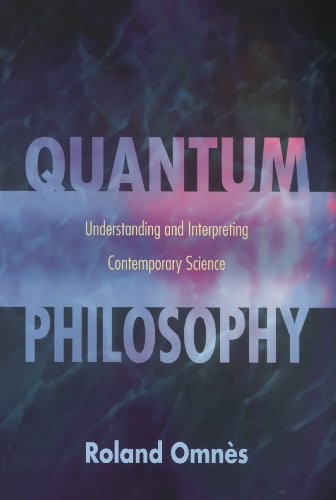
In this magisterial work, Roland Omnès takes us from the academies of ancient Greece to the laboratories of modern science as he seeks to do no less than rebuild the foundations of the philosophy of knowledge. One of the world’s leading quantum physicists, Omnès reviews the history and recent development of mathematics, logic, and the physical sciences to show that current work in quantum theory offers new answers to questions that have puzzled philosophers for centuries: Is the world ultimately intelligible? Are all events caused? Do objects have definitive locations? Omnès addresses these profound questions with vigorous arguments and clear, colorful writing, aiming not just to advance scholarship but to enlighten readers with no background in science or philosophy. The book opens with an insightful and sweeping account of the main developments in science and the philosophy of knowledge from the pre-Socratic era to the nineteenth century. Omnès then traces the emergence in modern thought of a fracture between our intuitive, commonsense views of the world and the abstract and–for most people–incomprehensible world portrayed by advanced physics, math, and logic. He argues that the fracture appeared because the insights of Einstein and Bohr, the logical advances of Frege, Russell, and Gödel, and the necessary mathematics of infinity of Cantor and Hilbert cannot be fully expressed by words or images only. Quantum mechanics played an important role in this development, as it seemed to undermine intuitive notions of intelligibility, locality, and causality. However, Omnès argues that common sense and quantum mechanics are not as incompatible as many have thought. In fact, he makes the provocative argument that the “consistent-histories” approach to quantum mechanics, developed over the past fifteen years, places common sense (slightly reappraised and circumscribed) on a firm scientific and philosophical footing for the first time. In doing so, it provides what philosophers have sought through the ages: a sure foundation for human knowledge. Quantum Philosophy is a profound work of contemporary science and philosophy and an eloquent history of the long struggle to understand the nature of the world and of knowledge itself.
User’s Reviews
Reviews from Amazon users which were colected at the time this book was published on the website:
⭐Professor Omnes (University of Paris XI) is one of France’s noted experimental physicists today. “Quantum Philosophy” is a poetic narrative of science from Ancient Greece to contemporary Quantum Mechanics is written with literary elegance which Arturo Sangalli’s translation has preserved.Although there are no equations, this book is not for the beginner. Omnes alludes to people, theories, events and ideas, which if not already known would remain quite mysterious. For the informed philosopher of science it is an insightful account of the main developments leading up to 20th Century formalism and the triumph of mathematics which was necessary to heal the fracture brought about by the post-intuitive sciences of Einstein, Bohr, Godel, Cantor and Hilbert.
⭐It is refreshing to read that classical physics and common sense should be explained from quantum physics, instead of trying to explain and understand qm in ordinary language. (For half a century I have considered classical physics and common sense to be approximations but have recently been surprised to find that even some good physicists fail to start from that assumption.)On the other hand Omnes doesn’t really address the most difficult problem: Since the Schrodinger equation is deterministic, where do the probabilities come from? He therefore misses the importance of the observer. His conclusions are good about EPR, but I don’t like his discussion of it much. He doesn’t see that EPR implies quantum superposition of macroscopic objects. He also makes a related mistake I have seen elsewhere: he thinks it is de-coherence that keeps one from seeing Everett’s other worlds, when in fact the explanation is much more basic than that. It follows simply from the linearity of Schrodinger’s equation. Decoherence affects the probabilities by preventing two paths to lead to the same outcome, but it in no way affects the individual outcomes.On page 124 there is a common misconception: “From now on, all physicists will rest on even more formal principles which often preclude any intuitive interpretation, when they do not openly defy common sense, or what we believe common sense to be.” Modern physics certainly defies common sense, but it is intuitive to physicists, just as mathematics is intuitive to mathematicians. As physics becomes more abstractly mathematical, it does not stop being intuitive, physical intuition becomes less like common sense and more like mathematical intuition. (A ”New Yorker” article on mathematicians vividly explained, to the rest of us, how intuitive pure mathematics is.)
⭐There are many books that aim to explain quantum mechanics to the general public, but Omnes takes a different tack. His goal is nothing less than to provide a scientific foundation for a new philosophy of knowledge (epistemology). This is a big job, and Omnes, a French physicist who has contributed to the theory of quantum decoherence, deserves a gentleman’s “C” for making the attempt. Potential readers must be warned, however, that Omnes – quite astonishingly as a physicist writing for a (presumably) non-technical audience – does not take time to explain the concepts of quantum mechanics (wave function, superposition, decoherence, etc.) which are essential to understanding his discussion. Because of this, it is highly recommended that before tackling Omnes, readers should at least have read a serious popular treatment such as Gribbin or Nick Herbert (to name only two of many).The book under review is the 1999 hardcover translation of Roland Omnes’ “Philosophie de la science contemporaine” (“Philosophy of Contemporary Science”), which was written in 1994. A 2002 paperback edition is also available. The book is about 290 pages long. It contains a glossary and index, but does not contain footnotes or a bibliography.The first half of the book tells a well-known story of the rise of empirical physics and mathematics (other sciences are not considered) from the Pre-Socratics through the 18th century in Europe, followed by the triumph of formalism in the 19th century and the first startling developments in 20th century physics. While perceptively and gracefully told, such a rapid review of the history of science has to suffer by the speed with which the author covers 2,000 years of scientific developments.The second half of the book moves to the present in discussing the implications of quantum mechanics towards the foundations of a new theory of knowledge. These chapters read like a series of interconnected essays, which circle around some rather big ideas: (1) it is possible to recover common-sense knowledge about ordinary objects from the formalism of quantum mechanics, (2) the theory of quantum decoherence is sufficient to dispose of certain well-known problems, such as Schroedinger’s Cat, that result from naively applying quantum superposition to classical objects, and (3) there are two kinds of metaphysical entity: a Logos, as represented by mathematics and logic, and a Reality, as represented by physics.Omnes’ key point in all of this, is that the future theory of knowledge will be solidly grounded on a firm scientific basis; but he himself admits that the presentation in this book is only the start of a sketch of such a grand plan.In summary, while I found some things of interest in the book, and appreciated its graceful and literate writing style, I was put off by a general superficiality and incompleteness of treatment, an inadequate explanation of concepts, and especially by the author’s unfortunate and all too frequent resort to bald “proof by assertion” instead of the discussion, give-and-take, and scholarly references which are expected even in a popular or semi-popular work.
⭐Quite simply, this may be one of the best books in recent history,on quantum theory and its role in the philosophy of science. Theauthor, admirably, does not insult his reader by leaving out theimportant mathematics needed to make quantum theory comprehensible.Neither are mathematical models left to speak for themselves; rather,the meaning of the theory is carefully and skillfully guided throughthe abstract symbols.Honors should also go to translator. One never feels that this easyto read book was ever written in any language but English.
⭐Just not very good.
Keywords
Free Download Quantum Philosophy: Understanding and Interpreting Contemporary Science 1st Edition in PDF format
Quantum Philosophy: Understanding and Interpreting Contemporary Science 1st Edition PDF Free Download
Download Quantum Philosophy: Understanding and Interpreting Contemporary Science 1st Edition 2002 PDF Free
Quantum Philosophy: Understanding and Interpreting Contemporary Science 1st Edition 2002 PDF Free Download
Download Quantum Philosophy: Understanding and Interpreting Contemporary Science 1st Edition PDF
Free Download Ebook Quantum Philosophy: Understanding and Interpreting Contemporary Science 1st Edition