Ebook Info
- Published: 2007
- Number of pages: 208 pages
- Format: PDF
- File Size: 1.75 MB
- Authors: Tim Maudlin
Description
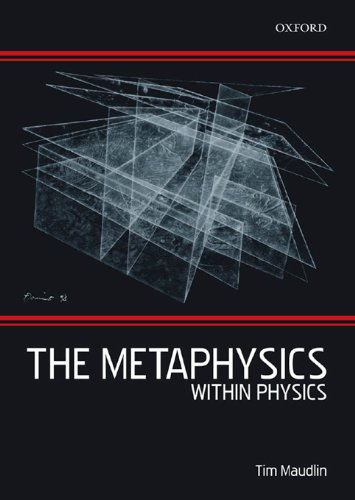
What fundamental account of the world is implicit in physical theory? Physics straightforwardly postulates quarks and electrons, but what of the more intangible elements, such as laws of nature, universals, causation and the direction of time? Do they have a place in the physical structure of the world?Tim Maudlin argues that the ontology derived from physics takes a form quite different from those most commonly defended by philosophers. Physics postulates irreducible fundamental laws, eschews universals, does not require a fundamental notion of causation, and makes room for the passage of time. In a series of linked essays The Metaphysics Within Physics outlines an approach to metaphysics opposed to the Humean reductionism that motivates much analytical metaphysics.
User’s Reviews
Reviews from Amazon users which were colected at the time this book was published on the website:
⭐You don’t find out until after you buy it that this is a collection of old published papers repackaged as a book. Normally such a deception would get an automatic 2 rating. There have to be consequences for dishonesty. But in this case I will make an exception.The papers hang together well. The lack of a need for ontological reductionism. The limitations of Humean style dogmas. The non seperability inherent in quantum theory and its challenges for traditional ontologies. The inconsistency of fibre bundles and gauge theories with a lot of traditional ‘metaphysical’ concepts and assumptions – which means tough luck for the traditional concepts and assumptions. Some discussions on counter factual and causation and on the possibility or otherwise if time travel. I was hoping/looking for more on the perplexities of quantum theory – other than the non seperability (entanglement ) which is already perplexing enough. But you don’t always get everything you want.His approach generally is that the physics is a given. The discussion/analysis comes after this. But not entirely. Which sounds about right.Bubbling over with questions, ideas and curiosity. Open minded. No dogmatic assertions of what MUST be the case here.Great to read. What’s not to love.
⭐In The Metaphysics within Physics, Tim Maudlin not only illuminates but also entertains. For example, commenting on Ockham’s Razor, he says “if the universe has been profligate, then the Razor will lead us astray…. If the ontology that arises most naturally from reflection on physics is too rich for Ockham or Hume or Lewis, then so much the worse for them. Let others subsist on the thin gruel of minimalist metaphysics: I’ll take my ontology mit Schlag.”Three of his discussions particularly interested me:(1) He examines the presupposition, made in classical physics, that the physical state of the world is “separable,” that is, “decomposable into small bits laid out in space or time” or “determined entirely by the spatio-temporal dispositions of bodies, their intrinsic physical properties (such as charge and mass), and the values of fields at all points in space through time” and then shows that that is not presupposed in quantum theory.(2) He discusses how to analyze causation (parts of this discussion will remind readers who are lawyers of the famous Palsgraf case in torts) and that under presuppositions of non-Newtonian physics, questions of causation arise differently or not at all.(3) He examines the passing of time.My only criticisms are:Since he insists that current physical theory implies laws of nature or “fundamental laws of temporal evolution” (FLOTEs), I had hoped that he would specify them. What, specifically, are the fundamental laws of nature presupposed by practicing physicists today? Other than two Newtonian laws of motion (regarding inertia and force), the principle that time passes, and several “adjunct principles needed to fill out the FLOTEs in particular contexts,” for example, Newton’s third law of motion and law of gravitation, Schrödinger’s equation, the Hamiltonian operator H in quantum mechanics, and the superselector rules of quantum mechanics (each of which adjunct principles he mentions without elaboration), Professor Mauldin does not specify the laws. Perhaps he assumes his readers know what the unspecified laws are. Or, perhaps there are too many fundamental laws to specify in just one or two essays.He mentions that some FLOTEs are deterministic whereas others are probabilistic, applying to randomly determined systems/processes. I had hoped that (in addition to specifying these FLOTEs) he would discuss whether, and if so, in what contexts and for purposes of what problems, today’s physicists presuppose both deterministic laws and probabilistic laws. Do they presuppose deterministic laws only in/for particular contexts/problems and presuppose probabilistic laws only in/for other contexts/problems (for example, in quantum mechanics)? Or, are there some contexts/problems in/for which physicists — the same physicists, not different groups of physicists — presuppose both deterministic laws and probabilistic laws? Again, he may assume that his readers already know all this. (In any case, it appears that those who do presuppose random processes and related probabilistic laws do so only if they also take as givens some fixed constraints, for example, a particular setup of a lab.)To sum up: the title, “The Metaphysics within Physics,” suggested that he would not just argue that there is a metaphysics within today’s physics but would also say (in some detail) what that metaphysics is.It may be that he has been doing that in his subsequent books. In 2019, Professor Maudlin published an excellent book on philosophy of quantum mechanics. In that book, he focuses more on the question what does quantum theory imply about “what there is” (in particular, what microscopic local elements) than on “what are the laws of how it behaves”. But, he does address in detail quantum theory’s mathematical techniques for making predictions about the outcomes of experiments. Perhaps for quantum mechanics those are the fundamental “laws.” In 2012, he published a book on philosophy of space and time (relativity), which I haven’t yet read. Perhaps he specifies some of today’s physics’ fundamental laws there. I’ll read it and see!
⭐Maudlin demonstrates the fallacy of the philosophical position of empiricism (of the Humean kind) by addressing a number of key questions and fundamental issues in both physics and philosophy having to do with the nature of reality and existence (ontology). Time, causality and the properties of objects are among the topics that Maudlin covers in criticizing empiricism. Maudlin has degrees in physics and philosophy and the manner in which he plumbs examples in physics to make his philosophical points is both compelling and stimulating.
⭐Maudlin’s Metaphysics within Physics sweeps away some of the philosophical cobwebs that entangle anyone trying to develop a coherent metaphysical position. A few threads in that web are Kant, Hume, Carnap, Lewis, empiricism, logical positivism, etc.The book pulls together five essays of the author on causation, time and laws of nature. It is argued that traditional philosophical ontologies must yield to scientific descriptions of nature, whenever these descriptions do not translate well into the traditional framework. The Humean picture of a vast mosaic of local matters of fact — instantiated at points — should be replaced by a global structure with non-local connections. In Maudlin’s picture, scientific laws and the direction of time are fundamental and are not suitable for philosophical analysis.My favorite essays were “Suggestions for Deep Metaphysics” which describes the metaphysical implications of gauge theories, and “Causation, Counterfactuals, and the Third Factor”, which demolishes the counterfactual analysis of causation due to David Lewis. The counterfactual treatment has always seemed like rubbish to me, and I never understood its popularity among philosophers.The best quote followed a critique of Occam’s Razor (p 4). “Let others subsist on the thin gruel of minimalist metaphysics: I’ll take my ontology mit Schlag.” — a good motto for those who are not attracted to weird deflationary and minimalist philosophies.
⭐Good critique of humean supervenience
⭐Maudlin presents six papers that are deeply interconnected. He both critiques contemporary metaphysical stances – especially Humeanism – and contrasts them with his own stance, which he urges is inspired by contemporary physics. Maudlin argues that Humeanism, conversely, has no real connection with modern science (as `admitted’ by e.g. Lewis). Instead, he (Maudlin) proffers his own `modest proposal’ i.e. “laws of nature ought to be accepted as ontologically primitive” [p.15]. He also represents this “at the conceptual level” [ibid], presumably to make analytic philosophers happy, i.e.: “the idea of a law of nature is not logically derived from, and cannot be defined in terms of, other notions.” Thus all the ways something can physically be are constrained by fundamental patterns. These patterns do not really `govern’ as such, they are primitive. He further casts doubt on Lewis’ approach by pointing out it essentially makes use of the principle of Separability (whereby the complete physical state of the World is determined by, or supervenes on, the intrinsic physical state of each ST point and the relations therein [c.f. pp. 51 – 61]); Maudlin then argues this principle is doubtful given the main interpretations of QM.The papers tackle many themes at the forefront of physics research, as well as those topics that clearly intersect with traditional metaphysical themes. An example of the latter is Maudlin’s treatment of time – he doesn’t really connect with discussions of a tensed versus tenseless universe, however he both argues that common sense intuitions about causality don’t appear in physics (i.e. no causality, a la Russell) whereas a fundamental time (i.e. the evolutionary unit over which we evolve a system or state) is thus present in fundamental physics. So: there is a direction of time, but no causality in the conventional sense. There are some interesting collieries to this view in the later papers, including the contentious claim that mathematical objects are not fit to represent the passage of time.He concludes that explanation in physics has essentially to do with how a state was produced (hence fundamental time-directionality), yet the Humean Mosaic* has no such historical evolution, thus is disconnected from the essentials of explanation. Perhaps Maudlin doesn’t really consider the D-N model of laws (and explanation) sufficiently, however.I found the book highly readable, clear, convincing, and concise. Maudlin presents a compelling metaphysic whereby time-evolution and the laws of physics are primitive in both the physical and conceptual sense. He also offers criticisms of Humeanism that anyone who believes ones metaphysics ought to be informed by real science will find very persuasive.* The Humean view whereby the universe is composed of local matters of fact, “just one thing after another”.
⭐A good book but very technical in parts you really need to know your subject before you try this book!
⭐As I wish, a quick delivery and good product as requested. Well done job, always I will use and recommend this seller.
Keywords
Free Download The Metaphysics Within Physics 1st Edition in PDF format
The Metaphysics Within Physics 1st Edition PDF Free Download
Download The Metaphysics Within Physics 1st Edition 2007 PDF Free
The Metaphysics Within Physics 1st Edition 2007 PDF Free Download
Download The Metaphysics Within Physics 1st Edition PDF
Free Download Ebook The Metaphysics Within Physics 1st Edition