

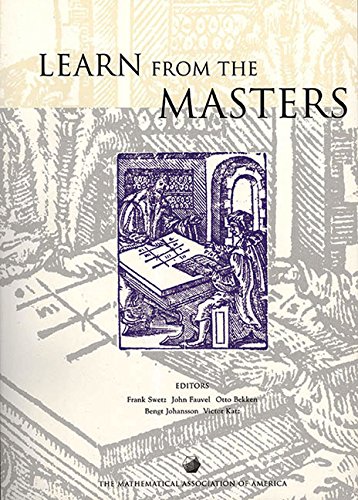
Ebook Info
- Published: 1997
- Number of pages: 311 pages
- Format: PDF
- File Size: 33.81 MB
- Authors: Frank Swetz
Description
This book is for high school and college teachers who want to know how they can use the history of mathematics as a pedagogical tool to help their students construct their own knowledge of mathematics. Often, a historical development of a particular topic is the best way to present a mathematical topic, but teachers may not have the time to do the research needed to present the material. This book provides its readers with historical ideas and insights which can be immediately applied in the classroom. The book is divided into two sections: the first on the use of history in high school mathematics, and the second on its use in university mathematics. The articles are diverse, covering fields such as trigonometry, mathematical modeling, calculus, linear algebra, vector analysis, and celestial mechanics. Also included are articles of a somewhat philosophical nature, which give general ideas on why history should be used in teaching and how it can be used in various special kinds of courses. Each article contains a bibliography to guide the reader to further reading on the subject.
User’s Reviews
Editorial Reviews: Book Description How to use history to teach mathematics; for high school and college teachers.
Reviews from Amazon users which were colected at the time this book was published on the website:
⭐Good book, good quality. Better than my expectation.
⭐Good book
⭐I’m reading selections from the book as borrowed from the library but will be buying a copy for my personal collection. I was drawn to the book for their historical discussion of logarithms as it applies to teaching them in the classroom and I think the material is very good. Plenty of references for further reading and good advice on teaching. In particular I like a recommendation in Chapter 4 that the teacher be careful of using examples that are “too simple” as it may trivialize the process and the past. In any event, there are a number of other chapters I look forward to reading and using to develop in class materials. My only complaint is one of omission. Both chapters on the historical context of logarithms refer to astronomical calculations, geodesy and navigation as a motivation for the creation of log tables. It would have been nice if a chapter were included introducing the reader to those problems with a bibliography.
⭐
Keywords
Free Download Learn from the Masters (Classroom Resource Materials) in PDF format
Learn from the Masters (Classroom Resource Materials) PDF Free Download
Download Learn from the Masters (Classroom Resource Materials) 1997 PDF Free
Learn from the Masters (Classroom Resource Materials) 1997 PDF Free Download
Download Learn from the Masters (Classroom Resource Materials) PDF
Free Download Ebook Learn from the Masters (Classroom Resource Materials)