

Ebook Info
- Published: 2010
- Number of pages: 214 pages
- Format: PDF
- File Size: 1.95 MB
- Authors: Robert H. Sanders
Description
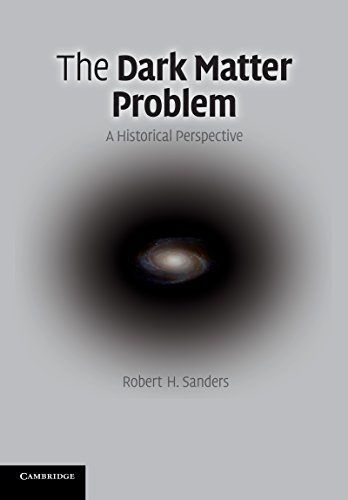
Most astronomers and physicists now believe that the matter content of the Universe is dominated by dark matter: hypothetical particles which interact with normal matter primarily through the force of gravity. Though invisible to current direct detection methods, dark matter can explain a variety of astronomical observations. This book describes how this theory has developed over the past 75 years, and why it is now a central feature of extragalactic astronomy and cosmology. Current attempts to directly detect dark matter locally are discussed, together with the implications for particle physics. The author comments on the sociology of these developments, demonstrating how and why scientists work and interact. Modified Newtonian Dynamics (MOND), the leading alternative to this theory, is also presented. This fascinating overview will interest cosmologists, astronomers and particle physicists. Mathematics is kept to a minimum, so the book can be understood by non-specialists.
User’s Reviews
Reviews from Amazon users which were colected at the time this book was published on the website:
⭐I was hoping this book would live up to its title and be a historical account of the dark matter problem. But as seems to happen too frequently, this is a retired astronomer’s account of his own experience in the field–as fraught as any such perspective inevitably is. In the end the account lacks the context, detail, depth and perspective which are so crucial to historical scholarship. It does provide the chronology of significant moments in the development of the science, but that by itself does not provide historical understanding.
⭐This is a well written, very informative account for the general public. It has 8 Appendices and most of the maths is relegated to them. I wonder if the book would be intelligible if one didn’t already have the background summarized in these appendices, or wasn’t willing to read through them. In any case, the arguments are very clearly presented, and there are numerous excellent illustrative pictures and figures. The book was published in 2010. Since then some things in the book have changed: the interpretation of the Pioneer anomaly, the results of the Hadron collider, etc. Sanders does have a more recent book, Deconstructing Cosmology.
⭐This book is a remarkably balanced look at the Dark Matter question, and it should give some pause to those who accept Dark Matter as a given. As a scientist who spent many hours over lunch discussing the ramifications of dark matter with Vera Rubin, my worry today is that the host of questions associated with our inability to observe dark matter directly are being shunted aside in an uncritical bandwagon effect that is scientifically disturbing.
⭐Got book within time and of good quality.
⭐The book is very well written in a non technical manner, but covers a lot of material relating to dark matter.
⭐Fantastic book in excellent brand new condition!!
⭐Robert Sanders explains how astronomers arrived at the conclusion that we cannot see 95 percent of the content of the universe. But he goes much deeper into the theoretical and observational problems. This is done in a nontechnical way and from a historical perspective.The most compelling evidence for dark matter is the absence of a decay in rotational velocity in the outer parts of spiral galaxies, as predicted by Newton’s law of gravitation. Consequently, the major part of the book is dedicated to those “flat” rotation curves, their systematics, riddles and still poorly understood features.Since the author actively took part in that research field for decades, it is particularly interesting to follow the complete story of its development, a coevolution of observations and theoretical models. Though Sanders confesses a certain sympathy for alternative gravity theories, the observational material is not biased and the reader is left to draw his own conclusions. As a bonus however, he describes how humans tend to develop theories, the social component of science.Most importantly, the author raises questions about scientific methodology: is the whole concept falsifiable, as long as we explain astrophysical non-detection with increasingly exotic properties of dark matter particles? Can the existence of such particles ever be disproved, if the theoretical predictions, after being unconfirmed by existing accelerators, squeeze out towards higher energies?To summarize, the book is a pleasantly readable survey of the dark matter idea for the interested layman, a treasure for the galactic astronomer and a must-read for the cosmologist who is convinced that the dark matter problem consists of adding more decimals to a number calculated from the power spectrum of the cosmic microwave background.Highly recommended!
Keywords
Free Download The Dark Matter Problem: A Historical Perspective in PDF format
The Dark Matter Problem: A Historical Perspective PDF Free Download
Download The Dark Matter Problem: A Historical Perspective 2010 PDF Free
The Dark Matter Problem: A Historical Perspective 2010 PDF Free Download
Download The Dark Matter Problem: A Historical Perspective PDF
Free Download Ebook The Dark Matter Problem: A Historical Perspective