Ebook Info
- Published: 1978
- Number of pages: 190 pages
- Format: PDF
- File Size: 10.13 MB
- Authors: Richard S. Westfall
Description
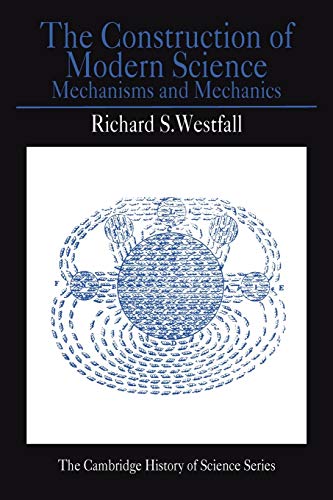
This introduction to the history of science in the seventeenth century examines the so-called ‘scientific revolution’ in terms of the interplay between two major themes. The Platonic-Pythagorean tradition looked on nature in geometric terms with the conviction that the cosmos was constructed according to the principles of mathematical order, while the mechanical philosophy conceived of nature as a huge machine and sought to explain the hidden mechanisms behind phenomena. Pursuing different goals, these two movements of thought tended to conflict with each other, and more than the obviously mathematical sciences were affected – the influence spread as far as chemistry and the life sciences. As this book demonstrates, the full fruition of the scientific revolution required a resolution of the tension between the two dominant trends.
User’s Reviews
Editorial Reviews: Book Description This book examines the interplay between the Platonic-Pythagorean tradition and the mechanical philosophy during the ‘scientific revolution’.
Reviews from Amazon users which were colected at the time this book was published on the website:
⭐Amazing book. As Westfall states “Science history is really the history of ideas.” This book explains the thought processes behind the great (and not so great) ideas of relevant scientists of the 16-18th centuries. I’ve been looking for a science history book that wasn’t just full of trivial information and this book is so much more than that. I strongly recommend it to anyone who’s ever wondered what Newton, Galileo and others thought about the universe.
⭐Classical antiquity and the Greek and Roman worlds are the source of and foundation of modern science. Without Aristotle, Pythagoras, Democritus, Ptolemy, Vitruvius, Archimedes, Ptolemy and many others we would not have Newton, Malpighi, Leibniz, Kepler, Galileo, Descartes, Copernico or Einstein.In this sense this book is a very interesting journey through the development of the Modern Science, and its countless obstacles to surmount with the Status Quo of different ages and historical momentsAlbert Einstein stated once “The science without religion is cripple but the religion without science is blind.”Totally recommended.
⭐This book really is a great introduction to the scientific revolution of the 17th century. It’s part of a series of books called “History of Science Series” and is dedicated to bringing the history of science to a wider audience. It presents the general reader with an accurate, short narrative and analysis of the scientific revolution of the 17th century. Unlike other books on this subject it does not require the reader to be familiar with a lot of technical background knowledge.Two major themes dominated the period covered in the book; the Platonic-Pythagorean tradition, which looked on nature in geometric terms, and the mechanical philosophy, which conceived of nature as a huge machine and sought to explain the hidden mechanisms behind phenomena. These themes run through the various chapters of the book. Starting out in the first chapter with the copernican revolution in astronomy (the heliocentric theory) it shows how two men, Kepler and Galileo, reformed the theory and opened up new questions for the comming century. The following chapters cover the various sciences such as mechanics, chemistry and biology. After an interluding chapter covering the organization of the scientific enterprise (showing that universities were not always the principal centers of scientific research) it ends with two chapters in which the two themes mentioned above are drawn together and ultimately lead to the discovery of Newton’s laws, solving major problems opened up at the beginning of the century.I had to read this book as part of a course at the university where I study. I enjoyed the book (and the course) a lot (which I don’t say verry often) even though it doesn’t have anything to do the primary subject of my study, business information technology. If you’re at all ‘science minded’ this book is a must. You wont regret purchasing it.
⭐Good introduction to the history of early modern science. Historiographically a little dated and therefore lacking in the thorough treatment of the broader social and political origins of science in this time period. Still, it is a classic.
⭐Good
Keywords
Free Download The Construction of Modern Science: Mechanisms and Mechanics (Cambridge Studies in the History of Science) in PDF format
The Construction of Modern Science: Mechanisms and Mechanics (Cambridge Studies in the History of Science) PDF Free Download
Download The Construction of Modern Science: Mechanisms and Mechanics (Cambridge Studies in the History of Science) 1978 PDF Free
The Construction of Modern Science: Mechanisms and Mechanics (Cambridge Studies in the History of Science) 1978 PDF Free Download
Download The Construction of Modern Science: Mechanisms and Mechanics (Cambridge Studies in the History of Science) PDF
Free Download Ebook The Construction of Modern Science: Mechanisms and Mechanics (Cambridge Studies in the History of Science)