Ebook Info
- Published: 1993
- Number of pages: 76 pages
- Format: PDF
- File Size: 16.66 MB
- Authors: Steven G. Krantz
Description
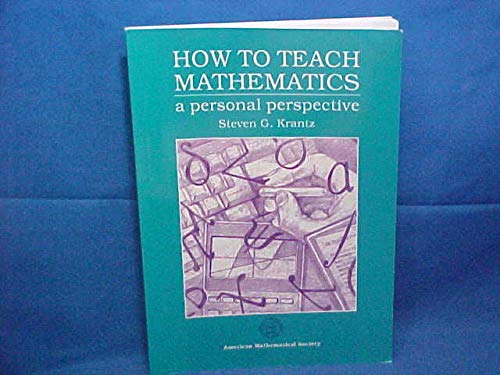
This expanded edition of the original bestseller, How to Teach Mathematics, offers hands-on guidance for teaching mathematics in the modern classroom setting. Twelve appendices have been added that are written by experts who have a wide range of opinions and viewpoints on the major teaching issues. Eschewing generalities, the award-winning author and teacher, Steven Krantz, addresses issues such as preparation, presentation, discipline, and grading. He also emphasizes specifics–from how to deal with students who beg for extra points on an exam to mastering blackboard technique to how to use applications effectively. No other contemporary book addresses the principles of good teaching in such a comprehensive and cogent manner. The broad appeal of this text makes it accessible to areas other than mathematics. The principles presented can apply to a variety of disciplines–from music to English to business. Lively and humorous, yet serious and sensible, this volume offers readers incisive information and practical applications.
User’s Reviews
Reviews from Amazon users which were colected at the time this book was published on the website:
⭐I am only on the first chapter and am enjoying this book to no end. I’ve been teaching like this my whole career. I can hardly wait to finish reading it.
⭐This book is mostly for new math teachers, contains some tips about board work, making tests. Not that innovative, but still a good read. Really more for college teachers than K12.
⭐This book is well worth reading from start to finish for a starting college instructor who hasn’t taught in North America before. An instructor who has been educated in North America has experience with standard ways instructors present material and is familiar with the expectations that students have for university courses, and will not benefit as much from reading this book. Much of the material in the book is obvious to someone who is reflective about their teaching and aware while teaching (you should have some feeling for a room, at a minimum to sense from pained faces if the students are not absorbing anything). The essays appended to Krantz’s book are mixed but several are well worth reading even by instructors who have taught for years.I assert that the biggest psychic obstacle to learning is thinking that your level of talent in a subject is fixed like fingerprints. Students should be explicitly told not to feel pride for mastering something with little practice, and should also be explicitly told not to feel shame for doing terribly at something when they first try it. I think it is one reason why students don’t work as much as they could on mathematics.The book seems to me to pose the following dilemma: either an instructor speaks and writes notes on a board that cover the material in the course, or students work in groups and the instructor probes them and gives them targeted help. I have two alternatives. One is tell students what to read in a textbook, so that the instructor might never mention some topics for which the students will nevertheless be responsible. The instructor could then focus just on the harder and more unifying ideas in the subject and repeat them several times. For example, I am certain it would benefit many students in a course on multivariable calculus to present the same proof of the implicit function theorem more than once, to help the students really chew on it. This is certainly how I read, and I don’t see why it can’t be how I am spoken to.A second alternative is repetition. My only serious experience of this was in my grade 10 Latin class, in which Magister Parker would have us conjugate verbs and decline nouns aloud. Drill is almost universally unpopular today. For series convergence tests in a first year calculus course, I think that the class saying them aloud would make students feel more personally involved and would help them remember the material better than doing “everyone find a partner” activities. From “Stand and Deliver”: “A negative times a negative equals a positive!” I feel like our instinct now is that this is silly and perhaps even demeaning, but I think there is no satisfying reason for this uneasiness and it should be overcome, like a fear of public speaking, applying for a job, or using a locker room shower.
⭐This book is fairly useful, but I want to comment on some things that annoyed me.Krantz is critical of teaching substantial applications such as Kepler’s laws and predator-pray systems in calculus classes, for this reason:”How will you test them on this material? Can you ask the students to do homework problems if their understanding is based on such a presentation?” (pp. 29-30)The direction of implication is deeply alarming: by *assuming* the mode of examination, Krantz *infers* what material is to be taught. Apparently he does not see a problem with this.Here is an example where Krantz is trying to teach us how to “answer awkward questions in a constructive manner”:”Q: Why isn’t the product rule (fg)’=f’g’? The answer is not ‘Here is the correct statement of the product rule and here is the proof.’ Consider instead how much more receptive students will be to this answer: Leibniz, one of the fathers of calculus, thought that this is what the product rule should be. … Because we have the language of functions, we can see quickly that Leibniz’s first idea for the product rule could not be correct. If we set f(x)=x^2 and g(x)=x then we can see rather quickly that (fg)’ and f’g’ are unequal. So the simple answer to you question is that the product rule that you suggest gives the wrong answer. Instead, the rule (fg)’=f’g+g’f gives the right answer and can be verified mathematically.” (p. 17)Krantz’s answer is worse than the dummy answer he is trying to improve upon. It perpetuates the highly misleading myth that “the language of functions” has some mysterious power to make insights appear. This is nonsense. Leibniz’s error was due to haste and negligence, not a lack of the talismanic power of “the language of functions.” He grasped the counterexample just as well as we do.And how is Krantz’s “that formula is wrong, this is right” any better than the original “here’s the right one, and here’s the proof”? In fact, it is much worse, since if the student did not already know that his formula was wrong and the other one right he could not even have asked the question in the first place.My answer to the question would be as follows. The calculus is not a game of formulas so one should not expect to find the right answer by such considerations. The misunderstanding (fg)’=f’g’ stems from thinking of (fg)’ as a string of symbols rather than the idea that it represents. What is this idea? We can think of it like this. fg is the area of a rectangle with sides f and g. (fg)’ means d(fg)/dx, the rate of change of this area with respect to x. So let’s say that x changes by dx. What happens to the rectangle fg? The sides increase by df and dg respectively, so the change in area is (df)g+(dg)f+(df)(dg). The last term can be neglected since it is infinitely small compared to the others. Dividing by dx then gives the answer.
⭐The author’s focus is on college teaching, but is also readily applicalbe to high school or other secondary teaching. Chapters include fundamentals such as how to lecture and other pedagogical ideas, to extremely practical items such as writing and grading tests and tutoring. Many ideas are presented for immediate adapting/absorbing into your own teaching framework. Being a high school calculus teacher, I was entertained by the glimpse this book provides of a college or university teaching situation. This book is readily available from the American Mathematical Society at ams.org.
⭐Good book!However, I find it strange that almost all reviewers have not bought this book.I bought this book at a local college book store.
⭐Well researched and documented. Bibliography and references are very helpful. A great book for novices and experienced teachers alike.
Keywords
Free Download How to Teach Mathematics: A Personal Perspective in PDF format
How to Teach Mathematics: A Personal Perspective PDF Free Download
Download How to Teach Mathematics: A Personal Perspective 1993 PDF Free
How to Teach Mathematics: A Personal Perspective 1993 PDF Free Download
Download How to Teach Mathematics: A Personal Perspective PDF
Free Download Ebook How to Teach Mathematics: A Personal Perspective