

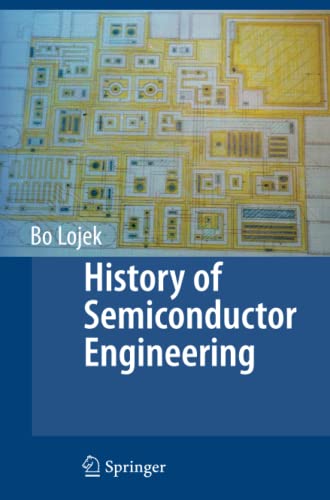
Ebook Info
- Published: 2007
- Number of pages: 400 pages
- Format: PDF
- File Size: 15.25 MB
- Authors: Bo Lojek
Description
This book provides a unique account of the history of integrated circuit, the microelectronics industry and the people involved in the development of transistor and integrated circuit. In this richly illustrated account the author argues that the group of inventors was much larger than originally thought. This is a personal recollection providing the first comprehensive behind-the-scenes account of the history of the integrated circuit.
User’s Reviews
Editorial Reviews: Review From pre-publication reviews”Your book is going to make a major contribution to semiconductor history. You and I agree that, while the world loves a hero, semiconductor progress depended on the efforts and ideas of a large number of people, and that moving forward depended on contributors going back a few decades in some cases. Also, as is the case with most inventions, a number of people with access to the same pool of common knowledge were working independently at the same time to put it all together and to make the necessary extensions to the existing technology and who realized that the time was right for society to accept the new concepts. Your diligent research points all this out.” Dr. Jay Last, former Shockley Laboratories employee, co-founder of Fairchild Semiconductor, co-founder of Amelco Semiconductor, and manager of the Fairchild’s group which design and produced the world first planar integrated circuit”Bo Lojek presents a remarkable document of the most important and significant technical development of our times. He describes in astounding detail the engineering efforts of modern microelectronics. He concentrates on the history of silicon semiconductor devices. California’s “Silicon Valley” is the center of attention, together with its ancestry of transistor invention at Bell Laboratories. He has collected a wealth of illustrative documentation, gives incisive insight into the lives of the main actors and shows the often tragic fates of the engineers and businessmen. He does not hide his firm believe in the individual engineer and warns of the retarding influence of present-day political correctness.” Dr. Hans J. Queisser, former Shockley Semiconductor scientist and retired director of the Max-Planck-Institute for Solids, Stuttgart”The technical history of the semiconductor industry rivals the 1849 California Gold Rush as a period filled with excitement and opportunity. Although I cannot first hand validate its complete accuracy, I enthusiastically encourage you to read the collected facts, opinions, and views of an author who was actually part of this amazing period, viewing it as a successful practicing Engineer during this “gold rush” like hay-day of the semiconductor industry.For educators and technologists you will find this collection of data, facts, and opinions, collected and observed first hand by the author, fascinating! It is a tough read for others due to the writing experience of the author and its technical focus.” John F. Gifford, former Fairchild Semiconductor Marketing Manager of Linear Integrated Circuits, co-founder of Advanced Micro Devices, and President and Chief Executive Officer of Maxim Integrated Products”Bo Lojek gets it right! There are few industries as dynamic as semiconductors and the history of the semiconductor industry is still unfolding. This book gives history of the people, places and the technology that resulted in today’s semiconductor industry. I particularly like the inclusion of many technical pieces in the book.” Robert Dobkin, former National Semiconductor Director of Advanced Circuit Development and co-founder and Chief Technical Officer of Linear Technology Corporation”This book contains an enormous amount of important material, much of it obtained by intense individual research by the author. The author’s viewpoint leads him to different stories and credits from those generally accepted by the media. This feature may make the book more interesting reading for some. However, its real value is as remarkably detailed account of accomplishments that constitutes semiconductor microelectronics.” Dr. Morgan Sparks, Former Bell Laboratories scientist, designer of the world’s first junction transistor, and retired president of Sandia Laboratories From the Back Cover When basic researchers started working on semiconductors during the late nineteen thirties and on integrated circuits at the end of the nineteen fifties, they did not know that their work would change the lives of future generations. Very few people at that time recognized the significance of, perhaps, the most important invention of the century. Historians have assigned the invention of integrated circuits to Jack Kilby and Robert Noyce. In this book, the author argues that the group of inventors was much larger. This richly illustrated account is a personal recollection of the development of integrated circuits and personalities – such as Russell Ohl, Karl Lark-Horovitz, William Shockley, Carl Frosch, Lincoln Derick, Calvin Fuller, Kurt Lehovec. Jean Hoerni, Sheldon Roberts, Jay Last, Isy Haas, Bob Norman, Dave Allison, Jim Nall, Tom Longo, Bob Widlar, Dave Talbert, Frank Wanlass, and Federico Faggin. Here is the first comprehensive behind-the-scenes account of the history of the integrated circuit, the microelectronics industry, and the people closely involved in the development of the transistor and the integrated circuit. “Your book is going to make a major contribution to semiconductor history. You and I agree that, while the world loves a hero, semiconductor progress depended on the efforts and ideas of a large number of people, and that moving forward depended on contributors going back a few decades in some cases. Also, as is the case with most inventions, a number of people with access to the same pool of common knowledge were working independently at the same time to put it all together and to make the necessary extensions to the existing technology and who realized that the time was right for society to accept the new concepts. Your diligent research points all of this out.”Dr. Jay Last, Former Shockley Laboratories employee, co-founder of Fairchild Semiconductor, co-founder of Amelco Semiconductor, and manager of Fairchild’s group which designed and produced the world first planar integrated circuit.”Bo Lojek presents a remarkable document of the most important and significant technical development of our times. He describes in astounding detail the engineering efforts of modern microelectronics. He concentrates on the history of silicon semiconductor devices. California’s “Silicon Valley” is the center of attention, together with its ancestry of transistor invention at Bell Laboratories. He has collected a wealth of illustrative documentation, gives incisive insight into the lives of the main actors and shows the often tragic fates of the engineers and businessmen. He does not hide his firm belief in the individual engineer and warns of the retarding influence of present-day political correctness.”Dr. Hans J. Queisser, Former Shockley Semiconductor scientist and retired director of the Max-Planck-Institute for Solids, Stuttgart, Germany. “The technical history of the semiconductor history rivals the 1849 California Gold Rush as a period filled with excitement and opportunity. Although I cannot first hand validate its complete accuracy, I enthusiastically encourage you to read the collected facts, opinions, and views of an author who was actually part of this amazing period, viewing it as a successful practicing Engineer during this “gold rush” – like hey-day of the semiconductor industry. For educators and technologists you will find this collection of data, facts, and opinions, collected and observed first hand by the author, fascinating! It is a tough read for others due to the writing experience of the author and its technical focus.”John F. Gifford, Former Fairchild Semiconductor Marketing Manager of Linear Integrated Circuits, co-founder of Advanced Micro Devices, and President and Chief Executive Officer of Maxim Integrated Products.”Bo Lojek gets it right! There are few industries as dynamic as semiconductors and the history of the semiconductor industry is still unfolding. This book gives the history of people, places and technology that resulted in today’s semiconductor industry. I particularly like the inclusion of many technical pieces in the book.”Robert Dobkin, Former National Semiconductor Director of Advanced Circuit Development and co-founder and Chief Technical Officer of Linear Technology Corporation. About the Author Bo Lojek received his Ph.D. in Solid State Physics from Charles University in Prague. He joined the semiconductor industry in the middle of the nineteen sixties and has been working in the industry since then. Currently, he is the Principal Engineer in Atmel Corporation and Adjunct Professor of Electrical Engineering at the University of Colorado in Colorado Springs. He holds over thirty patents, most of them on the nonvolatile memory cell. Read more
Reviews from Amazon users which were colected at the time this book was published on the website:
⭐I know the author, Bo Lojek, whom I consider a friend. For purposes of full disclosure, several years ago I prepared patent applications on his inventions. Setting friendship and business aside (I no longer work for Bo or his employer), Bo’s book is a valuable historical document because Bo was there, at a certain time and place in semiconductor history when the events that he describes transpired, going back to the early days of Silicon Valley. He personally knew the people at Fairchild Semiconductor, National Semiconductor and other companies that he describes. His book is a rich sharing of personal knowledge of people and events, memorabilia and research. His memorabilia includes advertising, correspondence, photographs and explanatory diagrams, some coming from patents. Of particular interest is research into semiconductor patents and inventions. While much is written about digital circuits and their history, Bo has a significant amount of material dealing with the history of linear semiconductors about which little is written. This is a great book for anyone interested in the history of Silicon Valley and semiconductor engineering.
⭐This is a rare work of excellence almost without equal in the huge geek/chip literature. If you don’t own it, you will regret it! I was there when it all happened and Bo has it RIGHT ON!
⭐I really enjoyed the author’s personal narrative of the growth of the semiconductor history. His view is not the normal public relations machine written history we normally read. His views come with a twist (for example: the author writes about Dr Shockley in a more positive manner than a recent biography) and it is fun to read despite the issue listed below. My wife’s response was humorous when I told her about his research material accounting for 672 square feet of material — her response was “no, no and NO.”The reason this book is not rated higher is because the narrative flow is marred by inadequate (if not missing attempts at) proofreading. I believe the esteemed publisher should be ashamed to pawn a book off as professional when the grammar is questionable in many places and many words are misspelled, missing (ie ‘the’, ‘an’ etc) or wrong (ie ‘let’ vs ‘led’ or ‘and’ vs ‘nad’). The scary part is I’m not a proper English usage fanatic but this book is so bad that my wife had to listen to me rant and rave every few minutes when I found another English problem. Once I found a number of errors, it was very easy to note a bunch of others which is very distracting.If you get past this grammar outrage, you can enjoy this unique book.
⭐The author gives an interesting account of the tumultuous development of the semiconductor industry. He is unapologetic in expressing his feeling towards many icons of the industry, often in contrary to the conventional views. He advocates the idea that creative people are necessarily eccentric. The book is titled “History”, but it reads more like a memoir. In between the events and the names of many people, the author fills in some technical details, such as recipes for transistor fabrication and IC circuitry.However, the $120 price tag seems unjustified; get it from the library and I don’t see the need to keep it in your personal library.
⭐I’d buy it — if I could afford it !Yes, I know that’s not a review. But I’m almost certain that the author and publisher would make more money if the price were lower (ref: price-volume curve). I buy tons of math, science, and engineering books. If this book had a reasonable price, I would have bought it five years ago. I can’t be the only one. Clearly, Springer is pricing books for libraries, not individuals. Maybe it works for obscure journals. But for this book, it’s not the way to go.
⭐I am a graduate student specializing in IC Design. I must say this is an interesting read. The narrative can be a little bit dry, with a lot of names, dates, etc that does not necessarily enhance the storyline in any bit, but just making the book more historically complete. It is a pleasure to read for a practicing engineer like myself, but it can be a very alien book for even an electrical engineer who does not do board/chip design on a regular basis. The author simply assumes that the reader is familiar with all the popular product lines from companies like national and linear, etc – this can be a serious impediment for this book to get a wider acceptance.The voice of the author tends to fall into the “Dilbert” stereotype, in a way venerating the eccentric but extremely smart engineers (like Shockley and others) while demonizing management-types (like Gordon Moore). I feel that the author went a little bit too far with his point that these broken geniuses are the one responsible for the success of the semiconductor industries and the management types took advantage of them. For a young buck like myself, I don’t know if this is true or not. But this rather extreme viewpoint of the author certainly cast a shadow upon the objectivity of the author’s account as a historian.But overall, this is still a good read for practicing circuit designers. It certainly got good endorsements from the industry big names
⭐I loved reading this book. It sketches the history of semiconductor engineering with a focus on the American part of it.It is well written but really needs extra editing or proof reading as the author has a strange way to deal with the (definite and undefinite) article and also sometimes with verbs in the English language. I’ll give you two examples (but you can find them in abundance):on page X he writes:I wrote book about engineers (sic)On p.8This book is my personal story and it is story about engineers … (sic)I also would have loved to read a bit more about cupper oxide, selenium and galena components which preceded the semiconductor revolution which the author describes.Some illustrations are also very hard to decipher (e.g. Fig. 1.1.)All this doesn’t mean it isn’t a good read, on the contrary, it is one of finest books I have read since long.
Keywords
Free Download History of Semiconductor Engineering in PDF format
History of Semiconductor Engineering PDF Free Download
Download History of Semiconductor Engineering 2007 PDF Free
History of Semiconductor Engineering 2007 PDF Free Download
Download History of Semiconductor Engineering PDF
Free Download Ebook History of Semiconductor Engineering