

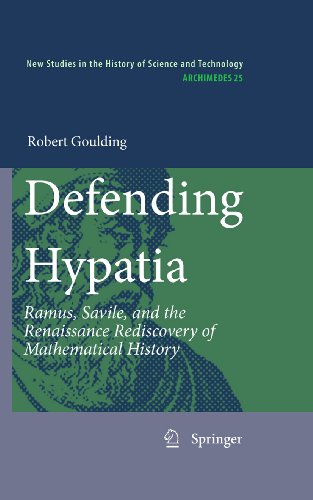
Ebook Info
- Published: 2010
- Number of pages: 413 pages
- Format: PDF
- File Size: 1.61 MB
- Authors: Robert Goulding
Description
In1713,PierreRem ´ onddeMontmortwrotetothemathematicianNicolasBernoulli: It would bedesirable if someone wanted totake thetrouble toinstruct how and inwhat order the discoveries in mathematics have come about . . . The histories of painting, of music, of medicine have been written. A good history of mathematics, especially of geometry, would bea much more interesting and useful work . . . Such a work, ifdone well,could be regarded to some extent as a history of the human mind, since it is in this science, more than in anything else, that man makes known that gift of intelligence that God has given him to rise 1 above all other creatures. Ahalf-centurylater,Jean-EtienneMontuclaprovidedsuchanaccountinhisHistoire des mathem ´ atiques ( rst printed in 1758, and reissued in a greatly expanded form 2 in 1799). Montucla’s great work is generally acknowledged as the rst genuine history of mathematics. According to modern historians, previous attempts at such a history had amounted to little more than collections of anecdotes, biographies or exhaustive bibliographies: “jumbles of names, dates and titles,” as one writer in the 3 Dictionary of Scienti c Biography characterizes them. Montucla, in contrast, was thoroughly animated by the Enlightenment project expressed in de Montmort’s l- ter. In his Histoire he set out to provide a philosophicalhistory of the “development 4 of the human mind,” as he himself described it.
User’s Reviews
Reviews from Amazon users which were colected at the time this book was published on the website:
⭐Much more than merely the most in-depth analysis of the Henry Savile’s mathematical career. Goulding’s talent for deductive reasoning (combined with exhaustive research) not only produces deep insights into Savile’s relationship with Euclid, Ramus, Savile’s student John Chamber and Queen Elizabeth among others, but also functions as a guide to how to elicit three dimensional portraits of people and ideas from the two dimensions of the printed and annotated page. The final chapter, wherein Hypatia finally makes her appearance is nothing short of exhilarating.
⭐Ramus, Savile and others in the 16th century invoked the history of mathematics largely for ideological propaganda purposes. For instance, “Savile confronted a university almost completely indifferent to the study of mathematics” (75), and “delivered a stirring rhetorical defence of mathematics which emphasized the discipline’s philosophical purity and ancient pedigree,” suited to his context “at Oxford [where] literary humanism was in the ascendant” (77). Thus it served his purposes well to elaborate ancient anecdotes about mathematics in florid language and supply them with suitable morals. Here is a particularly beautiful example:”When Aristippus, the Socratic philosopher, was shipwrecked on the shore of Rhodes, he found that his small band of companions in that same ill fortune and peril were greatly afraid: some feared that, although they had survived the waves and had thought that they were out of danger, they would now starve to death in a forsaken land; others, having braved the rocky, barbarous sea, trembled at the thought of beasts more terrible than any storm; and still others shuddered with fear of meeting men more dangerous than any beasts, human only in appearance. But Aristippus saw, drawn in the sand – that sand which can never be praised enough! – some mathematical diagrams, and took it as a very great sign of hope for them all. ‘The greatest dangers and wildest storms are now past’, he said. ‘Look in the sand, my friends, and see the calculations. See the circles, triangles, squares, polygons; in my misery the contemplation of them delights me, raises my spirits in my depression and consoles me in my suffering. I can tell you – not as an augur from the birds, not as a soothsayer from entrails, not from the stars as an astrologer (and never have I regretted my ignorance of their occult mysteries) – but as, perhaps, a prudent judge of our situation, I can prophesy from these drawings in the sand your safety and the end of all your miseries. These figures are tokens of humanity, and are no small mark of Greek learning. Believe me, my friends, the study of these arts is incompatible with a savage mind; these arts are noble and are learnt by noble men. Nor can anyone embrace the liberal arts unless he is liberally educated. Have high hopes for the character of these islands; those who know how to geometrize, know how to show mercy.'” (Savile, 94)Unfortunately 16th-century histories are full of factual errors as well as ideologically motivated distortions. “At times, humanists misread or distorted the available evidence because of their preconceived notions, whether philosophical or pedagogical. More often, they failed to examine the evidence at all, accepting a convenient and supposedly well-established position. And as before, there was also a contingent element: the evidence itself was patchy and ambiguous, or was misinterpreted for entirely benign reasons.” (144)Among the most glaring misconceptions is the fact that “sixteenth-century mathematicians nearly all believed that Euclid had written only the statements of the propositions, and that Theon had written the demonstrations found in the Greek text of the Elements” (150) “as a kind of commentary appended to Euclid’s list of geometrical propositions” (145). The textual basis for this in ancient sources is flimsy (150). Savile rightly noted that such a hypothesis is “stupid and ridiculous” (175).Other widespread errors were the mistaken identification of the Euclid of the Elements with “Euclid of Megara, the Socratic philosopher, a contemporary of Plato,” promulgated in “almost all … editions” of the Elements in the 16th century (120), and the mistaken dating of Proclus as living before Theon (173).Altogether an ostensibly historical account of mathematics such as that of Ramus says much about him but has little to do with actual past events. “Through a combination of solid research, wishful thinking and, it must be admitted, occasional falsification, Ramus constructed a coherent narrative of mathematics’ past that supported his contemporary educational program: mathematics in its formative beginnings (and hence in its essential nature) looked very much like the reformed mathematics he wished to have taught at the University of Paris.” (37)Pedagogically, Ramus disapproved of “the many great obscurities endemic to mathematics”: “One day … in fact, I had been trying unsuccessfully to get to the end of a demonstration on the binomial and residue; I concentrated my mind on it entirely; after keeping my body stuck in one position for a whole hour, I felt all the muscles in my back seize up. And at that, I threw away my drawing-board and ruler, and burst out in rage against mathematics, because it tortures so cruelly those who love it and are eager for it.” (30)Ramus “laid the blame for this state of affairs squarely at the feet of Euclid and Theon” (31) and envisioned instead that he would “Establish, finally, the elements of mathematics according to these laws of logic: the individual propositions arranged in place and order will not only be statements of their own truth, but even demonstrations of it.” (32) Of course he could claim credibility for this radical vision from the historical “fact” that the Elements were originally composed without proofs.Ramus also made much of Aristotle’s remark that “the mathematical arts were founded in Egypt; for there the priestly caste was allowed to be at leisure” (1). According to Ramus, this was “corroborated by Scripture. Genesis records (said Ramus) that Joseph, under Pharaoh’s orders, bought up all the land of the Egyptians during the famine, but that ‘Pharaoh granted the priests their land as a stipend for their profession of mathematics’. The Bible in fact says only that ‘the priests had a fixed allowance from Pharaoh, and lived on the allowance which Pharaoh gave them; therefore they did not sell their land’. Not even Josephus connected this royal stipend with mathematics; but for Ramus, it made perfect sense to harmonize all of his sources in this way. … [This] conflation of anecdotes also allowed Ramus to make [the] point … that mathematics deserved royal patronage, indeed, had always been an art patronized by kings.” (39)Finally, I must note that the title of this book is very poorly chosen, as Hypatia has basically nothing to do with it. She is mentioned only very briefly and tangentially (176-177). One may also wish that the book included more translations from the Latin instead of often leaving us to trust Goulding’s paraphrases.
⭐It’s always nice to come across scholarly work about ancient women philosophers, especially Hypatia. So imagine my surprise when the name invoked on the books title makes scant and more or less irrelevant appearances only starting on page 174! Those of us who specialize in scholarship about women philosophers may be tempted to purchase this for that reason: Hypatia must loom large in a book titled “Hypatia….” No. This is some author, a good scholar, no doubt, cashing in on the trendiness of the history of women in philosophy and its related fields. Aiming for the wrong audience. Pity.
Keywords
Free Download Defending Hypatia: Ramus, Savile, and the Renaissance Rediscovery of Mathematical History (Archimedes Book 25) 2010th Edition in PDF format
Defending Hypatia: Ramus, Savile, and the Renaissance Rediscovery of Mathematical History (Archimedes Book 25) 2010th Edition PDF Free Download
Download Defending Hypatia: Ramus, Savile, and the Renaissance Rediscovery of Mathematical History (Archimedes Book 25) 2010th Edition 2010 PDF Free
Defending Hypatia: Ramus, Savile, and the Renaissance Rediscovery of Mathematical History (Archimedes Book 25) 2010th Edition 2010 PDF Free Download
Download Defending Hypatia: Ramus, Savile, and the Renaissance Rediscovery of Mathematical History (Archimedes Book 25) 2010th Edition PDF
Free Download Ebook Defending Hypatia: Ramus, Savile, and the Renaissance Rediscovery of Mathematical History (Archimedes Book 25) 2010th Edition