Ebook Info
- Published: 2008
- Number of pages: 528 pages
- Format: PDF
- File Size: 2.96 MB
- Authors: Jeremy Gray
Description
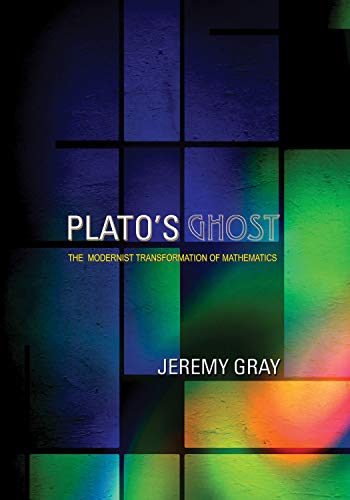
Plato’s Ghost is the first book to examine the development of mathematics from 1880 to 1920 as a modernist transformation similar to those in art, literature, and music. Jeremy Gray traces the growth of mathematical modernism from its roots in problem solving and theory to its interactions with physics, philosophy, theology, psychology, and ideas about real and artificial languages. He shows how mathematics was popularized, and explains how mathematical modernism not only gave expression to the work of mathematicians and the professional image they sought to create for themselves, but how modernism also introduced deeper and ultimately unanswerable questions.Plato’s Ghost evokes Yeats’s lament that any claim to worldly perfection inevitably is proven wrong by the philosopher’s ghost; Gray demonstrates how modernist mathematicians believed they had advanced further than anyone before them, only to make more profound mistakes. He tells for the first time the story of these ambitious and brilliant mathematicians, including Richard Dedekind, Henri Lebesgue, Henri Poincaré, and many others. He describes the lively debates surrounding novel objects, definitions, and proofs in mathematics arising from the use of naïve set theory and the revived axiomatic method―debates that spilled over into contemporary arguments in philosophy and the sciences and drove an upsurge of popular writing on mathematics. And he looks at mathematics after World War I, including the foundational crisis and mathematical Platonism.Plato’s Ghost is essential reading for mathematicians and historians, and will appeal to anyone interested in the development of modern mathematics.
User’s Reviews
Editorial Reviews: Review “One of Choice’s Outstanding Academic Titles for 2009″”In Plato’s Ghost, he has . . . present[ed] us with an ambitious and in many respects remarkable synthesis of the modern transformation of mathematics via structural and set-theoretic notions, together not only with its logic and philosophy but also with related developments in artificial languages and psychology. . . . I can certainly recommend Plato’s Ghost highly as a rich resource and point of departure for readers who want to learn more about this exciting period in the development of modern mathematics.”—Solomon Feferman, American Scientist”This accessible, rigorous volume belongs in every serious library.”—J. McCleary, Choice”In a book aimed at the educated public, the author presents an impressive amount of data–both of the kind mathematicians with some awareness of the history of their subject may be aware of, and of an entirely different kind, coming from the outskirts of mathematics, from philosophy, from physics, or from the popularization of mathematics, which will likely be new even to historians of mathematics.”—Victor V Pambuccian, Mathematical Reviews”It is . . . no small assertion to say that the book under review, Plato’s Ghost, is [Gray’s] most far-reaching and ambitious work to date. . . . [T]here is a wealth of valuable data here which, if not fully processed and pigeonholed, is at least tagged and cataloged in a helpful way. Plato’s Ghost provides an insightful and informative resource for anyone doing mathematics today who has wondered how (and perhaps why) the subject has come to possess the features it has today. The book gives us a lot to think about, which is exactly what a good history should do.”—Jeremy Avigad, Mathematical Intelligencer”In this book Jeremy Gray offers us the fruit of more than a decade reading and thinking about modernism in mathematics. He presents it, in very well written form, to a broad audience interested in mathematics, its history and philosophy.”—Erhard Scholz, Metascience”What we have here . . . is an excellent and detailed survey of how modernism took root in mathematics. Plato’s Ghost provides the launching pad for future ruminations on the modernist thesis.”—Calvin Jongsma, Perspectives on Science and Christian Faith”I commend Gray for writing an extraordinarily detailed and fascinating history of modernist mathematics, whose philosophical fruits remain ripe for the picking. The sections on geometry shine with clarity and convey the drama of modernism in a compelling and page-turning way. The treatments of less-studied actors are fascinating and promise to be of much use in incorporating their work into ongoing scholarship. The book could be fruitfully used as a supplement to a variety of courses in philosophy, including philosophy of mathematics and logic, history of analytic philosophy, and philosophy of science. It is a monument of scholarship and will reward careful study.”—Andrew Arana, Philosophia Mathematica”In the course of this study Gray uncovers many new and unexpected things. . . . Gray’s book offers a rich and . . . balanced account of how modernist ideas gradually gained inroads within pure mathematics.”—David E. Rowe, Bulletin of the American Mathematical Society Review “In this impressive synthesis, Gray brings, in a largely nontechnical way, the technical development of mathematics from the 1880s to the 1930s into the broader historical analysis of the concept of modernity. His argument promises not only to challenge historians of mathematics but also, finally, to bring mathematics into wider discussions of cultural history.”―Karen Hunger Parshall, author of James Joseph Sylvester: Jewish Mathematician in a Victorian World”A major addition to scholarship in the history of mathematics and in the history of science in general. Gray throws light on a major cultural transformation of mathematics. The book is written for a large readership of historians of science, philosophers, and scientists. It will have repercussions in broader debates on scientific culture, and will remain a reference work for many years to come.”―Moritz Epple, Johann Wolfgang Goethe University From the Back Cover “In this impressive synthesis, Gray brings, in a largely nontechnical way, the technical development of mathematics from the 1880s to the 1930s into the broader historical analysis of the concept of modernity. His argument promises not only to challenge historians of mathematics but also, finally, to bring mathematics into wider discussions of cultural history.”–Karen Hunger Parshall, author ofJames Joseph Sylvester: Jewish Mathematician in a Victorian World”A major addition to scholarship in the history of mathematics and in the history of science in general. Gray throws light on a major cultural transformation of mathematics. The book is written for a large readership of historians of science, philosophers, and scientists. It will have repercussions in broader debates on scientific culture, and will remain a reference work for many years to come.”–Moritz Epple, Johann Wolfgang Goethe University About the Author Jeremy Gray is professor of the history of mathematics and director of the Centre for the History of the Mathematical Sciences at the Open University. His books include Worlds Out of Nothing and János Bolyai, Non-Euclidean Geometry, and the Nature of Space. Excerpt. © Reprinted by permission. All rights reserved. PLATO’S GHOSTTHE MODERNIST TRANSFORMATION OF MATHEMATICSBy JEREMY GRAYPRINCETON UNIVERSITY PRESSCopyright © 2008 Princeton University PressAll right reserved.ISBN: 978-0-691-13610-3ContentsIntroduction…………………………………………………1I.1 Opening Remarks…………………………………………..1I.2 Some Mathematical Concepts…………………………………161 Modernism and Mathematics……………………………………181.1 Modernism in Branches of Mathematics………………………..181.2 Changes in Philosophy……………………………………..241.3 The Modernization of Mathematics……………………………322 Before Modernism……………………………………………392.1 Geometry…………………………………………………392.2 Analysis…………………………………………………582.3 Algebra………………………………………………….752.4 Philosophy……………………………………………….782.5 British Algebra and Logic………………………………….1012.6 The Consensus in 1880……………………………………..1123 Mathematical Modernism Arrives……………………………….1133.1 Modern Geometry: Piecemeal Abstraction………………………1133.2 Modern Analysis…………………………………………..1293.3 Algebra………………………………………………….1483.4 Modern Logic and Set Theory………………………………..1573.5 The View from Paris and St. Louis…………………………..1704 Modernism Avowed……………………………………………1764.1 Geometry…………………………………………………1764.2 Philosophy and Mathematics in Germany……………………….1964.3 Algebra………………………………………………….2134.4 Modern Analysis…………………………………………..2164.5 Modernist Objects…………………………………………2354.6 American Philosophers and Logicians…………………………2394.7 The Paradoxes of Set Theory………………………………..2474.8 Anxiety………………………………………………….2664.9 Coming to Terms with Kant………………………………….2775 Faces of Mathematics………………………………………..3055.1 Introduction……………………………………………..3055.2 Mathematics and Physics……………………………………3065.3 Measurement………………………………………………3285.4 Popularizing Mathematics around 1900………………………..3465.4 Writing the History of Mathematics………………………….3656 Mathematics, Language, and Psychology…………………………3746.1 Languages Natural and Artificial……………………………3746.2 Mathematical Modernism and Psychology……………………….3887 After the War………………………………………………4067.1 The Foundations of Mathematics……………………………..4067.2 Mathematics and the Mechanization of Thought…………………4307.3 The Rise of Mathematical Platonism………………………….4407.4 Did Modernism “Win”?………………………………………4527.5 The Work Is Done………………………………………….458Appendix: Four Theorems in Projective Geometry…………………..463Glossary…………………………………………………….467Bibliography…………………………………………………473Index……………………………………………………….503Chapter One MODERNISM AND MATHEMATICS 1.1 Modernism in Branches of Mathematics The origins of modern mathematics can be found in the mathematical practices of the nineteenth century. It has become a commonplace that the nineteenth century saw the rigorization of analysis under the slogan, coined by Felix Klein in a public lecture in 1895, of the “arithmetization of analysis.” Klein was then making his bid to be the leading mathematician in Germany, with a vision of the subject as a whole, and, as he was eager to point out, the arithmetization he was criticizing underestimated the flourishing nineteenth-century line in applied mathematics, but it is true nonetheless that analysis was rigorized, and indeed based on arithmetic. However, this was only intermittently the aim of mathematicians, and their motives were various (correct reasoning, proving theorems, resolving contradictory answers, obtaining good applications, and pedagogy belong among them). The late nineteenth century saw many overlapping kinds of mathematics being done, as well as a growing awareness of the possibility of error in mathematical reasoning. Attempts to give some “established truths” the security of a decent proof can seem obscure or pedantic-as they did to many physicists-but once the point is successfully put across that a proof is lacking, the search for one can simply become part of accepted mathematical practice. Developments in geometry displaced old “certainties” about the nature of mathematics and mathematical objects. The discovery of non-Euclidean geometry by Jnos Bolyai and Nicolai Lobachevskii (and, if one is charitable, Carl Friedrich Gauss) resolved ancient difficulties about the parallel postulate in the most contentious way. Mathematicians finally accepted their work after it was given foundations in differential geometry by Bernhard Riemann, who was widely recognized as the most original mathematician of the mid-nineteenth century, and Eugenio Beltrami. It was then speedily incorporated into projective geometry by Klein. This, the most famous “revolution” in mathematics, put an end to any idea that mathematics was, as it were, distilled science. If there are two distinct geometries, then neither can be necessarily true. The situation was, however, even more complicated and difficult for mathematicians. A chain of writers from Gauss and August Crelle at the start of the nineteenth century to Moritz Pasch and Bertrand Russell at the end found problems with the very apparatus of Euclid’s geometry: terms once obvious seemed harder and harder to define, gaps in reasoning harder and harder to fill. There were discussions of what counts as a plane, for example. Hitherto unnoticed gaps in reasoning (or missing axioms) were picked out and filled, most famously by Pasch as part of wholesale rewrite of elementary (projective) geometry. It was noticed, for example, that the opening definitions in Euclid’s Elements do not actually succeed in defining anything. Consider the first: “A point is that which has no part.” This is very evocative if you know what a point is, but it is of no use if you do not. Deliberate errors (such as the famous purported proof that all triangles are isosceles) were put forward to highlight the degree to which Euclidean arguments presupposed diagrams and might for that reason be erroneous. These, and other criticisms I shall look at, all cumulatively undermined previous confidence that Euclid’s Elements were indeed the epitome of reasoning. Projective geometry, by any standards the most remarkable success story of nineteenth-century geometry, in both its synthetic and analytic modes deployed points, lines, and ultimately hyperplanes at infinity in a manner unintelligible to classical geometry. Moreover, as the philosopher and historian Ernest Nagel argued many years ago, the use of duality in projective geometry plays havoc with intuition and, he argued, opens the door to purely logical reasoning. This claim has recently been contested in a nineteenth-century English setting by Richards, but I think it is on the mark and the English are best seen here and in algebra as a case unto themselves (and a good test case for the modernist thesis). Modernism in geometry arrives with Hilbert, and the difference between his Grundlagen der Geometrie (Foundations of Geometry) and the earlier work of Pasch. As recent scholars have emphasized, from Hans Freudenthal to Elena Marchisotto and Michael Hallett and Ullrich Majer, the Italian contribution is if anything more abstract in its axiomatic approach, and it is currently being integrated into a full historical account in the work of Avellone et al. and Umberto Bottazzini. Several threads need to be disentangled. The absorption of non-Euclidean geometry into differential geometry need not have provoked a crisis in the foundations of mathematics (that it did is another matter, connected to the global character of Euclidean definitions). The break with any kind of geometric intuition in defining geometric terms is characteristically modernist, however. A similar shift took place in the presentation of projective geometry. Then there are the implications for other branches of mathematics-and so for mathematics as a whole-of the introduction of the abstract axiomatic method. A significant group here is the American postulation theorists, who also influenced the logician Alfred Tarski in the 1920s. Last, but indeed by no means least, there are the philosophers’ responses and debates about the import of non-Euclidean geometry for philosophy in general and the philosophies of mathematics and science in particular. Poincar’s famous conventionalism arose in this setting, but the passions the topic aroused (contagious even among modern painters, as Henderson has described in her The Fourth Dimension and Non-Euclidean Geometry in Modern Art, 1983) are worthy of independent attention. A long-running topic of relevance to the development of proof is the convergence of series, especially Fourier series. Another is potential theory: the persistent failure of mathematicians to prove the existence of harmonic functions satisfying arbitrary boundary conditions, although physicists found strong heuristic grounds for accepting them. These often, and for once well-told, tales bear reexamination for two reasons. They exemplify the origins of rigorous analysis in broad lines of mathematical inquiry, and they culminate in what might be called the crisis of continuity. This is the widespread feeling among mathematicians around 1900, documented in many sources, that the basic topic of analysis, continuity, was profoundly counterintuitive. This realization marks a break with all philosophies of mathematics that present mathematical objects as idealizations from natural ones; it is characteristic, I argue, of modernism. 1.1.1 Ontology and Epistemology There are indeed two foundational aspects at work-one largely ontological, the other largely epistemological. The first is the one usually called the arithmetization of analysis. It traces a path from Cauchy’s novel theory of functions in the 1820s that was based on certain limiting processes defining continuity, differentiability, and integrability through its unclear notion of the real numbers to an eventual resolution somewhere in the use of limiting processes to define the real numbers. Such a destination presupposed a satisfactory theory of the integers, whence the familiar slogan. At least for mathematicians, ontological clarity was shed on the nature of the real numbers by the ways in which they were defined from the rational numbers (which were themselves constructed from the integers), and then, in a second phase, light was shed on the integers themselves. In the first phase it was the difficult and sometimes counterintuitive behavior of limit processes that forced the nature of irrational numbers onto the attention of mathematicians. In the second phase, formulations of arithmetic led inexorably to set theory and then to deep problems with set theory, one of the many instances where it was sometimes felt that problems had only been traded in for deeper problems. The epistemological aspect stays with the notion of continuity: its separation from differentiability, the emergence of a class of phenomena sometimes called pathological and which required special techniques to handle that must (it was suggested) demarcate mathematics from science or philosophy. These too provoked deep problems that set theory was created to handle. The third major domain of mathematics sees a similar transformation; indeed, the term “modern algebra” has greater resonance than modern analysis or modern geometry. The latter two sound like marketing terms today, but the first carries real weight: the arrival of structural algebra with the work of Emmy Noether and her school in the 1920s and then Bourbaki in the next generation. The historian Leo Corry has recently analyzed the history in considerable detail, laying great emphasis on the structural aspects. As with applied mathematics, there was also a strong sense that these developments grew out of real questions in mathematics and were not pursued merely for their own sake. It is well known to historians of mathematics that many of the key elementary terms of modern structural algebra can be found in nineteenth-century algebraic number theory and algebraic geometry, along with proofs of many of the key results. In view of this tradition, it is necessary to characterize the modernist aspect of the matter with greater precision, and again this can be done in ontological and epistemological terms. As with the analysis of continuity, the abstraction and generality of the new ontology promoted the new epistemology. Ontologically, the erosion of the concept of number is crucial. The most famous example is that of the quaternions, a noncommutative system of numberlike objects discovered by William Rowan Hamilton in 1843. I shall argue that the asymmetrical responses to non-Euclidean geometry and quaternions are interesting and need fresh thought: geometry was put with mechanics and empirical matters, while numbers remained with logic. But the high road to structural algebra leads from the algebraic integers used even by Leonhard Euler to Ernst Kummer’s more mysterious ideal numbers to Richard Dedekind’s ideals, and then joins a complicated and previously not-well-understood topic concerned with Kronecker’s vision of algebra and its reception. This last stands at the junction of algebraic number theory and algebraic geometry. The outcome is a concept of algebraic integer vastly more general than that of the usual integers, and an array of theorems that show just how clearly the usual integers form a special case. This aspect is the epistemological one. The two together made it possible for mathematicians to take the decisive modernist step of setting up the new theory in opposition to all previous ones, as the new autonomous domain that includes, in reworked form, all “that matters” of earlier approaches. Unlike the developments in classical mathematics, contemporary changes in logic grew out of a moribund field. It is generally agreed that investigations into logic grew quietly to a halt after Leibniz, his followers like Christian Wolff, and finally Johann Heinrich Lambert at the end of the eighteenth century. They were revived by a remarkable British school, prominent among whom were de Morgan and Boole. After them, but independently, Gottlob Frege recast the traditional theory of logic insofar as it was an analysis of mathematical language, and the period of modern logic began. The nature of Frege’s contribution and its significance (then or since) remains controversial, and so too does the work of his contemporaries. Some (see van Heijenoort 1980) see a bifurcation into algebraic logic, associated with George Boole, Charles Sanders Peirce, and Ernst Schrder, and the alternative offered by Frege and Peano. An early exponent of this view was Russell, who, it is often said, was influential in marginalizing the algebraic viewpoint. Others, such as Anellis (1995), find the algebraic school more active in its day, and more substantial in their points, than Russell appreciated, and consequently differ in their historical assessment of the period. The first significance of the explosion of interest in mathematical logic in the second half of the nineteenth century is that it took place at all, given the hitherto quiet state of affairs. Gradually during the first half of the nineteenth century it had come to be appreciated that classical logic was inappropriate to classical mathematics: Euclidean geometry was simply not written in syllogisms. What then emerged as an acknowledged unsolved problem in the subject was posed by quantifiers. This problem would not in itself have caught the attention of mathematicians, who were in the process of giving up Euclidean geometry anyway. What caught their attention was both the algebraic side of the new logic, growing as it did out of the formal approach to problems in analysis, and the possibility that logic was a possible resting place for mathematics, deprived as it was increasingly of bedrock in the natural sciences. The second significance of the explosion is that it promoted successive waves of investigation into logic itself. Logic, it transpired, was not a simple matter of thinking clearly, which, to be sure, might not be a simple matter to describe fully and accurately. There were levels of logic, requiring assumptions about modes of reasoning, which seemed arbitrary and did not at all have the force of the elementary logical laws (which could quite naturally be thought of as laws of thought). This recognition was slowly and painfully won, and consequently many of the earliest analyses of the relation between logic and mathematics are bedeviled by obscurities. In particular, the existence of models, and the nature of various kinds of models for various kinds of axiom systems, was obscure for a long time, an obscurity that can be measured by the distance from Hilbert to Thoralf Skolem and Tarski. The third significance is that the enterprise was to have no satisfactory resolution. Many, some might say all, of the major problems that were thrown up have been solved; their answers are theorems in modern mathematical logic. But the answers collectively show both that elementary logic is inadequate as a foundation for any kind of sophisticated mathematics, and that no adequate foundation has enough intuitive feel or force to command assent. In short, the modernist transformation of logic itself meant that even logic no longer has a straightforward connection with simple clear thinking. Taken together, this plunge into the depths of the nature of truth and proof in mathematics epitomizes the introspective, even anxious character of modernist mathematics. The initial possibility that logic could give naive but acceptable answers to problems in the foundations of mathematics, upon which mathematicians could then erect sophisticated theories of an entirely mathematical kind, was found to be barren. Once this was discovered, there was no alternative but to seek sophisticated foundations, adequate to the sophisticated mathematics of the day. Issues in the foundations of mathematics became issues in the very philosophy of mathematics, and because of their intimate connection to other branches of mathematics caught the attention of mathematicians. (Continues…) Excerpted from PLATO’S GHOSTby JEREMY GRAY Copyright © 2008 by Princeton University Press. Excerpted by permission. All rights reserved. No part of this excerpt may be reproduced or reprinted without permission in writing from the publisher.Excerpts are provided by Dial-A-Book Inc. solely for the personal use of visitors to this web site. Read more
Reviews from Amazon users which were colected at the time this book was published on the website:
⭐Plato’s Ghost covers the development of mathematics from 1880 to 1920, which is a topic that would normally challenge even the very best writers of science. Yet, Gray handles the material with ease in a manner that allows both mathematicians and non-mathematicians to grasp the significance of the key events and players in this field. At the same time, this subject matter is well-documented, so the reader can easily follow up on anything he or she might have a greater interest in pursuing. Gray is such a good writer on science and mathematics, that I have decided that I must consider reading anything he writes in these disciplines. I am now reading his next book, Henri Poincare, A Scientific Biography on the French mathematician and physicist. Poincare, like David Hilbert the German mathematician, each came very close to discovering relativity; so it is interesting to compare their work on a layman’s level to that of Albert Einstein’s. If anything, Gray is handling even more complex subject matter than in Plato’s Ghost, yet once again with great ease. I highly recommend Plato’s Ghost to anyone who is looking for an excellent introduction to this period in the development of mathematics; and I highly recommend that you consider reading Jeremy Gray, if you have an interest in mathematics and science. Gray sets a standard that will be hard for other writers in these disciplines to achieve.
⭐Gray’s thesis, subdued through much of the book, is that the rise of modern mathematics not only coincided with the rise of what historians call Modernism in the arts, but that mathematics in its own way shared with Modernism an analogous change in viewpoints, values, and intellectual concerns. He doesn’t propose any specific influences from the arts upon mathematics or particular mathematicians, although he does briefly note influences going the other way.In philosophy, however, the stature of Immanuel Kant (1724-1804) and therefore of Kant’s views on cognition and intuition in mathematics, especially in the light of the later discoveries of non-Euclidean geometry, stimulated mathematicians’ thinking about mathematics as being within the purview of cognition and about mathematicians’ own notions of the cognitive status and role of so-called mathematical intuition in mathematical knowledge. This scrutiny of epistemological concepts in relation to mathematics included, and indeed required, a critical examination of the pivotal notions of logic, definition, and proof. Here, the philosophical convictions of Gottfried Leibniz (1646-1716) on the nature of logic and on the relation of mathematics to logic stimulated mathematicians’ thinking.The development of mathematics had reached a point where mathematicians were concerned to find the unequivocal and comprehensive epistemological basis of mathematics. That basis, if it was not found in some form external to mathematics, be it as Kant traced it or otherwise, would be found within the anatomy of mathematics itself. This left open the question of the cognitive relations of mathematics to the physical world.The pursuit of clarity and accuracy within mathematics had, independently of the concerns mentioned earlier, led to considerations of mathematics as a form of language, and soon involved the question of the cognitive relations of any specific language (upon which the language of mathematics seemed to depend) or, more abstractly even the cognitive relations of language in general, to the physical world. The linguistic distinction between syntax and semantics became especially important with the increased study of axiomatic systems, and with that distinction came, as understanding increased, the distinction between the provable and the true. The additional distinction between a consistent axiomatic system and a true axiomatic system raised further questions.Wherein, then, is found truth? Truth proposed as a relation raises questions of ontology, including the ontology of relations, and if a relation is an abstract structure, then questions are raised about the ontology of abstract structures, which abound in mathematics (the concept of structure itself being abstract). From these considerations, more questions concerning cognition and so-called mathematical intuition in mathematics arose.Mathematics, it seemed, was entangled with the very core of fundamental philosophical questions, notably prominent in Kant’s philosophy, on how we know, on what we know, on what there is to know, and on whether what there is to know is all there is. The rise of modern mathematics had lead to complex questions of philosophy that mathematicians began now to debate. What was the relation of logic to mathematics and of logic to knowledge? What was the relation of language? What was the relation of experience? What was the relation of mind?With a basis of mathematics eventually established (although not proven) within set theory (an axiom system within mathematics itself) in conjunction with formalized mathematical logic, and with the heuristic success of associated formalist views of mathematics, which carefully maintain the distinction between syntax and semantics and thus between proof and truth, unanswered philosophical questions on mathematics began to seem less forceful and germane to mathematicians. Because set theory is itself a mathematical structure, a basis found within the anatomy of mathematics itself, questions concerning the ontology of mathematics, especially that of sets and natural numbers, held the attention of philosophers, whereas working mathematicians, if pressed to offer an ontological theory to outsiders, settled upon a relatively indifferent, imaginative realism. The crisis was over.[Gray is not always this specific but all of this is implicit in his discussion.]= CONTENTS =[fully expanded > contents page = a.b]* Introduction_ I.1 Opening Remarks__ I.1.1 Mathematical Modernism____ I.1.1.1 What is in this Book____ I.1.1.2 The Spread of Mathematical Modernism____ I.1.1.3 A First Overview____ I.1.1.4 Modernisms__ I.1.2 Mehrten’s Moderne Sprache Mathematik__ I.1.3 Disclaimers____ I.1.3.1 Modernity____ I.1.3.2 What this Book is Not____ I.1.3.3 Plato’s Ghost____ I.1.4 Acknowledgments____ I.1.4.1 Permissions_ I.2 Some Mathematical Concepts* 1. Modernism and Mathematics_ 1.1 Modernism and Branches of Mathematics__ 1.1.1 Ontology and Epistemology__ 1.1.2 Psychology and Language_ 1.2 Changes in Philosophy__ 1.2.1 The Path Out of Kant__ 1.2.2 The Path to Logic and Logicism__ 1.2.3 Formalism__ 1.2.4 Science, Mathematics, and Philosophy_ 1.3 The Modernization of Mathematics__ 1.3.1 Experts and Audiences__ 1.3.2 Professionalization* 2. Before Modernism_ 2.1 Geometry__ 2.1.1 Projective Geometry____ 2.1.1.1 Pole and Polar____ 2.1.1.2 Duality__ 2.1.2 Non-Euclidean Geometry____ 2.1.2.1 Lobachevskii____ 2.1.2.2 Bolyai____ 2.1.2.3 The Significance____ 2.1.2.4 Geometry__ 2.1.3 Acceptance: Riemann and Beltrami____ 2.1.3.1 Beltrami__ 2.1.4 Professional Aspects_ 2.2 Analysis__ 2.2.1 What to Look For in a History of Mathematical Analysis__ 2.2.2 Cauchy____ 2.2.2.1 Cauchy’s Definition of the Integral____ 2.2.2.2 First Responses__ 2.2.3 Weierstrass__ 2.2.4 George Green and Potential Theory_ 2.3 Algebra__ 2.3.1 Algebraic Number Theory_ 2.4 Philosophy__ 2.4.1 Kant__ 2.4.2 Two Post-Kantians: Herbart and Fries____ 2.4.2.1 Herbart____ 2.4.2.2 Fries__ 2.4.3 Mathematicians and Scientists as Philosophers of Mathematics____ 2.4.3.1 Grassmann____ 2.4.3.2 Riemann__ 2.4.4 Kronecker’s Foundations for Arithmetic__ 2.4.5 Helmholtz’s Foundations for Arithmetic and Geometry____ 2.4.5.1 Arithmetic____ 2.4.5.2 Geometry__ 2.4.6 Erdmann and Tobias____ 2.4.6.1 Erdmann____ 2.4.6.2 Tobias_ 2.5 British Algebra and Logic__ 2.5.1 Boole__ 2.5.2 The Americans: Pierce and Ladd____ 2.5.2.1 Algebraic Logic by 1880_ 2.6 The Consensus in 1880* 3. Mathematical Modernism Arrives_ 3.1 Modern Geometry: Piecemeal Abstraction__ 3.1.1 Projective Geometry: The Kleinian View__ 3.1.2 Projective Geometry: Rigor, Duality, Novel Spaces, Novel Ingredients__ 3.1.3 Non-Euclidean Geometry__ 3.1.4 The Helmholtz-Lie Space Problem____ 3.1.4.1 Space Forms_ 3.2 Modern Analysis__ 3.2.1 What are the Real Numbers?__ 3.2.2 Cantor’s Introduction of the Transfinite____ 3.2.2.1 Ordinal Numbers____ 3.2.2.2 Catholic Modernism____ 3.2.2.3 Cardinal Numbers____ 3.2.2.4 The Continuum Hypothesis__ 3.2.3 The Philosophy of Paul Du Bois-Reymond_ 3.3 Algebra__ 3.3.1 Dedekind__ 3.3.2 The Unity of Nineteenth-Century Mathematics__ 3.3.3 Kronecker_ 3.4 Modern Logic and Set Theory__ 3.4.1 Some German Philosophers__ 3.4.2 Frege____ 3.4.2.1 Frege on Number____ 3.4.2.2 Frege’s Grundgesetze__ 3.4.3 Dedekind__ 3.4.4 Peano_ 3.5 The View from Paris and St. Louis* 4. Modernism Avowed_ 4.1 Geometry__ 4.1.1 Abstract Italian Geometry__ 4.1.2 Hilbert____ 4.1.2.1 Straightness and Shortest Distance____ 4.1.2.2 Poincaré____ 4.1.2.3 Enriques__ 4.1.3 Implicit Definitions__ 4.1.4 The Nagel-Enriques Thesis__ 4.1.5 Non-Euclidean Geometry__ 4.1.1 Poincaré’s Geometric Conventionalism____ 4.1.6.1 Calinon and Lechalas_ 4.2 Philosophy and Mathematics in Germany__ 4.2.1 Geometry and Intuition____ 4.2.1.1 Klein____ 4.2.1.2 Hölder____ 4.2.1.3 Borel__ 4.2.2 Hilbert, Husserl, Frege__ 4.2.3 Hilbert, Nelson, and the Neo-Friesians_ 4.3 Algebra__ 4.3.1 Group Theory__ 4.3.2 Vector Spaces_ 4.4 Modern Analysis__ 4.4.1 The French Modernists____ 4.4.1.1 Measure Theory__ 4.4.2 Dimension__ 4.4.3 Continuous Curves__ 4.4.4 Riesz on Space and Topology__ 4.4.4 Modernism and Modern Analysis_ 4.5 Modernist Objects__ 4.5.1 Hensel’s New Numbers__ 4.5.2 Knots and Topology_ 4.6 American Philosophers and Logicians__ 4.6.1 Pierce____ 4.6.1.1 Russell versus Pierce__ 4.6.2 Royce__ 4.6.3 American Axiomatizers_ 4.7 The Paradoxes of Set Theory__ 4.7.1 Thinking about Sets__ 4.7.2 Paradox__ 4.7.3 Hilbert’s First Thoughts__ 4.7.4 Zermelo and Well-Ordering__ 4.7.5 The “Five Letters”__ 4.7.6 Zermelo’s Axiomatization__ 4.7.7 Poincaré: Impredicativity__ 4.7.8 The Schoenflies-Korselt Exchange_ 4.8 Anxiety__ 4.8.1 The Appreciation of Error__ 4.8.2 Anxiety: Kronecker and Enriques__ 4.8.3 Perron’s Inaugural Address_ 4.9 Coming to Terms with Kant__ 4.9.1 The Leibnizian Revival____ 4.9.1.1 Russell__ 4.9.2 Poincaré Replies__ 4.9.3 Russell and Whitehead____ 4.9.3.1 Hausdorff__ 4.9.4 Around 1910: Weyl, Winter, Study, and Cassirer____ 4.9.4.1 Weyl____ 4.9.4.2 Winter____ 4.9.4.3 Study____ 4.9.4.4 Cassirer__ 4.9.5 Brouwer* 5. Faces of Mathematics_ 5.1 Introduction_ 5.2 Mathematics and Physics__ 5.2.1 On the Roles of Mathematics in Physics__ 5.2.2 Maxwell__ 5.2.3 Riemann__ 5.2.4 Poincaré contra Duhem____ 5.2.4.1 Le Roy and Duhem__ 5.2.5 Hertz__ 5.2.6 Hilbert__ 5.2.7 Minkowski__ 5.2.8 Einstein_ 5.3 Measurement__ 5.3.1 Classical and Representational Theories__ 5.3.2 Poincaré__ 5.3.3 Measuring the Infintesimal____ 5.3.3.1 Du Bois-Reymond’s and Stolz’s Numbers__ 5.3.4 Bettazzi____ 5.3.4.1 The Bettazzi-Vivanti Debate___5.3.5 Veronese___5.3.6 Hölder__ 5.3.7 Frege__ 5.3.8 Russell: Measurement as Ordering__ 5.3.9 Campbell on Measurement in Physics_ 5.4 Popularizing Mathematics around 1900__ 5.4.1 Introduction__ 5.4.2 Paul Carus__ 5.4.3 Poincaré__ 5.4.4 Enriques_ 5.5 Writing the History of Mathematics__ 5.5.1 History and Historians in Germany____ 5.5.1.1 German Historians of Mathematics__ 5.5.2 History and Historians in France and Italy____ 5.5.2.1 French Historians of Mathematics____ 5.5.2.2 Italian Historians of Mathematics__ 5.5.3 Why the History of Mathematics was Written____ 5.5.3.1 Non-Euclidean Geometry____ 5.5.3.2 A Connection to Mathematical Modernism?* 6. Mathematics, Language, and Psychology_ 6.1 Languages Natural and Aritificial__ 6.1.1 National Languages in Mathematics around 1900__ 6.1.2 An International Language__ 6.1.3 Mathematics as a Language__ 6.1.4 An Ideal Language__ 6.1.5 Nineteenth-Century Linguistics__ 6.1.6 Semantics__ 6.1.7 Hilbert and Semantics_ 6.2 Mathematical Modernism and Psychology__ 6.2.1 Poincaré__ 6.2.2 Intuition and Psychology in a German Setting__ 6.2.3 Helmholtz on Knowledge and Visual Perception__ 6.2.4 Wilhelm Wundt__ 6.2.5 Cognitive Foundations of Mathematics____ 6.2.5.1 Wundt____ 6.2.5.2 Lipps____ 6.2.5.3 Santerre* 7. After the War_ 7.1 The Foundations of Mathematics__ 7.1.1 Introduction and Overview__ 7.1.2 Hilbert and Proof Theory__ 7.1.3 Brouwer and Weyl__ 7.1.4 Axiomatic Set Theory__ 7.1.5 Gödel____ 7.1.5.1 Coda_ 7.2 Mathematics and the Mechanization of Thought__ 7.2.1 Can Computers Think?__ 7.2.2 Hilbert__ 7.2.3 Turing and the Turing Test__ 7.2.4 Von Neumann and Neural Networks_ 7.3 The Rise of Mathematical Platonism__ 7.3.1 Working Platonists?__ 7.3.2 Schlick’s Anti-Platonism__ 7.3.3 Bernay’s Formulation__ 7.3.4 Platonism, Nominalism, and Fictionalism__ 7.3.5 Carnap’s Linguistic Frameworks__ 7.3.6 Challenges to Philosophy__ 7.3.7 Alternatives to Platonism . . .__ 7.3.8 . . . and Gödel’s Platonism__ 7.3.9 Hilbert’s Garden_ 7.4 Did Modernism “Win”?__ 7.4.1 Objects__ 7.4.2 Proofs__ 7.4.3 The Philosophy of Mathematics_ 7.5 The Work Is Done* Appendix: Four Theorems in Projective Geometry__ Pappus, Desargues, Uniqueness of the Fourth Harmonic Point, Pascal* Glossary* Bibliography* Index
⭐This book has nothing in particular to say. It fills its pages with unimaginative, thoroughly neutral, semi-encyclopaedic surveys of one branch of mathematics after another, one philosophical debate after another, and so on, while offering next to nothing by way of synthesis or interpretation.I shall criticise Gray for being rather more uncritical than befits a historian in his acceptance of party-line modernism. The tenet of party-line modernism that I shall focus on is the myth that history shows that intuition must be abandoned since it leads to “false” results. It is an important task for historians to reject such propaganda abuses of history as the fabrications that they are; but unfortunately Gray is somewhat rubbing the back of the establishment in this case.A typical statement of the myth in question is the following passage, where Gray is supposedly quasi-paraphrasing Perron:”Spatial intuition is a very frequent source of error, especially when it is used to supplant proofs, as, for example, in proofs of the intermediate value theorem. ‘Intuition is a crude instrument that lets us make out true relationships only imprecisely’ (p. 204), and this is particularly so of our understanding of curves, which may fail in all sorts of ways to have the intuitive properties one suspects.” (p. 275)The propaganda myth is that intuition leads one to suspect that curves should have certain properties while they really don’t. Rather, the problem is that the intuitive notion of “curve” does not correspond precisely to the formal mathematical notion. So the “error” referred to above is not at all an error of intuition; it is the error of stupidly taking intuition to apply to formal objects.All of this is spelled out explicitly by Perron himself on the very page that Gray is referring to above (204). But you will have to go read the original article to find that out, for Gray omits it, thus skewing Perron’s point to agree with party-line modernism. (In other contexts, however, Gray does quote people making the exact same point (almost verbatim) as Perron; namely Pierpont on p. 229 and Felix Klein on p. 197.)Gray’s discussion of the Dirichlet principle is similarly skewed. Weierstass’s “decisive” criticism of this principle constituted, according to Gray, “evidence, it would seem, that a mixture of physical intuition and mathematical naivety was capable of leading mathematicians astray” (p. 75). But again intuition is being blamed for something that was not its fault. In fact, the Dirichlet principle is perfectly true, and it was only by extrapolating a particular formal generalisation of it (which no one claimed was intuitively obvious) that Weierstass was able to construct a so-called “counterexample.”But perhaps the clearest example of Gray’s party-line tendencies is his enthusiastic approval of the ludicrous propaganda history of arch-establishmentarian axe-grinder Ernest Nagel:”Nagel argued [that] the use of duality in projective geometry plays havoc with intuition and, he argued, opens the door to purely logical reasoning. … I think [this claim] is on the mark” (p. 19).It is baffling how Gray can accept such nonsense. The leading systematiser of duality in projective geometry was Jakob Steiner, the most intuitively inclined mathematician of all time. And Gray himself quotes Enriques as saying that “projective geometry refers to intuitive concepts, psychologically well defined” (pp. 122, 363) and Klein agreeing that it is “always intuitive” (p. 123).Another illustration of Gray’s underhand attack on intuition concerns Euclidean geometry. Pasch wrote accurately that “Elementary geometry cannot only be reproached for its difficulties, but also for its incompleteness and obscurities …” From here Gray concludes: “[Pasch’s] criticism of elementary, intuitive geometry from the standpoint of late nineteenth century criteria of rigor was typical.” (p. 118). Note Gray’s sneaky insertion of the word “intuitive.” Pasch did not use this word, and he had good reason not to. Sure enough, Euclid’s Elements contains numerous flaws from a formal point of view; for example, the triangle congruence “theorems” should really be axioms and so on. But it makes no sense to blame intuition for this. It is plainly a flaw of the Elements qua formal system.Now perhaps some party-liners might object that it was intuition that tricked Euclid into making this mistake. To this I have two replies. First, I would say that we have intuitions about geometry, not about axiomatic structures. Secondly, I would ask if, in the opinion of this person, there could ever be any mistake in mathematics that he would attribute to formalism rather than intuition. Because if this is not a mistake of formalism then I do not know what such a mistake would look like, whence it would appear that one runs the risk of simply defining “intuition” as “that thing that causes all errors whatever in mathematical reasoning.”
Keywords
Free Download Plato’s Ghost: The Modernist Transformation of Mathematics 1st Edition in PDF format
Plato’s Ghost: The Modernist Transformation of Mathematics 1st Edition PDF Free Download
Download Plato’s Ghost: The Modernist Transformation of Mathematics 1st Edition 2008 PDF Free
Plato’s Ghost: The Modernist Transformation of Mathematics 1st Edition 2008 PDF Free Download
Download Plato’s Ghost: The Modernist Transformation of Mathematics 1st Edition PDF
Free Download Ebook Plato’s Ghost: The Modernist Transformation of Mathematics 1st Edition