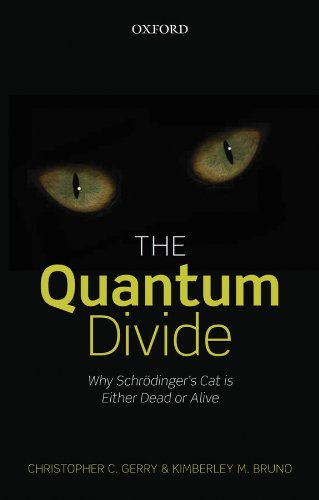
Ebook Info
- Published: 2013
- Number of pages: 197 pages
- Format: PDF
- File Size: 1.17 MB
- Authors: Christopher C. Gerry
Description
Using a selection of key experiments performed over the past 30 years or so, we present a discussion of the strikingly counter-intuitive phenomena of the quantum world that defy explanation in terms of everyday “common sense” reasoning, and we provide the corresponding quantum mechanical explanations with a very elementary use of associated formalism. Most, but certainly not all, of the experiments we describe are optical experiments involving a very small number ofphotons (particles of light). We begin with experiments on the wave-particle duality of electrons, proceed to experiments on the particle nature of light and single photon interference, delayed choice experiments and interaction-free detection, then go on to experiments involving the interference oftwo photons, quantum entanglement and Bell’s Theorem, quantum teleportation, large-scale quantum effects and the divide between the classical and quantum worlds, addressing the question as to whether or not there is such a divide.
User’s Reviews
Reviews from Amazon users which were colected at the time this book was published on the website:
⭐Anyone who really wants to know the details behind the quantum experiments that prove the fundamental theories, this is the book for you. Many of the experiments discussed are surprisingly recent and are about the basic quantum principles—not obscure stuff.. And if you have some background in advanced high school or just undergraduate science and math, it’s not hard to understand either. Well written, must read for real science nerds. Not too much detail or math formulas. Also, not really any touchy feely philosophy or human story. Just cold hard facts and enough analysis of the experiments to help you understand the significance of the results.
⭐This ranks as one of the most difficult of the dozen or so QM popularizations I’ve read. However, it’s also one of the best because it provides genuine insight into QM concepts like superposition+entanglement. Unlike most popularizations, there’s relatively little about the history and personalities involved- instead the focus is on explaining QM concepts through modern QM experiments.”Difficult” is a relative word because there’s none of the high-level math found in real textbooks. So for the laymen, this book may be the closest thing to obtaining real understanding without getting mired in solving the Schrodinger equation. Having said that, I’ll definitely have to re-read this book (esp. the chapter on entanglement).
⭐This is the best introductory text for such a challenging subject that I’ve ever read. Anyone with a halfway decent grasp of algebra should be able to follow the author’s clear explanations. He illuminates the wonders of quantum level phenomenon by describing important experiments and their importance. This book would make a great present for any aspiring electrical engineering or physics student.
⭐Read it twice! Wonderful simple mathematical picture into many of the odd quantum experiments over the past few decades .Rally fun if u like QM and ( if like me) it blends so well with “ the bigger picture”
⭐One of the best explanations of how recent experiments validate quantum physics. If you are patient absorbing the equations and understanding the gist of the experiments, you get a clear understanding of complimentarity, uncertainty, the wave equation and most importantly the Copenhagen interpretation and why other interpretations have not been favored.Highly recommended for those who have taken college physics.
⭐The authors take you on a tour of many of the fascinating experiments that reveal surprising aspects of the quantum world, with more explicit detail than you’ll find in most of the literature that’s geared for the general public. That’s very cool. The equations do a good job explaining concepts but don’t require a graduate degree to understand.The disappointing part is that despite illustrating how absurd the Copenhagen interpretation is, they cling to it throughout almost the entire book. Only in the end do they mention the Everett solution to this paradox, but they frame it in the traditional “universe splitting” narrative of MWI that tends to get people riled up instead of a more sensible way like how Sean Carroll explains it (search YouTube for “Extracting the Universe From the Wavefunction”). It would have been more courageous to help readers realize that the wave function doesn’t actually ever collapse.
⭐This is the best work I’ve found, explaining the relationship of the “quantum world” with all its’ weirdness to the “classical world” with our sense of logical and causation. There are equations – they are mathematical statements, clearly described. An informed layman, with high school math and physics, could make sense of the equations and the conclusion drawn – there is no divide. Well worth the effort!
⭐Excellent book with in detailed insights into fundamental principles behind quantum mechanics. This book, unlike other pop science stuff explains about how physicists use different experiments to prove or disprove a theory.
⭐The Quantum Divide attempts to bridge the gap between pop sci books on QM and deeply mathematical textbooks that require formal study to understand. QM is introduced and explained by describing a handful of experiments that exhibit Quantum effects, with little of the history and biography that most authors fall back on in lieu of being able to explain the actual science without going into the maths. As such, it is quite refreshing, but it doesn’t really provide a deeper understanding of the subject. Some equations are presented, but no calculations are shown so it really only serves to introduce the notation physicists use. This might be useful as a bridge to further, deeper study, but in itself it is just a rather dry way of describing the subject.Since the book contains various equations, the digital edition seems to be in a textbook format that my Kindle Paperwhite cannot display… I had to dig out my old Kindle Fire HDX to read it (any tablet with the Kindle App should suffice)
⭐I have a physics degree from 1980’s. Saw a recommendation for this. Thought it would be good to catch up on current state of QM albeit from a pop perspective – minimal maths. Especially the measurement problem. It almost delivered. It ran out of detail too quickly in each chapter though. Clearly aimed at the tldr generation. You can read the whole book in roughly one self indulgent toilet session. But left me unsatisfied as a degree holder of old. It also skipped a couple of key steps in some explanations that spoiled a couple of experiment descriptions. Having said that, the delayed choice quantum eraser experiment description was awesome. If that doesn’t truly blow your mind then nothing. Move over dull old double split experiment.
⭐Quantum physics is interesting, fundamental to modern technology and it is a bit weird. However, to ‘understand’ it from a scientific point of view – nobody really understands it, hence the quotation marks – you do need a little background education in maths and physics (no more than A-level, though, and even then, to get into this book, you only really need to know enough A-level science to understand interference phenomena and Young’s double slit experiment with some very basic algebra). Unfortunately, because of this pre-requirent most accounts of quantum physics aimed at the pure layman (e.g. on TV, the internet and some popular science books) tend to over-simply their accounts to the point of being wrong about some key concepts. Even worse, there is a lot of sensationalist philosophy out there which plays on people’s ignorance of actual quantum science and combines this with the fact that there is some weird behaviour in the quantum world to produce sensationalist / mystical interpretations of quantum physics and present these interpretations as if they are scientific theories.Not so with this book. This book asks that you have a bit of science education to begin with (as described above) and, in return, it rewards you with a succinct but scientific and non-sensationalist non-mystical account of quantum physics in about 185 small pages. The account is based on the description of key experiments (mostly in optics) and shows how the results of those experiments cannot be explained by classical physics thereby necessitating an alternative explanation – quantum physics – which in turn can predict phenomena that have since been demonstrated to be true by further experiments. They do also discuss alternative theories to quantum physics in a measured and rational way and explain why, so far, quantum physics is the preferred choice as determined from experimental results to date. They introduce key concepts and mathematical notations of the science of quantum theory but in a simplified way. You will not have enough detailed knowledge to go away and make your own quantum calculations to predict new phenomena (for that you would have to get proper degree-level knowledge in the subject) but the information and notation they give is sufficient to go away and read some of the professional research papers in the field and (almost) understand them.I must admit that for me, the going got a bit tough in the later chapters but I sort of followed the gist – I would need to re-read them and perhaps look up some of the papers they cite to ‘fully’ grasp what is going on but I do feel that the book has given me the ability to do this (I did in fact look up one paper and I actually understood it enough to learn what I needed to know from it).As they freely admit, quantum physics does not explain nature, it merely provides a consistent mathematical framework to describe and predict experimentally observed phenomena at the level of the (sub)atom with implications for larger systems. Some of the key feature of quantum physics (like superposition) remain counter-intuitive and mysterious from an everyday experience point of view. However, if you want a sober and scientific account of the subject rather than a sensationalist watered down overview and you have some scientific background knowledge, then this is the book for you. A physics undergraduate will probably also benefit from this book as a primer to their main university courses on the subject.
⭐This book says that it discusses some of the strange aspects of Quantum Mechanics. After a general introduction the first part of the book describes experiments to verify that quantum particles namely electrons and particularly photons can produce diffraction patterns where only 1 particle is in the apparatus at a time. The book then deals with experiments with entangled photons of different polarizations which establish Quantum Mechanics as a non-local theory.The second section pages (132 – 148) deals with Quantum computing, then Quantum Cryptography and Quantum Teleportation. These subjects are treated more tersely than the previous and subsequent ones, but extensive bibliography is provided for all sections.The third section on Schrödinger’s Cat (a sub-title of the book) starts on page 149 (the book has 197 pages including the index) and was very clear in my opinion. The next topic deals with the experimental verification of Anthony Leggett’s (a Nobel Laureate for work on super fluids) suggestion that superconducting electrons in a Josephson’s junction may exhibit `Cat – Like’ states in being a linear combination of clockwise and counter- clockwise rotating states for about 1 billion electrons.The last section is entitled Quantum Philosophy and concludes with a section entitled `The Mystery Remains’.Other points on the book:Page 123 six lines up from bottom has a sentence `That experiment provided the most convincing evidence local hidden variable theory to that date’. Presumably it should be `evidence against’?A review on the dust jacket says that the book would be useful for professional physicists, students and the educated layman. There is a sprinkling of state functions in Dirac ket vector notation and some of these have coefficients involving i the square root of -1, laypersons unfamiliar with these things can still get much from the book but are best informed in advance in my view.Appendix A1. This is a Quantum Mechanics Timeline; I have a few comments on this:2. Dirac does not appear at all.3. The Copenhagen Interpretation does not appear in spite of its use in the book.4. Davisson and Germer are credited with establishing electrons exhibited wave behaviour.While this is true G.P. Thomson did further work and it was Davisson and Thomson that received the Nobel Prize.5. It mentions briefly near the end the Many Worlds view of Quantum Mechanics but doesn’t include it in the TimeLineAppendix.6. Also while it doesn’t mention the Path Integral Approach to Quantum Mechanics in the text including it in the Timeline as it is another strange aspect of Quantum Mechanics was possibly an option
⭐An exceptionally clear and pragmatic presentation of the mysteries of quantum mechanics told through increasingly mind boggling experimental results. There is no maths apart from the use of state vectors to illustrate issues such as entanglement, non-locality, cryptography and teleportation. The book mainly sticks to the conventional ‘Copenhagen’ viewpoint and its attractions over other ideas such as ‘implicate order’ and ‘many – worlds’ while admitting its shortcomings. The mysteries remain.
Keywords
Free Download The Quantum Divide: Why Schrödinger’s Cat is Either Dead or Alive 1st Edition in PDF format
The Quantum Divide: Why Schrödinger’s Cat is Either Dead or Alive 1st Edition PDF Free Download
Download The Quantum Divide: Why Schrödinger’s Cat is Either Dead or Alive 1st Edition 2013 PDF Free
The Quantum Divide: Why Schrödinger’s Cat is Either Dead or Alive 1st Edition 2013 PDF Free Download
Download The Quantum Divide: Why Schrödinger’s Cat is Either Dead or Alive 1st Edition PDF
Free Download Ebook The Quantum Divide: Why Schrödinger’s Cat is Either Dead or Alive 1st Edition