

Ebook Info
- Published: 2011
- Number of pages: 264 pages
- Format: PDF
- File Size: 1.69 MB
- Authors: Gordon McCabe
Description
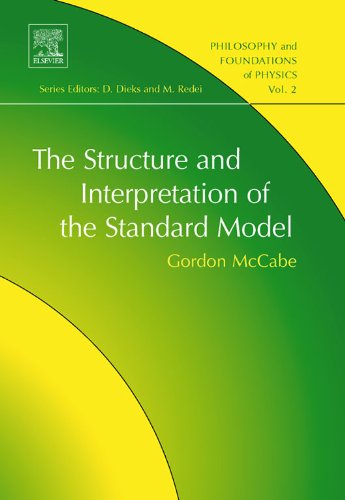
This book provides a philosophically informed and mathematically rigorous introduction to the ‘standard model’ of particle physics. The standard model is the currently accepted and experimentally verified model of all the particles and interactions in our universe. All the elementary particles in our universe, and all the non-gravitational interactions -the strong nuclear force, the weak nuclear force, and the electromagnetic force – are collected together and, in the case of the weak and electromagnetic forces, unified in the standard model. Rather than presenting the calculational recipes favored in most treatments of the standard model, this text focuses upon the elegant mathematical structures and the foundational concepts of the standard model.· Combines an exposition of the philosophical foundations and rigorous mathematical structure of particle physics· Demonstrates the standard model with elegant mathematics, rather than a medley of computational recipes· Promotes a group-theoretical and fibre-bundle approach to the standard model, rather than the Lagrangian approach favoured by calculationalists· Explains the different approaches to particle physics and the standard model which can be found within the literature
User’s Reviews
Reviews from Amazon users which were colected at the time this book was published on the website:
⭐My grandfather actually picked this up at the Caltech library while he was looking for books. He thought I would be interested in it. He was right.Just a disclaimer: I’m a mathematician doing mathematical physics, so I’m very comfortable with representation theory of Lie groups, differential geometry, functional analysis (including nonlinear functional analysis), partial differential equations, and topology…and there were some parts of the book that required some careful reading.The author noted in the preface his inspiration for such a book is Derdzinski’s
⭐. Fortunately, they are republishing that excellent book, which gives you some idea of the level of mathematical sophistication of the “Structure and Interpretation of the Standard Model”.Although the author sometimes uses rather esoteric philosophical terms, it is only in one chapter — the introduction.The book deals with the subject of the “first quantization” for the standard model. This is (in the words of the author on page 25) “the process of obtaining a Hilbert space of cross-sections of a vector bundle” over the light cone.However, the author lucidly explains the notion of a “fibre bundle” that is exquisite. I have never seen anyone explain it as well as the author. It made the use of such a mathematical gadget straight forward and obvious.Additionally, the author never made any demands on spacetime as the base manifold (i.e. it wasn’t assumed to be flat or curved), so it is a trivial exercise for the motivated reader to incorporate general relativity into the scheme.This is a “must have” for anyone who is doing research on the standard model or particle physics, or even wants to learn it from a mathematical point of view. It is not a physicist’s introduction to the subject, it’s a rigorous introduction to the beautiful topic.
⭐
Keywords
Free Download The Structure and Interpretation of the Standard Model (ISSN Book 2) 1st Edition in PDF format
The Structure and Interpretation of the Standard Model (ISSN Book 2) 1st Edition PDF Free Download
Download The Structure and Interpretation of the Standard Model (ISSN Book 2) 1st Edition 2011 PDF Free
The Structure and Interpretation of the Standard Model (ISSN Book 2) 1st Edition 2011 PDF Free Download
Download The Structure and Interpretation of the Standard Model (ISSN Book 2) 1st Edition PDF
Free Download Ebook The Structure and Interpretation of the Standard Model (ISSN Book 2) 1st Edition