

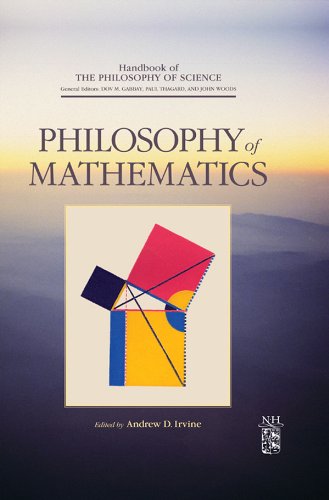
Ebook Info
- Published: 2009
- Number of pages: 1097 pages
- Format: PDF
- File Size: 43.89 MB
- Authors: Andrew Irvine
Description
One of the most striking features of mathematics is the fact that we are much more certain about the mathematical knowledge we have than about what mathematical knowledge is knowledge of. Are numbers, sets, functions and groups physical entities of some kind? Are they objectively existing objects in some non-physical, mathematical realm? Are they ideas that are present only in the mind? Or do mathematical truths not involve referents of any kind? It is these kinds of questions that have encouraged philosophers and mathematicians alike to focus their attention on issues in the philosophy of mathematics. Over the centuries a number of reasonably well-defined positions about the nature of mathematics have been developed and it is these positions (both historical and current) that are surveyed in the current volume. Traditional theories (Platonism, Aristotelianism, Kantianism), as well as dominant modern theories (logicism, formalism, constructivism, fictionalism, etc.), are all analyzed and evaluated. Leading-edge research in related fields (set theory, computability theory, probability theory, paraconsistency) is also discussed. The result is a handbook that not only provides a comprehensive overview of recent developments but that also serves as an indispensable resource for anyone wanting to learn about current developments in the philosophy of mathematics.-Comprehensive coverage of all main theories in the philosophy of mathematics-Clearly written expositions of fundamental ideas and concepts-Definitive discussions by leading researchers in the field-Summaries of leading-edge research in related fields (set theory, computability theory, probability theory, paraconsistency) are also included
User’s Reviews
Reviews from Amazon users which were colected at the time this book was published on the website:
⭐This book is part of a multi-volume series called Handbook of the Philosophy of Science. I rate the individual articles below. Readers with concerns about the ontological status of what philosophers often call “mathematical objects” (by which they tend mostly to mean numbers, mainly the natural numbers, and sets) and the epistemological implications of this ontology will appreciate some of the essays far more than I did. A common (I do not say universal) theme of contemporary discussions in the philosophy of mathematics seems to be the avoidance of all reference to anything resembling advanced mathematics. Are these philosophers as blithely ignorant as their discussions suggest? See also the quotation I give below from James Franklin’s essay “Aristotelian Realism”.For the reader who wishes to focus on the more philosophical essays, I recommend reading those essays out of sequence. Hart is a kind of overview, but it’s a little quirky. He could be read at any point. Definitely before Balaguer read Colyvan, Bostock, and Bonevac (this is a good reading sequence). They discuss the same issues that Balaguer is concerned with, but with more clarity and less tedium. Insert Franklin either before Colyvan or just after him in the sequence given above. Leave Tiles for last unless you’re an enthusiastic Kantian, since her concerns differ from those of the other authors. She writes turgidly but has some interesting points.Readers wanting less philosophical perplexity and more mathematical substance will be thankful to find especially the essays by Kanamori, McCarty, and Sieg. Also mathematical are those by Williamson and jointly by Apostoli, Hinnion, Kanda, and Libert, and also the essays by Hintikka, Simons, and perhaps Mortensen. Given the cost of this book, it’s unfortunate that it contains so few exceptional essays and so many of such little long-lasting value. Of the fifteen essays, Akihiro Kanamori’s “Set Theory from Cantor to Cohen” and Wilfried Sieg’s “On Computability” will be referenced by scholars and mathematicians long after most of the others are ignored.I rate the individual articles as follows.:+: exceptional; :=: noteworthy; :o: ordinary; :s: substandard; :~: unrated:o: W. D. Hart – Les Liaisons Dangerous, pp. 1-33:s: Mark Balaguer – Realism and Anti-Realism in Mathematics, pp. 35-101:+: James Franklin – Aristotelian Realism, pp. 103-155:o: David Bostock – Empiricism in the Philosophy of Mathematics, pp. 157-229:=: Mary Tiles – A Kantian Perspective on the Philosophy of Mathematics, pp. 231-270:o: Jaako Hintikka – Logicism, pp. 271-290:o: Peter Simons – Formalism, pp. 291-310:+: Charles McCarty – Constructivism in Mathematics, pp. 311-343:o: Daniel Bonevac – Fictionalism, pp. 345-393:+: Akihiro Kanamori – Set Theory from Cantor to Cohen, pp. 395-459:~: Peter Apostoli, Roland Hinnion, Akira Kanda, Thierry Libert – Alternative Set Theories, pp. 461-491:~: Jon Williamson -Philosophies of Probability, pp. 493-533:+: Wilfried Sieg – On Computability, pp. 535-630:~: Chris Mortensen – Inconsistent Mathematics, pp. 631-649:=: Mark Colyvan – Mathematics and the World, pp. 651-702- Selected quotations -“Aristotelians deplore the narrow range of examples chosen for discussion in traditional philosophy of mathematics. The traditional diet – numbers, sets, infinite cardinals, axioms, theorems of formal logic – is far from typical of what mathematicians do. It has lead to intellectual anorexia, by depriving the philosophy of mathematics of the nourishment it would and should receive from the expansive world of mathematics of the last hundred years. Philosophers have almost completely ignored not only the broad range of pure and applied mathematics and statistics, but a whole suite of ‘formal’ or ‘mathematical’ sciences that have appeared only in the last seventy years.” – James Franklin, p. 123″Mathematics, as the pure theory of manifolds and their possible (relational) structures is thus presupposed in any knowledge of objects, and in any logic which includes the forms of knowledge of objects as well as concepts, since it presupposes objects as given, as identifiable and capable of individuation in some manner. Equally, mathematics is dependent on logic for the expression of its knowledge and for the theory of the forms of its judgments and principles of its reasoning. Thus in insisting that knowledge requires both intuitions and concepts, Kant is also insisting that it requires both mathematics and logic to articulate its forms.” – Mary Tiles, p. 235″How Gödel transformed set theory can be broadly cast as follows: On the larger stage, from the time of Cantor, sets began making their way into topology, algebra, and analysis so that by the time of Gödel, they were fairly entrenched in the structure and language of mathematics. But how were sets viewed among set theorists, those investigating sets as such? Before Gödel, the main concerns were what sets are and how sets and their axioms can serve as a reductive basis for mathematics. Even today, those preoccupied with ontology, questions of mathematical existence, focus mostly upon the set theory of the early period. After Gödel, the main concerns became what sets do and how set theory is to advance as an autonomous field of mathematics. The cumulative hierarchy picture was in place as subject matter, and the metamathematical methods of first-order logic mediated the subject. There was a decided shift toward epistemological questions, e.g. what can be proved about sets and on what basis.” – Akihiro Kanamori, p.433
⭐
Keywords
Free Download Philosophy of Mathematics (Handbook of the Philosophy of Science) 1st Edition in PDF format
Philosophy of Mathematics (Handbook of the Philosophy of Science) 1st Edition PDF Free Download
Download Philosophy of Mathematics (Handbook of the Philosophy of Science) 1st Edition 2009 PDF Free
Philosophy of Mathematics (Handbook of the Philosophy of Science) 1st Edition 2009 PDF Free Download
Download Philosophy of Mathematics (Handbook of the Philosophy of Science) 1st Edition PDF
Free Download Ebook Philosophy of Mathematics (Handbook of the Philosophy of Science) 1st Edition