

Ebook Info
- Published: 2012
- Number of pages: 158 pages
- Format: PDF
- File Size: 1.16 MB
- Authors: Alastair Rae
Description
Quantum physics is believed to be the fundamental theory underlying our understanding of the physical universe. However, it is based on concepts and principles that have always been difficult to understand and controversial in their interpretation. This book aims to explain these issues using a minimum of technical language and mathematics. After a brief introduction to the ideas of quantum physics, the problems of interpretation are identified and explained. The rest of the book surveys, describes and criticises a range of suggestions that have been made with the aim of resolving these problems; these include the traditional, or ‘Copenhagen’ interpretation, the possible role of the conscious mind in measurement, and the postulate of parallel universes. This new edition has been revised throughout to take into account developments in this field over the past fifteen years, including the idea of ‘consistent histories’ to which a completely new chapter is devoted.
User’s Reviews
Editorial Reviews: Review “The book can be strongly recommended to all who are interested in this fascinating subject, which remarkably demonstrates that physics and philosophy are not two separate disciplines.” Peter J. Bussey in Contemporary Physics Book Description This new edition has been revised throughout to take into account developments in this field over the past fifteen years.
Reviews from Amazon users which were colected at the time this book was published on the website:
⭐An attempt to explain the EPR problem and Bells Theorem, and the Issues around the Measurement Problem in Quantum Mechanics. As for the first part. It’s a bit confusing and hard to follow. There’s no use making half hearted watered down attempts. Go the whole hog or go home. Mathematics required. As for the measurement problem – a thorough and sane coverage of a difficult problem. Expertly surveys some of the possible explanations. Definitely well worth a careful read. Though again a little more math would be useful and illuminating. I suppose the author can be forgiven for thinking the Copenhagen interpretation is still a good idea. Or might be. The book was first written in the early eighties. It was only just then beginning to crack. I sigh sadly when he quotes Wittgenstein in his closing remarks. Wittgenstein was a huckster selling snake oil. A temporary fad. Sounds hip and smart while saying nothing, and hence by his own admonition best ignored completely.
⭐In terms of classical physics, the physical reality may be defined as matter and energy behaving according to the laws of physics in classical spacetime, and the human being is a passive observer of this reality. According to quantum physics, matter and energy behave according to the laws of quantum physics in quantized spacetime, and the human observer is an integral part of this reality: The quantum physics include consciousness as an integral part of its laws.In this book the author discusses the deficiencies of two major interpretations of quantum physics: The Copenhagen interpretation expounded by Niels Bohr and the Many worlds’ interpretation proposed by Hugh Everett III. The author also discusses a third hypothesis called the consistent histories approach. The book starts with a traditional text book style introduction to Young’s double slit experiments. In a popular book such as this, it is a turn off, because an ordinary reader would like to read more about the descriptive part rather than the experimental part. Complicating this further, some chapters require reasonable knowledge of physics and mathematics and an interest in experimental physics to appreciate the subject matter.The quantum physical problem arises from how elementary particles at the microscopic level (quantum physics) are measured from the macroscopic instruments (classical physics). In the quantum world, an elementary particle or a collection of such particles can exist in a superposition of two or more possible states of physical being. It can be in a superposition of different locations, velocities and orientations of its spin anywhere in the universe, but when we measure one of these properties we see one of the elements of the superposition, but not a combination of them. The measuring macroscopic object will not be in this superposition. How do we explain this unique world of reality emerge from the multiplicities of alternative superposed quantum states? The wave functions that represent each quantum state treat each element of the superposition as equally real (but not necessarily equally probable.)The Schrödinger equation delineates how a quantum system’s wave function will change through time. This predicts a smooth and deterministic (no randomness) change. But mathematics contradicts this when humans observe a quantum system with an instrument. At the moment of measurement, the wave function describing the superposition of all states collapse into one member of the superposition, thus interrupting the smooth evolution of the wave function and introducing discontinuity in the system. The selected state at the moment of measurement is arbitrary, and its emergence does not evolve logically from the information packed wave function of the particle. In addition, the mathematics of collapse does not emerge from the seamless flow of the Schrödinger equation, but collapse has to be added as an additional process that seems to violate the equation. This is the main argument of the Copenhagen interpretation. This approach privileges the external observer in a classical realm distinct from the quantum realm of the object observed and the nature of the boundary between the quantum and classical realms remains unclear.The Many worlds’ interpretation addresses precisely this point by merging the microscopic and macroscopic worlds, thus making the observer an integral part of the quantum system. A universal wave function links macroscopic observers and microscopic objects as a part of a single quantum system, which would introduce a discontinuity in the wave-function collapse. Conversely, if we assume the continuous evolution of wave functions is not interrupted by the act of measurement. And if the Schrödinger equation holds good even for objects and observers alike with no elements of superposition banished from reality. Under these circumstances the wave function of an observer would, in effect, bifurcate at each interaction of the observer with a superposed object. The universal wave function would contain branches for every alternative making up the object’s superposition. Each branch has its own copy of the observer, a copy that perceived one of those alternatives as the outcome (resulting in multiple universes). According to a fundamental mathematical property of the Schrödinger equation, once formed, the branches do not influence one another. Thus, each branch (universe) embarks on a different future, independently of the others.The consistent histories is based on a consistency criterion that allows the history of a system to be described such that the probabilities for each history obey the rules of classical probability while being consistent with Schrodinger’s equation. It turns out that none of these theories are completely satisfactory. At the end of the book, the author expresses hope that sometime in future, quantum physics will be able to distinguish the illusion and physical realty. This is farfetched because there is a growing consensus among many physicists that the answers to the problems in quantum reality may be found in string physics such as superstring theory or brane physics, and not through the unification of quantum physics with classical physics. Some physicists even believe that the unification of the two theories with respect to the gravitational force is inherently problematic if not impossible.1.
⭐2
⭐Be warned, this book assumes you know a little about quantum physics to begin with. It’s not going to walk you through all the basics of the field. But for those who’ve had an introduction to the concepts of quantum physics, it’s a great examination of the conceptual problems of quantum physics. Don’t be fooled by its short length — this is a book to be read slowly, re-read, an digested. The discussion of the EPR paradox and Bell’s Theory is especially good, because it’s more technical and mathematical than those in other intro books, and while therefore more difficult, it’s also more rewarding.
⭐i am a practicing psychiatrist who was not had calculus nor physics for the past 30 years. i became interested in the quantum physics material by reading “the elementary particles” by michel houllebecque. so i needed a primer–something introductory, but yet not so simple that the concepts would be degraded. this book by Rae is the MOST STUPENDOUS example of an introductory, fully explanatory, course on the subject. i have read other books now on quantum physics and i am constatntly telling friends how GRATEFUL I WAS THAT RAE’S BOOK WAS THE FIRSWT I READ. Rae’s book gave all the other material understanding–i would have been in a black hole on the subject if not for the preparation given me by Rae’s highly developed but comprehensible text. Thank you sir!
⭐This book, with all its merits and demerits, is not a balanced introduction to quantum physics. It touches on some main issues, but the emphasis is on the measurement problem, with quite some technical discussions of photons. These are handled well, but do not add up to an overview of quantum physics. Thus, indeterminacy, entangling, quantum jumping, multiple dimensions, gravity, and other cardinal issues are not mentioned at all or discussed much too hastily. And, most disturbing of all, the standard model as a whole is not presented and discussed systematically.Instead, the book allocates space to esoteric issues, such as extrasensory perception (pp. 73-74); and doubtful comments on the philosophy of the mind (pp. 62-72). Still, readers particularly interested in the measurement problem will find the book worth reading. But I cannot recommend it as a general introduction to quantum physics.Professor Yehezkel DrorThe Hebrew University of Jerusalem
⭐I already own the book buy the same title with a much earlier copyright date also labeled second edition.I though this book would be an update since it shows copyright 2012.It is not copyright 2012 it is reprinted in 2012. It is exactly the same book as can be found under the same title with an earlier copyright date. It only has a new cover.It is still a good book.
⭐Nerd son loves
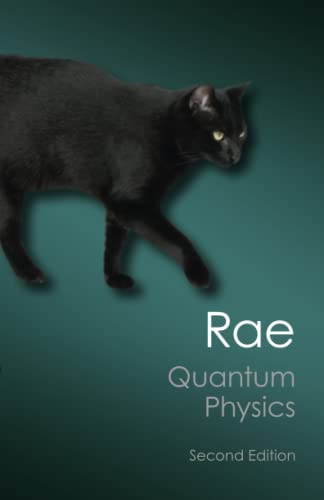
⭐This book provides an excellent overview of the different ways of explaining the puzzles of the quantum world. The cat on the cover is of course Schrodinger’s cat. While many professional physicists simply ignore these thorny philosophical problems – they simply solve Schrodinger’s equation! – some of us would also like to be able to understand what on earth is going on using logical English sentences. Anyway, Alastair Rae’s lucid book covers all the usual suspects, including the Copenhagen interpretation, many worlds, and the idea that the collapse of the wave function is intimately associated with human consciousness. He discusses in considerable detail the relationship between measurement and thermodynamic irreversibility and, while he does not offer a definitive answer to the perplexities of the quantum world, one senses that he himself is inclined to think that the solution lies in this direction.In my view, this is the best book of its type on the subject. Although it is a book for the scientifically-literature reader, most of the chapters are ‘equation free’ and, where there is an equation, it is always a simple one. Anyone wishing to engage at a higher level should read the same author’s excellent “Quantum Mechanics” which, unusually for a QM textbook, contains a 35-page final chapter on the conceptual problems of quantum theory.
⭐Unputdownable says it all.
⭐”Illusion or Reality” sets out clearly the unavoidable difficulties of any attempt to visualise what is actually going on in the quantum world. You may end up agreeing with those quantum purists who insist that it is best not to ask; but at least the author deals with all the main attempts at interpretation in a generally unbiassed way, only revealing his own preferences in a final summary chapter. A slim book, it is by no means a quick read: the subject is precisely argued and concisely expressed.I found only one misprint in this book, annoyingly in an equation – a missing minus sign on page 41. And in only one place did the presentation seem at all partial. Einstein (and his EPR partners) come out pretty badly from this analysis of their objections to the consequences of the Bohr interpretation: granted that Einstein’s hidden variables have – ironically – turned out to require the very non-locality to which he was objecting; that still does not let Bohr and his Copenhagen group off the non-local hook.This book is a balanced take on a subject that Richard Feynman asserted nobody understands.The bibliography is also excellent, opening up many possibilities for further reading in related fields.Footnote: A. Rodgers (see comment) kindly points out that I have slipped up over the page number. Sorry about that. Could be quantum indeterminacy at work; could be senior indeterminacy.
⭐good read….not quite for the layman as I first thought….but had to read it twice to really get some parts….definitely makes you think !
Keywords
Free Download Quantum Physics (Canto Classics): Illusion or Reality? 2nd Edition in PDF format
Quantum Physics (Canto Classics): Illusion or Reality? 2nd Edition PDF Free Download
Download Quantum Physics (Canto Classics): Illusion or Reality? 2nd Edition 2012 PDF Free
Quantum Physics (Canto Classics): Illusion or Reality? 2nd Edition 2012 PDF Free Download
Download Quantum Physics (Canto Classics): Illusion or Reality? 2nd Edition PDF
Free Download Ebook Quantum Physics (Canto Classics): Illusion or Reality? 2nd Edition