

Ebook Info
- Published: 2008
- Number of pages: 378 pages
- Format: PDF
- File Size: 50.79 MB
- Authors: Bonnie Gold
Description
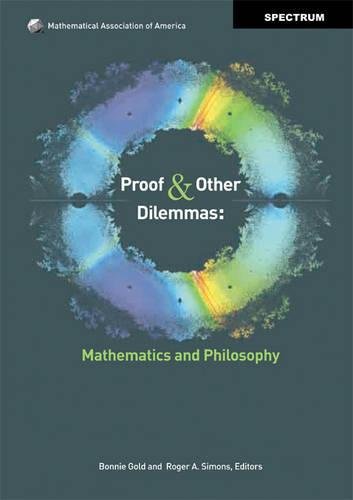
For the majority of the twentieth century, philosophers of mathematics focused their attention on foundational questions. However, in the last quarter of the century they began to return to basics, and two new schools of thought were created: social constructivism and structuralism. The advent of the computer also led to proofs and development of mathematics assisted by computer, and to questions concerning the role of the computer in mathematics. This book of sixteen original essays is the first to explore this range of new developments in the philosophy of mathematics, in a language accessible to mathematicians. Approximately half the essays were written by mathematicians, and consider questions that philosophers have not yet discussed. The other half, written by philosophers of mathematics, summarise the discussion in that community during the last 35 years. A connection is made in each case to issues relevant to the teaching of mathematics.
User’s Reviews
Editorial Reviews: Book Description This collection of sixteen original essays is the first to explore a range of new developments in the philosophy of mathematics, in a way mathematicians will understand. Coverage includes emerging questions in the field as well as recent thinking on classical ideas, all relevant to the teaching of mathematics. About the Author Bonnie Gold is a Professor in the Mathematics Department at Monmouth University, New Jersey.Roger Simons is a Professor in the Department of Mathematics and Computer Science at Rhode Island College.
Reviews from Amazon users which were colected at the time this book was published on the website:
⭐The following is quoted from a review by John Corcoran to appear in Mathematical Reviews.This volume is in the Mathematical Association of America’s Spectrum Series, which is intended to “appeal to a broad range of readers, including students and teachers of mathematics, mathematical amateurs, and researchers”. Its sixteen chapters are individual essays each written by a different author. The authors are said to be “leading mathematicians, mathematics educators, and philosophers of mathematics”. It also includes a 20-page introduction by one of the editors. The seventeen essays are intended to be “a sampler of current topics in philosophy of mathematics”; the essays by philosophers are said to “provide a much gentler introduction to what philosophers have been discussing over the last 30 years than will be found in a typical book”. This should not be taken to mean that these essays give a summary or overview of the last 30 years of philosophy of mathematics. The book also includes a glossary of the “more common philosophical terms (such as epistemology, ontology, etc.)”. The content of the book fully justifies the subtitle “Mathematics and Philosophy”; but nothing seems to explain the implication in the main title “Proof and other Dilemmas” that proof is a dilemma, nor is there anything to indicate which “other dilemmas” are intended. Unfortunately, there are no indexes. There is no easy way to see how the terms in the glossary are actually used in the book or to compare different authors on the same issue or topic. For example, an index would reveal that the realist philosophy of mathematics called “platonism” is widely accepted–both as “the default position among philosophers” (pages xv and 179) and as the view “still dominant among working mathematicians” (page 40); but an index would also reveal that platonism is widely rejected–by leading mathematicians Paul Cohen and Saunders Mac Lane, and also by “most of the famous mathematicians who have expressed themselves on the question” (page 140). An index would greatly improve the usefulness of the book: it would prevent many misleading impressions.The glossary is neither well-written nor accurate: for example, existential import is confused with ontological commitment, token is confused with occurrence, entailment is confused with implication, and there is no hint of awareness of the multiple meanings that have been attached to the word `implication’ and its cognates–to mention a small selection from the 30 entries. Any reader new to philosophy of mathematics is advised to ignore the glossary and to rely instead on one of the several excellent philosophy dictionaries made by philosophers. One favorite is the 1999 Cambridge Dictionary of Philosophy. The first three essays concern the focus in the title of the book: proof, as in “demonstrative proof” as opposed to “proof theory”. All three are subjectivist in that they emphasize subjective belief or “conviction” while ignoring objective cognition–the idea that a proof proves a proposition to be true: a proof produces knowledge in the strict sense, not just persuasion. Moreover, there is no reference to the traditional “truth-and-consequence” conception of proof: that a proposition is proved to be true by showing that it is a logical consequence of known truths, i. e. by deducing the conclusion from established premises–leaving no room for pictures, constructions, diagrams, analogue or digital devices, or anything other than deductive reasoning once the premises have been taken. Overall the book is not easy to read or easy to use. There are however some generally excellent articles–those by Michael Detlefsen, Stewart Shapiro, and Julian Cole stand out–but even these are heavy going, even for someone familiar with previous writings by the same author. Moreover, in almost every essay there are scattered passages containing informative scholarship, useful insights, and interesting and provocative points.
⭐
⭐
⭐
Keywords
Free Download Proof and Other Dilemmas: Mathematics and Philosophy (Spectrum) in PDF format
Proof and Other Dilemmas: Mathematics and Philosophy (Spectrum) PDF Free Download
Download Proof and Other Dilemmas: Mathematics and Philosophy (Spectrum) 2008 PDF Free
Proof and Other Dilemmas: Mathematics and Philosophy (Spectrum) 2008 PDF Free Download
Download Proof and Other Dilemmas: Mathematics and Philosophy (Spectrum) PDF
Free Download Ebook Proof and Other Dilemmas: Mathematics and Philosophy (Spectrum)