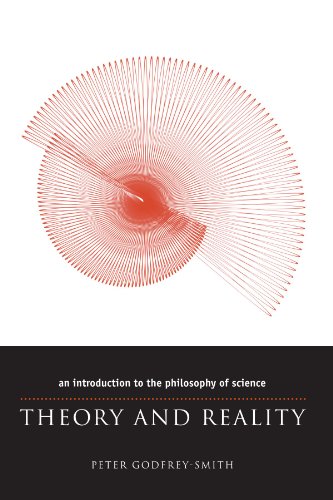
Ebook Info
- Published: 2003
- Number of pages: 272 pages
- Format: PDF
- File Size: 8.74 MB
- Authors: Peter Godfrey-Smith
Description
How does science work? Does it tell us what the world is “really” like? What makes it different from other ways of understanding the universe? In Theory and Reality, Peter Godfrey-Smith addresses these questions by taking the reader on a grand tour of one hundred years of debate about science. The result is a completely accessible introduction to the main themes of the philosophy of science. Intended for undergraduates and general readers with no prior background in philosophy, Theory and Reality covers logical positivism; the problems of induction and confirmation; Karl Popper’s theory of science; Thomas Kuhn and “scientific revolutions”; the views of Imre Lakatos, Larry Laudan, and Paul Feyerabend; and challenges to the field from sociology of science, feminism, and science studies. The book then looks in more detail at some specific problems and theories, including scientific realism, the theory-ladeness of observation, scientific explanation, and Bayesianism. Finally, Godfrey-Smith defends a form of philosophical naturalism as the best way to solve the main problems in the field. Throughout the text he points out connections between philosophical debates and wider discussions about science in recent decades, such as the infamous “science wars.” Examples and asides engage the beginning student; a glossary of terms explains key concepts; and suggestions for further reading are included at the end of each chapter. However, this is a textbook that doesn’t feel like a textbook because it captures the historical drama of changes in how science has been conceived over the last one hundred years.Like no other text in this field, Theory and Reality combines a survey of recent history of the philosophy of science with current key debates in language that any beginning scholar or critical reader can follow.
User’s Reviews
Editorial Reviews: Review “While addressing important issues (such as the difference between logical positivism and logical empiricism), Godfrey-Smith displays consistent clarity. It is truly refreshing to read a text that is thorough, clear, and penetrating. Students with little or no background in philosophy or philosophy of science will find this book to be extremely worthwhile. Professionals in other fields and other disciplines will appreciate the breadth and depth. . . .Whether you teach philosophy of science, or whether you are simple interested in issues relating science, philosophy, history, and other fields, I am confident that you’ll find Theory and Reality an accessible and rewarding read.”–James Sage, Metapsychology — James Sage ― Metapsychology”Godfrey-Smith presents a clear, comprehensive, and accessible introductory survey of the major problems and movements in the philosophy of science. It is an excellent book to use on its own in a lower-level philosophy of science course or as a supplement to some anthology of primary texts in a more sophisticated upper-level course. It would also suit anyone who has interest in the subject but little patience for jargon-heavy professional philosophy. . . . His exposition is accented by insightful commentary and criticism, and by examples from the history of science all with a keen sense of humor.” — Michael Veber ― Science Education”A stimulating introduction to nearly every department of general philosophy of science. . . . Godfrey-Smith’s attempt to inject new vigor and liveliness into philospohy of science is quite successful, as evidenced by the charmingly opinionated style of presentation and the ease with which he ties latter-day perspectives on science back to the classic positivist tradition and the history of science. . . . A very fresh and well-conceived book.” — Matthew D. Lund ― Journal of the History of the Behavioral Sciences From the Back Cover How does science work? Does it tell us what the world is “really” like? What makes it different from other ways of understanding the universe? In Theory and Reality, Peter Godfrey-Smith addresses these questions by taking the reader on a grand tour of one hundred years of debate about science. The result is a completely accessible introduction to the main themes of the philosophy of science. Intended for undergraduates and general readers with no prior background in philosophy, Theory and Reality covers logical positivism; the problems of induction and confirmation; Karl Popper’s theory of science; Thomas Kuhn and “scientific revolutions”; the views of Imre Lakatos, Larry Laudan, and Paul Feyerabend; and challenges to the field from sociology of science, feminism, and science studies. The book then looks in more detail at some specific problems and theories, including scientific realism, the theory-ladeness of observation, scientific explanation, and Bayesianism. Finally, Godfrey-Smith defends a form of philosophical naturalism as the best way to solve the main problems in the field. Throughout the text he points out connections between philosophical debates and wider discussions about science in recent decades, such as the infamous “science wars.” Examples and asides engage the beginning student; a glossary of terms explains key concepts; and suggestions for further reading are included at the end of each chapter. However, this is a textbook that doesn’t feel like a textbook because it captures the historical drama of changes in how science has been conceived over the last one hundred years.Like no other text in this field, Theory and Reality combines a survey of recent history of the philosophy of science with current key debates in language that any beginning scholar or critical reader can follow. About the Author Peter Godfrey-Smith is professor in the School of History and Philosophy of Science at the University of Sydney. He is the author of many books, including Other Minds: The Octopus, the Sea, and the Deep Origins of Consciousness and Philosophy of Biology. Excerpt. © Reprinted by permission. All rights reserved. Theory and Reality: an Introduction to the Philosophy of ScienceBy Peter Godfrey-SmithUniversity of Chicago PressCopyright © 2003 Peter Godfrey-SmithAll right reserved.ISBN: 0226300633Introduction 1.1 Setting OutThis book is a survey of roughly one hundred years of argument about the nature of science. Well look at a hundred years of argument about what science is, how it works, and what makes science different from other ways of investigating the world. Most of the ideas we will examine fall into the field called philosophy of science, but we will also spend a good deal of time looking at ideas developed by historians, sociologists, psychologists, and others. The book mostly has the form of a grand tour through the decades; ideas will be discussed in roughly the order in which they appeared. Note the word roughly in the previous sentence; there are exceptions to the historical structuring of the book, and I will point out some of them as they arise. Why is it best to start with older ideas and work through to the present? One reason is that the historical development of general ideas about science is itself an interesting topic. Another reason is that the philosophy of science has been in a state of fermentation and uncertainty in recent years. A good way to understand the maze of options and opinions in the field at the moment is to trace the path that brought us to the state were in now. But this book does not only aim to introduce the options. I will often take sides as we go along, trying to indicate which developments were probably wrong turns or red herrings. Other ideas will be singled out as being on the right track. Then toward the end of the book, I will start trying to put the pieces together into a picture of how science works. Philosophy is an attempt to ask and answer some very basic questions about the universe and our place within it. These questions can sometimes seem far removed from practical concerns. But the debates covered in this book are not of that kind. Though these debates are connected to the most abstract questions about thought, knowledge, language, and reality, they have also turned out to have an importance that extends well outside of philosophy. They have made a difference to developments in many other academic fields, and some of the debates have reverberated much further, affecting discussions of education, medicine, and the proper place of science in society. In fact, throughout the latter part of the twentieth century, all the fields concerned with the nature of science went on something of a roller-coaster ride. Some people thought that work in the history, philosophy, and sociology of science had shown that science does not deserve the dominating role it has acquired in Western cultures. They thought that a set of myths about the trustworthiness and superiority of mainstream science had been thoroughly undermined. Others disagreed, of course, and the resulting debates swirled across the intellectual scene, frequently entering political discussion as well. From time to time, scientific work itself was affected, especially in the social sciences. These debates came to be known as the Science Wars, a phrase that conveys a sense of how heated things became. The Science Wars eventually cooled down, but now, as I write these words, it is fair to say that there is still a great deal of disagreement about even the most basic questions concerning the nature and status of scientific knowledge. These disagreements usually do not have much influence on the day-to-day practice of science, but sometimes they do. And they have huge importance for general discussions of human knowledge, cultural change, and our overall place in the universe. This book aims to introduce you to this remarkable series of debates, and to give you an understanding of the present situation. 1.2 The Scope of the Theory If we want to understand how science works, it seems that the first thing we need to do is work out what exactly we are trying to explain. Where does science begin and end? Which kinds of activity count as science? Unfortunately this is not something we can settle in advance. There is a lot of disagreement about what counts as science, and these disagreements are connected to all the other issues discussed in this book. There is consensus about some central cases. People often think of physics as the purest example of science. Certainly physics has had a heroic history and a central role in the development of modern science. Molecular biology, however, is probably the science that has developed most rapidly and impressively over the past fifty years or so. These seem to be central examples of science, though even here we encounter hints of controversy. A few have suggested that theoretical physics is becoming less scientific than it used to be, as it is evolving into an esoteric, mathematical modelbuilding exercise that has little contact with the real world (Horgan 1996). And molecular biology has recently been acquiring connections with business and industry that make it, in the eyes of some, a less exemplary science than it once was. Still, examples like these give us a natural starting point. The work done by physicists and molecular biologists when they test hypotheses is science. And playing a game of basketball, no matter how well one plays, is not doing science. But in the area between these clear cases, disagreement reigns. At one time the classification of economics and psychology as sciences was controversial. Those fields have now settled into a scientific status, at least within the United States and similar countries. (Economics retains an amusing qualifier; it is often called the dismal science, a phrase due to Thomas Carlyle.) There is still a much-debated border region, however, and at the moment this includes areas like anthropology and archaeology. At Stanford University, where I teach, this kind of debate was one element of a process in which the Department of Anthropology split into two separate departments. Is anthropology, the general study of humankind, a fully scientific discipline that should be closely linked to biology, or is it a more interpretive discipline that should be more closely connected to the humanities? The existence of this gray area should not be surprising, because in contemporary society the word science is a loaded and rhetorically powerful one. People will often find it a useful tactic to describe work in a borderline area as scientific or as unscientific. Some will call a field scientific to suggest that it uses rigorous methods and hence delivers results we should trust. Less commonly, but occasionally, a person might call an investigation scientific in order to say something negative about itto suggest that it is dehumanizing, perhaps. (The term scientistic is more often used when a negative impression is to be conveyed.) Because the words science and scientific have these rhetorical uses, we should not be surprised that people constantly argue back and forth about which kinds of intellectual work count as science. The history of the term science is also relevant here. The current uses of the words science and scientist developed quite recently. The word science is derived from the Latin word scientia. In the ancient, medieval, and early modern world, scientia referred to the results of logical demonstrations that revealed general and necessary truths. Scientia could be gained in various fields, but the kind of proof involved was what we would now mostly associate with mathematics and geometry. Around the seventeenth century, when modern science began its rise, the fields that we would now call science were more usually called natural philosophy (physics, astronomy, and other inquiries into the causes of things) or natural history (botany, zoology, and other descriptions of the contents of the world). Over time, the term science came to be used for work with closer links to observation and experiment, and the association between science and an ideal of conclusive proof receded. The current senses of the term science and the associated word scientist are products of the nineteenth century. Given the rhetorical load carried by the word science, we should not expect to be able to lay down, here in chapter 1, an agreed-on list of what is included in science and what is not. For now we will have to let the gray area remain gray. A further complication comes from the fact that philosophical (and other) theories differ a lot in how broadly they conceive of science. Some writers use terms like science or scientific for any work that assesses ideas and solves problems in a way guided by observational evidence. Science is seen as something found in all human cultures, even though the word is a Western invention. But there are also views that construe science more narrowly, seeing it as a cultural phenomenon that is localized in space and time. For views of this kind, it was only the Scientific Revolution of the sixteenth and seventeenth centuries in Europe that gave us science in the full sense. Before that, we find the initial roots or precursors of science in ancient Greece, some contributions from the Arab world and from the Scholastic tradition in the late Middle Ages, but not much else. So this is a view in which science is treated as a special social institution with a definite history. Science is something that descends from specific people and places, and especially from a key collection of Europeans, including Copernicus, Kepler, Galileo, Descartes, Boyle, and Newton, who all lived in the sixteenth and seventeenth centuries. To set things up this way is to see science as unlike the kinds of investigation and knowledge that routinely go along with farming, architecture, and other kinds of technology. So a view like this need not claim that people in nonscientific cultures must be ignorant or stupid; the idea is that in order to understand science, we need to distinguish it from other kinds of investigation of the world. And we need to work out how one approach to knowledge developed by a small group of Europeans turned out to have such spectacular consequences for humanity. As we move from theory to theory in this book, we will find some people construing science broadly, others narrowly, and others in a way that lies in between. But this does not stop us from outlining, in advance, what kind of understanding we would eventually like to have. However we choose to use the word science, in the end we should try to develop both 1. a general understanding of how humans gain knowledge of the world around them and 2. an understanding of what makes the work descended from the Scientific Revolution different from other kinds of investigation of the world. We will move back and forth between these two kinds of questions throughout the book.Before leaving this topic, there is one other possibility that should be mentioned. How confident should we be that all the work we call science, even in the narrower sense described above, has that much in common? One of the hazards of philosophy is the temptation to come up with theories that are too broad and sweeping. Theories of science need to be scrutinized with this problem in mind. 1.3 What Kind of Theory? This book is an introduction to the philosophy of science. But most of the book focuses on one set of issues in that field. Within the philosophy of science, we can distinguish between epistemological issues and metaphysical issues (as well as issues that fall into neither category). Epistemology is the side of philosophy that is concerned with questions about knowledge, evidence, and rationality. Metaphysics, a more controversial part of philosophy, deals with general questions about the nature of reality. Philosophy of science overlaps with both of these. Most of the issues discussed in this book are, broadly speaking, epistemological issues. For example, we will be concerned with questions about how observational evidence can justify a scientific theory. We will also ask whether we have reason to hope that science can succeed in describing the world as it really is. But we will occasionally encounter metaphysical issues, and issues in the philosophy of language. The discussion will intersect with work in the history of science and other fields as well. All of philosophy is plagued with discussion and anxiety about how philosophical work should be done and what a philosophical theory should try to do. So we will have to deal with disagreement about the right form for a philosophical theory of science, and disagreement about which questions philosophers should be asking. One obvious possibility is that we might try for an understanding of scientific thinking. In the twentieth century, many philosophers rejected this idea, insisting that we should seek a logical theory of science. That is, we should try to understand the abstract structure of scientific theories and the relationships between theories and evidence. A third option is that we should try to come up with a methodology, a set of rules or procedures that scientists do or should follow. In more recent years, philosophers influenced by historical work have wanted to give a general theory of scientific change. A distinction that is very important here is the distinction between descriptive and normative theories. A descriptive theory is an attempt to describe what actually goes on, or what something is like, without making value judgments. A normative theory does make value judgments; it talks about what should go on, or what things should be like. Some theories about science are supposed to be descriptive only. But most of the views we will look at do have a normative element, either officially or unofficially. When assessing general claims about science, it is a good principle to constantly ask: Is this claim intended to be descriptive or normative, or both? For some people, the crucial question we need to answer about science is whether or not it is objective. But this term has become an extremely slippery one, used to mean a number of very different things. Sometimes objectivity is taken to mean the absence of bias; objectivity is impartiality or fairness. But the term objective is also often used to express claims about whether the existence of something is independent of our minds. A person might wonder whether there really is an objective reality, that is to say, a reality that exists regardless of how people conceptualize or describe it. We might ask whether scientific theories can ever describe a reality that exists in this sense. Questions like that go far beyond any issue about the absence of bias and take us into deep philosophical waters. Because of these ambiguities, I will often avoid the terms objective and objectivity. But the questions that tend to be asked using those terms will be addressed, using different language, throughout the book. And I will return to objectivity in the final chapter. Another famous phrase is scientific method. Perhaps this is what most people have in mind when they imagine giving a general theory of science. The idea of describing a special method that scientists do or should follow is old. In the seventeenth century, Francis Bacon and Ren Descartes, among others, tried to give detailed specifications of how scientists should proceed. Although describing a special scientific method looks like a natural thing to try to do, during the twentieth century many philosophers and others became skeptical about the idea of giving anything like a recipe for science. Science, it was argued, is too creative and unpredictable a process for there to be a recipe that describes itthis is especially true in the case of great scientists like Newton, Darwin, and Einstein. For a long time it was common for science textbooks to have an early section describing the scientific method, but recently textbooks seem to have become more cautious about this. I said that much twentieth-century philosophy of science aimed at describing the logical structure of science. What does this mean? The idea is that the philosopher should think of a scientific theory as an abstract structure, something like a set of interrelated sentences. The philosopher aims to give a description of the logical relations between the sentences in the theory and the relations between the theory and observational evidence. Philosophy can also try to describe the logical relations between different scientific theories in related fields. Philosophers taking this approach tend to be enthusiastic about the tools of mathematical logic. They prize the rigor of their work. This kind of philosophy has often prompted frustration in people working on the actual history and social structure of science. The crusty old philosophers seemed to be deliberately removing their work from any contact with science as it is actually conducted, perhaps in order to hang onto a set of myths about the perfect rationality of the scientific enterprise, or in order to have nothing interfere with the endless games that can be played with imaginary theories expressed in artificial languages. This kind of logic-based philosophy of science will be discussed in the early chapters of this book. I will argue that the logical investigations were often very interesting, but ultimately my sympathy lies with those who insist that philosophy of science should have more contact with actual scientific work. If looking for a recipe is too simplistic, and looking for a logical theory is too abstract, what might we look for instead? Here is an answer that will be gradually developed as the book goes on: we can try to describe the scientific strategy for investigating the world. And we can then hope to describe what sort of connection to the world we are likely to achieve by following that strategy. Initially, this may sound vague or impossible, or both. But by the end of the book I hope to show that it makes good sense. Several times now I have mentioned fields that neighbor on philosophy of sciencehistory of science, sociology of science, and parts of psychology, for example. What is the relation between philosophical theories of science and ideas in these neighboring fields? This question was part of the twentieth-century roller-coaster ride that I referred to earlier. Some people in these neighboring fields thought they had reason to believe that the whole idea of a philosophical theory of science is misguided. They expected that philosophy of science would be replaced by fields like sociology. This replacement never occurred. What did happen was that people in these neighboring fields constantly found themselves doing philosophy themselves, whether they realized it or not. They kept running into questions about truth, about justification, and about the connections between theories and reality. The philosophical problems refused to go away. Philosophers themselves differ a great deal about what kind of input from these neighboring fields is relevant to philosophy. This book is written from a viewpoint that holds that philosophy of science benefits from lots of input from other fields. But the argument that philosophy of science needs that kind of input will not be given until chapter 10. Continues…Excerpted from Theory and Reality: an Introduction to the Philosophy of Scienceby Peter Godfrey-Smith Copyright © 2003 by Peter Godfrey-Smith. Excerpted by permission. All rights reserved. No part of this excerpt may be reproduced or reprinted without permission in writing from the publisher.Excerpts are provided by Dial-A-Book Inc. solely for the personal use of visitors to this web site. Read more
Reviews from Amazon users which were colected at the time this book was published on the website:
⭐This book seems to satisfactorily achieve its proclaimed goal — that is, its goal of offering an intelligible overview of both the history of the philosophy of science over the twentieth century (its entire history takes place in the twentieth century, with a less combative aftermath over unsettled issues persisting into the present century) and a subsequent, ahistorical presentation of the dominating themes of the philosophy of science in our time. Towards this end, it surveys in detail the perspectives of the Vienna Circle, the Logical Positivists, the Logical Empiricists, Karl Popper, Thomas Kuhn, Imre Lakatos, Larry Laudan, and Paul Feyerabend, and then proceeds to the perspectives furnished by “feminist epistemologists” (the very existence of whom insults the man of intellectual honesty, but whose parasitic influence must not be ignored), Robert Merton and other sociologists of science, various prominent theories of causal explanation, the relevance of Bayesianism to current thought on the philosophy of science, and perspectives favoring and opposing empiricism, metaphysical naturalism, and scientific realism as contrasted with instrumentalism.The author does not bother to conceal what his particular perspective on certain positions are; for example, he openly declares his adherence to a moderate form of empiricism, to naturalism, and to realism. Generally speaking, one would anticipate that an introduction of this sort to the field as such, while not avoiding personal perspective entirely (that’s not possible, as there is no such thing as a non-biased work), would tend to be a bit more subtle in such respects. I suppose I don’t find this problematic in any case, but I might as well note that I do not find very convincing his attempted rebuttal of the “theory-ladenness of observation” retort levied against empiricism by many in philosophy of science, concerning both its radical and moderate forms. It is simply not possible to view, perceive, or describe the world in a manner that does not rely heavily on rationalist, non-empirical elements. Also, while I myself subscribe to scientific realism as a sort of heuristic, to defend it more strongly than that is a pretty futile endeavor, a barrier which clearly the author believes himself to somehow circumvent or at least mitigate.Of course, there is much to praise about the author’s perspective. In particular, he seems to competently mix and match the strengths of the major thinkers into one system while disposing of the weaknesses of each thinker.I think, as long as one plans to read a bit more on the same subject after the book, _Theory and Reality_ offers a beyond satisfactory account of the field for the layman.
⭐I think by philosophy of science Peter Godfrey-Smith means sales philosophy of science because throughout he seems to be pitching the science instead of engaging in it. Also, he feels women scientists do best in primatology studying chimps and baboons. I hope that doesn’r reflect the author’s general attitude toward women. Finally in the chapter on naturalism where he illustrates the Müller-Lyer illusion–two lines of equal length where the line with the arrows at the end of the line pointing toward each other is supposed to appear longer than the line with the arrows at the end of the line pointing away from each other–the illusion is convincing mostly because it’s not an illusion: the longer line measures 1 and 7/8th inches and the shorter 1 and 6/8th inches. I believe somewhere in the book the author mentions that very little cheating goes on in science. I believe him. I guess he included the Müller-Lyer illusion to remind scientists how to do it in case they’ve forgotten.
⭐This book is an extremely good summary, to a large extent in chronological order, of many of the main developments in philosophy of science (over the past hundred years or so), from the point of view of the author, Prof. Godfrey-Smith. The writing is, for the most part clear and understandable, at the level of a high school student or first year college student. Nevertheless, to supplement a study of philosophy of science at a more advanced, but still introductory, level, I think that its clarity and simplicity is helpful. The author’s “voice” intrudes, but that is not unhelpful, in my view, because it makes it clear that we are experiencing this summary from a certain viewpoint, if nonetheless well thought out and developed. For its intended audience, i.e. beginners or amateurs at the philosophy of science like myself, it is superb and to be highly recommended. Even so, at that level, I can only recommend it as a summary, and not as some deep philosophical investigation. Even the author makes it clear that there is a substantial intellectual investment and time-cost involved to progress beyond this modest introduction.
⭐Godfrey-Smith is a good writer. You’ll learn a lot from this good intro to the philosophy of science. However, I would be very cautious about recommending this book. The author seems deeply committed to philosophical naturalism/materialism, and does not seriously deal with alternative philosophical positions while attempting to justify his naturalism.
⭐Wow! Having just recently been introduced to the field of Philosophy of Science, I wanted to find something that was not overly technical but at the same time was a little more academic than a book that only offered a brief synopsis of this field of thought. Needless to say, I was not disappointed by this book at all!The book treats the reader as if they are taking a class on this subject for the very first time and that their knowledge of the material is negligible or completely non-existent. This means that the reader is taken through the beginnings of what is now known as the field known as Philosophy of Science. Everyone is in this book from the Logical Positivists, Kuhn, Popper and even people from the field of the sociology of science.The book works in two ways. First, it takes you through the history of the material. Secondly, it shows where the field is headed today and the different approaches to understanding and describing what the Philosophy of Science is. One of the best things about the book is the fact that the author graciously spells out what his own thoughts and approaches to the discipline is.Simply put, a great read. It is slightly difficult to work through in parts but this is to be expected. This is a great entry level book for anyone wanting to learn more about the discipline or hoping for a refreshment of things that they learned before.
⭐I first read this book when it was the set text on an MA philosophy of science module and found it absolutely fascinating. It’s still one of my favourite of the set texts that we worked with on the course. What I especially liked about it is how accessible it is to anyone not familiar with philosophy while at the same time not dumbing down any of the issues and I have enthusiastically recommended it to friends who work in science. I’m returning to buy the Kindle version now in order to re-read and refresh my memory. Definitely one of my all time favourite intros in philosophy.
⭐This book gives an insightful account of modern philosophy of science. I find the author unnecessarily commits himself to scientific realism at early on, without much argument or explanation, only to admit a more eclectic and sophisticated balanced view at the end. The main strength of the book is that it gives a good overview of the core debates.
⭐Excellent introduction to the Theory of Knowledge. Used for instance by the Karolinska Institutet to teach courses on it to Ph.D. students (although they don’t probably read the whole thing).
⭐Love how accessible yet remaining formative and detailed.
⭐This book was quite an eye-opener for me. Whilst debating climate change with my son he recommended I read it.My education was pre-1970. Even my Chemical Engineering uni degree (1971) was based on a relatively simplistic and unsophisticated philosophy of science. It tended to assume that science was on an unchallengeable pedestal.So I found it very interesting that most of the current philosophical ideas in this area are post 1970.As a result, my view of science (like most people of my era and probably most people generally) was VERY outdated.I found it well written and easy to read even if I didn’t take the time to fully understand the details.
Keywords
Free Download Theory and Reality: An Introduction to the Philosophy of Science (Science and Its Conceptual Foundations series) in PDF format
Theory and Reality: An Introduction to the Philosophy of Science (Science and Its Conceptual Foundations series) PDF Free Download
Download Theory and Reality: An Introduction to the Philosophy of Science (Science and Its Conceptual Foundations series) 2003 PDF Free
Theory and Reality: An Introduction to the Philosophy of Science (Science and Its Conceptual Foundations series) 2003 PDF Free Download
Download Theory and Reality: An Introduction to the Philosophy of Science (Science and Its Conceptual Foundations series) PDF
Free Download Ebook Theory and Reality: An Introduction to the Philosophy of Science (Science and Its Conceptual Foundations series)