

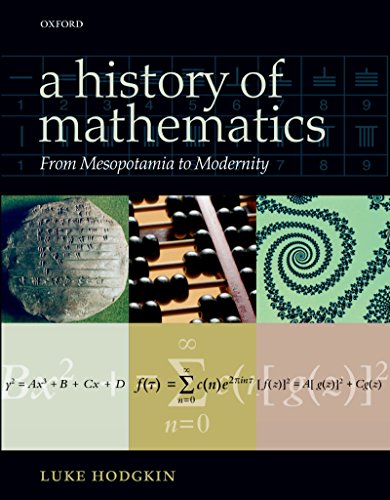
Ebook Info
- Published: 2013
- Number of pages: 296 pages
- Format: PDF
- File Size: 4.15 MB
- Authors: Luke Hodgkin
Description
A History of Mathematics: From Mesopotamia to Modernity covers the evolution of mathematics through time and across the major Eastern and Western civilizations. It begins in Babylon, then describes the trials and tribulations of the Greek mathematicians. The important, and often neglected, influence of both Chinese and Islamic mathematics is covered in detail, placing the description of early Western mathematics in a global context. The book concludes with modernmathematics, covering recent developments such as the advent of the computer, chaos theory, topology, mathematical physics, and the solution of Fermat’s Last Theorem.Containing more than 100 illustrations and figures, this text, aimed at advanced undergraduates and postgraduates, addresses the methods and challenges associated with studying the history of mathematics. The reader is introduced to the leading figures in the history of mathematics (including Archimedes, Ptolemy, Qin Jiushao, al-Kashi, al-Khwarizmi, Galileo, Newton, Leibniz, Helmholtz, Hilbert, Alan Turing, and Andrew Wiles) and their fields. An extensive bibliography with cross-references tokey texts will provide invaluable resource to students and exercises (with solutions) will stretch the more advanced reader.
User’s Reviews
Reviews from Amazon users which were colected at the time this book was published on the website:
⭐The book is in very good condition. A lot of effort put into the packaging. On time delivery. Very happy with this seller.
⭐This book compares favorably with the short history written by David Berlinski. Both works are superficial, but this cannot be avoided to a large extent in such short histories, and the both suffer from singular intrusions of personal biases and proclivities. One understands that such biases are inevitable, but the disparaging attitudes Prof. Hodkin displays especially toward much of recent mathematics and other areas of history and historical work is unwarranted. There are some particularly good sections in the book, especially about non-European mathematics. I feel too that many of his remarks to help mathematicians reading the book focus on what one is presented with in the history of mathematics is very cogent. He makes some perceptive observations. The extensive lists of books for reference and his comments about the books are also useful, to make his book helpful to refer to later. On balance, the text, like Berlinski’s, is satisfactory for a short history of mathematics. For myself, I would like to see a history of mathematics book concentrate more on modern mathematics, where we have seen over the past few centuries an explosion of development, but this demands a level of knowledge of mathematics few historians (if any) possess.
⭐A slightly more descriptive title for this book would be On the History of Mathematics, because the book is not a chronology and detailed narrative of the development of mathematics over the course of human history, but rather a careful, questioning look at selected past moments in mathematics. It does not attempt to tell a comprehensive story of its subject, and in fact ponders at times how such a story should be told. The writing style is polished and reflective. The author often compares the methods, notation, meanings, and possible intentions of earlier mathematicians to those of our own, and contemplates what the differences might imply for our understanding of the texts. The book is a scholarly, thoughtful overview, and would work well as an introductory supplement to more comprehensive general histories of mathematics.Hodgkin refers often throughout the text to Fauvel and Gray’s
⭐.Brief ContentsIntroduction1. Babylonian mathematics2. Greeks and ‘origins’3. Greeks, practical and theoretical4. Chinese mathematics5. Islam, neglect and discovery6. Understanding the scientific revolution7. The calculus8. Geometry and space9. Modernity and its anxieties10. A chaotic end?ConclusionBibliographyIndex”We have not, unfortunately, resisted the temptation to cover too wide a sweep, from Babylon in 2000 BCE to Princeton 10 years ago. We have, however, selected, leaving out (for example) Egypt, the Indian contribution aside from Kerala, and most of the European eighteenth and nineteenth centuries. Sometimes a chapter focuses on a culture, sometimes on a historical period, sometimes (the calculus) on a specific event or turning-point. At each stage our concern will be to raise questions, to consider how the various authorities address them, perhaps to give an opinion of our own, and certainly to prompt you for one.”Accordingly, the emphasis falls sometimes on history itself, and sometimes on historiography: the study of what historians are doing.” (4)
⭐Although the chapter topics follow the current model of history of mathematics text books (compare the table of contents Victor J. Katz’s history of mathematics; notably similar), the text has a strength, depth, and honesty found all too seldom in a text book mathematical history. This is not the typical text-book on technical history that can be dismissed (as Victor J. Katz’s should be) as “a pack of lies” with only “slight exageration” (to quote William Berkson’s Fields of Force).Also, the text is bold enough to quote and translate the actual and typical style of presentation used in Bourbaki meetings: “tu es demembere foutu Bourbaki” (“you are dismmembered [..]) [a telegram sent by Bourbaki group to Cartan, informing him that his book was accepted and would be published]. Luke Hodgkin’s text dispenses with the asterisk (see p.241).
⭐Hodgkin is a historiography geek with no interest in writing a history of mathematics other than to nitpick about details. Basically, each chapter summarises the conventional story—usually rather scornfully, and too briefly for anyone to gain from it—and then dwells on a myriad of minuscule objections to this version raised by highly specialised historians and published (for a reason, I would say) in highly specialised journals. This piling up of obscure historiographical hypotheses rarely makes a coherent point, let alone does it contribute to any substantial understanding of the history of mathematics.
⭐Mr. Hodgkin gives a great overview of the history of mathematics, the current state of historical arguments, and all the references (including websites) for further study. At 262 pages it is very readable – I was not looking for a ponderous work with every possible fact catalogued. His approach is refreshingly irreverent and even funny:”10th century Damascus must surely have been unique as a place where copying the text of Euclid could earn you a living.” and”Perhaps rather than decrying the ‘low level’ of geometry present in Vitruvius’s architecture, we should think about the fact that it was a Roman, rather than a Greek, who bothered to write such a treatise….We have different cultures (cohabiting in the same empire) with different ideas of what a book is for.”I have slogged my way through many math histories without learning half as much, and to be entertained as well is more than one hopes for in such a book.
Keywords
Free Download A History of Mathematics: From Mesopotamia to Modernity in PDF format
A History of Mathematics: From Mesopotamia to Modernity PDF Free Download
Download A History of Mathematics: From Mesopotamia to Modernity 2013 PDF Free
A History of Mathematics: From Mesopotamia to Modernity 2013 PDF Free Download
Download A History of Mathematics: From Mesopotamia to Modernity PDF
Free Download Ebook A History of Mathematics: From Mesopotamia to Modernity