

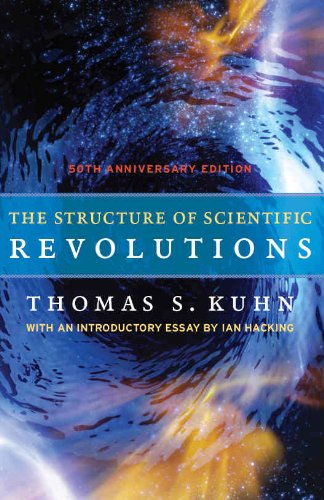
Ebook Info
- Published: 2012
- Number of pages: 212 pages
- Format: PDF
- File Size: 1.44 MB
- Authors: Thomas S. Kuhn
Description
A good book may have the power to change the way we see the world, but a great book actually becomes part of our daily consciousness, pervading our thinking to the point that we take it for granted, and we forget how provocative and challenging its ideas once were—and still are. The Structure of Scientific Revolutions is that kind of book. When it was first published in 1962, it was a landmark event in the history and philosophy of science. Fifty years later, it still has many lessons to teach.With The Structure of Scientific Revolutions, Kuhn challenged long-standing linear notions of scientific progress, arguing that transformative ideas don’t arise from the day-to-day, gradual process of experimentation and data accumulation but that the revolutions in science, those breakthrough moments that disrupt accepted thinking and offer unanticipated ideas, occur outside of “normal science,” as he called it. Though Kuhn was writing when physics ruled the sciences, his ideas on how scientific revolutions bring order to the anomalies that amass over time in research experiments are still instructive in our biotech age.This new edition of Kuhn’s essential work in the history of science includes an insightful introduction by Ian Hacking, which clarifies terms popularized by Kuhn, including paradigm and incommensurability, and applies Kuhn’s ideas to the science of today. Usefully keyed to the separate sections of the book, Hacking’s introduction provides important background information as well as a contemporary context. Newly designed, with an expanded index, this edition will be eagerly welcomed by the next generation of readers seeking to understand the history of our perspectives on science.
User’s Reviews
Reviews from Amazon users which were colected at the time this book was published on the website:
⭐First, let me state the obvious – since Kuhn is talking about the philosophy of science, this is not light reading. That said, this book is as relevant as it was when it was first published – perhaps more so. Kuhn makes a well-reasoned argument that science is not an objective search for “truth,” as many people believe. Instead, “normal science” is a problem solving endeavor, solving known problems by known methods. Science only changes the rules by which it operates (its “paradigm” – that over-used and often misused term in contemporary language) only when the current paradigm causes more problems than it solves. This is the real answer to any from any field who say, “The science is settled. There is no room for discussion.” Those who make that statement need to re-read Kuhn and come to grips with the reality that all knowledge is inevitably socially constructed. If you read this in graduate school, it is worth revisiting. If you have never read it and you are ready for some deep thinking, dive in. You will find your horizons expanded, and that is a good thing.
⭐Science is not a purely additive process. New facts and theories are not simply added to the pile of existing ones. New knowledge and understanding often requires abandoning or drastically reconceiving old theories and observations. Kuhn explores this in great detail, and I found it fascinating and insightful.For example, prior to the invention of the telescope, the celestial sphere was viewed as fundamentally different from the earthly sphere. But a simple look at the moon in Galileo’s telescope reveals it to be a body that is very similar to the Earth. It has mountains which cast shadows as the light moves across them, and so on.The “moon” must now be be viewed as a rather different concept, and this new conception is invoked every time one looks at it. This new “paradigm” affects other observations, such as those of Jupiter and Saturn. They are not pure, static points of light like stars, and some color and a circular shape can be see with the new telescope. Must they be bodies like that of the Moon or Earth as well?In the book, as Kuhn presents his analysis, it seems we are also taking a deep look at epistemology, and the subtleties and differences between how something is perceived and how it is conceived. Grounded in the historical narrative of scientific advancement, I found this investigation of those difficult and elusive topics to be more enlightening than usual.I believe that some criticize Kuhn for how sharp and discontinuous he describes his paradigm shifts to be (although I haven’t looked at this closely yet, I may be mistaken). For me, this was not a main point. I enjoyed his detailed analysis of how paradigms change in general, and why this is a more accurate description of how science progresses, compared to additive models.
⭐10/10. Eighth ever perfect rating: ‘Structure’ is not overrated at all.This is the scientific counterpart to the invaluable work of Alisdair MacIntyre in philosophy. Those works (‘After Virtue’, ‘Whose Justice?’, ‘Three Rival Versions’) are some of the most important for understanding the practice of philosophy and the seemingly-insurmountable aporiae in philosophy and ethics.Kuhn’s work does the same for science, is extensible to many other disciplines, and is the only work I’m aware of that gives a partial, though plausible, set of criteria for distinguishing between science (which progresses *in regards to its ability to solve puzzles about nature* after consolidation in to one framework of practice per subspecialty, with other agreed-upon frameworks overarching) and everything else (e.g. philosophy, which doesn’t seem to progress in a linear fashion, *because it has not found a paradigm* – those aforementioned aporiae – and is besotted with paradigmatically scientific definitions of progress). On the whole, Kuhn’s sketched definition of science does more to solve the demarcation problem than any positivist or ((Popperian)) falsificationist accountMacIntyre throws light on Kuhn, Kuhn throws light on MacIntyre.A work by an atheist that may pave the way for my turn to a modified creationism (one which can account for the reality of human biodiversity and group differences unlike typical Hammian young-earth ‘creation science’: Cavalli-Sforza [in ‘The History and Geography of the Human Genome’] estimates that major adaptations can occur in under 10,000 years and full speciation in 40,000) from the teleological evolutionism I now believe, and which in any case makes that teleological evolutionism more secure than the adirectional – ironically, for Kuhn argues for a picture of scientific development that is as adirectional as the most consistent materialist picture of evolution as opposed to the received picture of an essentially teleological development.
⭐An excellent book. The author observes that we look at scientific progress with the hindsight of history. Advancement seems clear and tidy, with each prominent discoverer identified. However, when we look forward from what, say, a person would observe from 1000 AD, scientific progress is very messy. Progress has starts and stops and dead ends, and progress is function of many people making observations. Many of our scientific giants did not actually discover what we think they did. Instead, they pointed out differences between observations and the then current theory, which made others think of a new theory. It goes in much more depth then that. You should read it.
⭐It was rare for a philosophy essay to have the impact this had when it was published in 1962. Both widely read and serious, it featured in millennial lists of great books of the 20th century – New York Times, Time etc. Its key concept – paradigm – has passed into the social sciences, the arts and business studies and beyond into popular culture. It certainly might be considered a “should read”.It is not easy though. Structure addresses academic scientists and philosophers. In particular he confronts the ideas and propositions of Karl Popper. Some familiarity with physics and chemistry will be required.It has dated a little. Throughout Kuhn refers to scientists as men, not so strange in the 1960s. He holds a very “western view” of science, too. He accords to the practice and its practitioners a respect that has dimmed somewhat in the years since. Certainly today we are not so comfortable with the notion that science best manages itself. Nonetheless Kuhn’s ideas remain as important as they are challenging.Students are likely to encounter Structures on philosophy courses and as part of a taught programme it will easier to understand. It should appeal to graduates and undergraduates in the natural sciences especially. Kuhn himself tells us that in his own days as a student and then professor he found textbooks useful training manuals for physics, chemistry etc but inadequate in other ways. They misrepresented the history of their discipline and misconstrued how it reached its current point and how it would progress in the future. That was the 1940s and 1950s – have current texts been adapted as he suggested? Something readers today could usefully consider.The popularization of key ideas in Structure should be viewed with caution. Concepts such as paradigm have been transferred all too loosely into other domains. Furthermore, it would be false to see Kuhn as a “voice of the 60s” or to suggest that he was debunking technology and rationality. This edition has a useful introduction by Ian Hacking which supplies a corrective to such notions and valuable context.
⭐Kuhn’s masterpiece is still as relevant today as it was when it was published. The text is clear and accessible to all, and that’s certainly something for a philosopher. Just look at Foucault).This book transcends disciplines. An important work of philosophy, yes, but it should not be them it is limited to. If there is one work outside their field I could make every scientist read, it would be this.If you found this review useful in any way I’d be super grateful if you clicked the “helpful” button below to let me know 🙂
⭐I was disappointed by this book, considering the reputation it enjoys. It seems very much of its time, being written when physics rather than biology or AI was the paradigmatic science. It thus illustrates the very phenomenon it sets out to explain, but does so in an over-systematic way that doesn’t really convince – a point that the introduction to this 5Oth anniversary edition comes close to acknowledging. Still, it is worth reading because Kuhn is often cited in post-truth, post-modernist literature in order to justify relativism. The very title of the work should be enough to deter those of a deconstructionist bent from adducing it to support this position.
⭐You can do science without the philosophy of science however I believe it’s in the spirit of the enterprise to do more than just ‘what works’. Meta questions need to be asked to comprehend the purpose and scope of the scientific method.This is one of the most important book for understanding how science progresses and the structure of its history. It’s essential reading for philosophy students or those with an interest in the foundations of science.This book prompted the shift away from seeing the subject as a linear progression and toward the view that it moves forward via ‘paradigm shifts’ in understanding.The book is very clear, insightful, logical and at the same time easy to read, which cannot be said for many great philosophical work and a testament to Kuhn’s clear thinking. Whilst not every part of his argument is successful the fact that his views remain a live debate in philosophy classes to this day, show how important this work is, in this area of western thought.
⭐It rarely happens that you feel you are reading a masterpiece from the first few pages of a book. Here we have one of those situations. This book is also one of those you wish you had read years before, and yet you realise you probably wouldn’t have been ready for it.The intuition won’t disappoint. The book unveils answers to questions like “What is science and how does it differ from other disciplines?” or “Why do scientists behave in the way they do?” or “How does humanity progress in our understanding of nature?”.Not everybody would ask these questions about a subject that is part of our everyday life. Hence, when those questions surprisingly find an answer, it feels like you suddenly understand something that has always been in front of you. And that is an exhilarating feeling.I’d consider this a must-read book for scientists and historians, as well as for lovers of both disciplines. But I believe the pages are of great value also for people with different professions and interests.It is, in fact, possible to draw analogies between the behaviour of scientists before and during a scientific revolution and the behaviour of other types of professionals when the paradigm they are anchored to is challenged.From that standpoint, this book has been invaluable to me. Now, I can better understand particular dynamics typical in my field (high-tech) when an emerging technology threatens the status quo.It is more comprehensible to me why, how, and when proponents and critics of the emerging technology defend their positions or change their minds about it.The book also opens the eyes to a fascinating angle with profound philosophical implications, articulated in Section X: replacing a paradigm with another doesn’t merely lead to a different interpretation of the same data. Instead, it leads to capturing new data, resetting the observer’s worldview (scientist or otherwise) rather than expanding it.My recommendation is to skip the introductory essay by Ian Hacking and start from Section I. It makes more sense to read the introductory essay after finishing the book. And by the book, I mean inclusive of the Postscript, which contains another intriguing philosophical entanglement: an embraced paradigm influences perception (just like life experience influences the predictions that the human brain constantly makes).A word of caution on the language: while accessible to most, the style is eloquent and erudite. Fully understanding each sentence requires above-ordinary focus and concentration.
Keywords
Free Download The Structure of Scientific Revolutions: 50th Anniversary Edition 4th Edition in PDF format
The Structure of Scientific Revolutions: 50th Anniversary Edition 4th Edition PDF Free Download
Download The Structure of Scientific Revolutions: 50th Anniversary Edition 4th Edition 2012 PDF Free
The Structure of Scientific Revolutions: 50th Anniversary Edition 4th Edition 2012 PDF Free Download
Download The Structure of Scientific Revolutions: 50th Anniversary Edition 4th Edition PDF
Free Download Ebook The Structure of Scientific Revolutions: 50th Anniversary Edition 4th Edition