

Ebook Info
- Published: 1999
- Number of pages: 372 pages
- Format: PDF
- File Size: 2.77 MB
- Authors: Jeff Hecht
Description
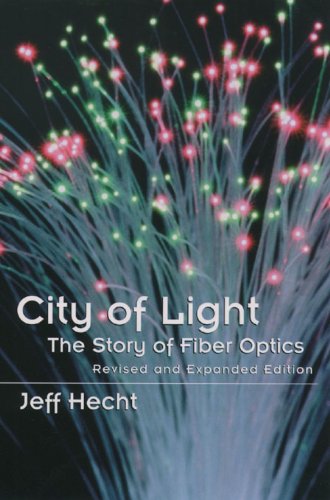
City of Light tells the story of fiber optics, tracing its transformation from 19th-century parlor trick into the foundation of our global communications network. Written for a broad audience by a journalist who has covered the field for twenty years, the book is a lively account of both the people and the ideas behind this revolutionary technology. The basic concept underlying fiber optics was first explored in the 1840s when researchers used jets of water to guide light in laboratory demonstrations. The idea caught the public eye decades later when it was used to create stunning illuminated fountains at many of the great Victorian exhibitions. The modern version of fiber optics–using flexible glass fibers to transmit light–was discovered independently five times through the first half of the century, and one of its first key applications was the endoscope, which for the first time allowed physicians to look inside the body without surgery. Endoscopes became practical in 1956 when a college undergraduate discovered how to make solid glass fibers with a glass cladding. With the invention of the laser, researchers grew interested in optical communications. While Bell Labs and others tried to send laser beams through the atmosphere or hollow light pipes, a small group at Standard Telecommunication Laboratories looked at guiding light by transparent fibers. Led by the recipient of the 2009 Nobel Prize in Physics, Charles K. Kao, they proposed the idea of fiber-optic communications and demonstrated that contrary to what many researchers thought glass could be made clear enough to transmit light over great distances. Following these ideas, Corning Glass Works developed the first low-loss glass fibers in 1970. From this point fiber-optic communications developed rapidly. The first experimental phone links were tested on live telephone traffic in 1977 and within half a dozen years long-distance companies were laying fiber cables for their national backbone systems. In 1988, the first transatlantic fiber-optic cable connected Europe with North America, and now fiber optics are the key element in global communications. The story continues today as fiber optics spread through the communication grid that connects homes and offices, creating huge information pipelines and replacing copper wires. The book concludes with a look at some of the exciting potential developments of this technology.
User’s Reviews
Reviews from Amazon users which were colected at the time this book was published on the website:
⭐I worked on R&D of fiber optic communication system and device since 1976. Thus, I worked for period as same as the latter 1/3 of this book. I attended OFC from 1999 to 2013 and felt the bubble’s up and down by myself. I found several (or more) familiar names with whom I worked and who wrote papers I read again and again. Many technologies are described in the book, but also many people who devoted their time and efforts for fiber optics are introduced. Good book to summarize my own R&D experience in the technical field.
⭐Just like the title says, it is a story/history of optical fibers narrated like a thriller with suspense! It is well detailed and I learnt a lot about science/scientist (and beliefs) by reading this book. Nothing is impossible at the end.
⭐Well written, fascinating and surprising history.
⭐love it!
⭐Fiber optics, the backbone of local and international communications and of the Internet, seems like a new technology, but in this comprehensive history of the field Jeff Hecht describes the Victorian origins of light guiding via jets of water. In the first half of the 20th century a number of researchers independently discovered flexible glass fibers, and with the introduction of the laser in the 1950s long-distance optical communication became a possibility. The main section of the book focuses on the work of researchers in Britain, Japan, and the United States from the 1950s through the 1980s as they overcome many technical problems and develop the beginnings of modern fiber optic cables, documenting the failures, the dead-ends, and the ultimate success in the early 1980s. Extensively researched and annotated, with much material from primary sources, City of Light is accessible to the non-technical reader, yet has enough detail and links to additional sources to satisfy students of engineering history.
⭐This is book has a wealth of information on the early years of fibre optics that I have not seen anywhere else. It is full of names and brief explanations of their contribution. But overall I thought this was a dull, slow moving book with little insight. More of an ongoing collection of notes that have been put together for another better book on the history of fibre once the real story finally emerges. There is very little science here. You won’t learn much about light physics or why the technology works -only that it does and who patented it. (But the science may be reserved for Hecht’s other book.) Also , for those who are trying to keep up with Gilder this book will be disappointing. There is nothing on DWDM (one brief, unexplained mention) or nothing that maps out the current players, companies, or technologies. (I can tell that Gilder has read it because some of the historical facts have been mentioned in the GTR) But there are only a few pages at the end that try to update where the technology has been in the last 10 years, where it is going or why. Huge gaps where a technology is mentioned but not even defined, much less explained. I wish there was a better book on the subject, but for now this is it, and maybe it is worth reading for that reason alone. Sorry to be so critical, but if you like Burke’s “Connections” this will only get you lost. It probably would not have been published but for the sudden surge in tech stocks. I hope the Slone series is not all like this.
⭐This is the book which I always recommend to anyone wanting to learn the rich story behind optical fibre communication. Those of us who helped develop the technology tell differing stories, usually ones with much greater emphasis on the significance of our own research communities. Jeff managed to interview all the key players and then wove their different stories into a single exciting tale. This is not a text book, it is an adventure. The more recent history is not included, but don’t let that put you off. Recent history is always distorted in the telling.If you are interested in more information about the UK lab where pioneer and Nobel Laureate Charles Kao began the fibre story, see […]
⭐The author has an easy narrative style, even though clarity is obstructed by poetic wax in a few places.I am amazed out how much information about fiber optics I have absorbed without study.If you like techie stuff, you’ll love this book. If you like Dilbert, you’ll love this book.Read it!
⭐Fine
⭐Readable, comprehensive – a very good account
⭐Imperdibile per tutti coloro che hanno studiato la fibra ottica sui banchi di scuola o che ne volgiano comprendere le origini e la tortuosa strada che hanno fatto per affermarsi.Ammetto la mia ignoranza dicendo che il contenuto del libro mi ha spesso sorpreso raccontando fatti che non immaginavo.Narrazione cronologica “giornalistica” della nascita e dell’evoluzione della trasmissione ottica, per cui si può leggere iniziando dal capitolo del periodo che più interessa.Andrebbe ampliato con un secondo volume che racconti anche gli ultimi 20 anni e le applicazioni ottiche usate nei satelliti Starlink, ma probabilmente l’autore è ormai in pensione da un pezzo.
⭐
⭐現在世界中で使われている通信用光ファイバについて、その開発の秘話や決定的なブレークスルーとなった革新的技術を取り上げながら、興味深く記述されている。光ファイバをサイエンスの立場から考察し、何が真の技術革新に貢献したかを、丹念に調査し技術史としてまとめ上げたJ.Hecht氏のサイエンスライターとしての力量に敬服する。光ファイバが世にでたことで、インターネットの世界的規模での発展に多大な貢献をしたことは誰しも疑う余地などないだろう。インターネット世界は、Web1.0からWeb2.0へと更なる発展を遂げていると言われる今、地上はもとより海底に至るまで公衆通信の動脈となって世界中に何億kmも張り巡らされている光ファイバの開発史をひもとくことは、日々その恩恵にあずかるユーザーとして大いに意義あることと感じた。
⭐
Keywords
Free Download City of Light: The Story of Fiber Optics (Sloan Technology Series) in PDF format
City of Light: The Story of Fiber Optics (Sloan Technology Series) PDF Free Download
Download City of Light: The Story of Fiber Optics (Sloan Technology Series) 1999 PDF Free
City of Light: The Story of Fiber Optics (Sloan Technology Series) 1999 PDF Free Download
Download City of Light: The Story of Fiber Optics (Sloan Technology Series) PDF
Free Download Ebook City of Light: The Story of Fiber Optics (Sloan Technology Series)