

Ebook Info
- Published: 2004
- Number of pages: 436 pages
- Format: PDF
- File Size: 2.85 MB
- Authors: Dale M Grimes
Description
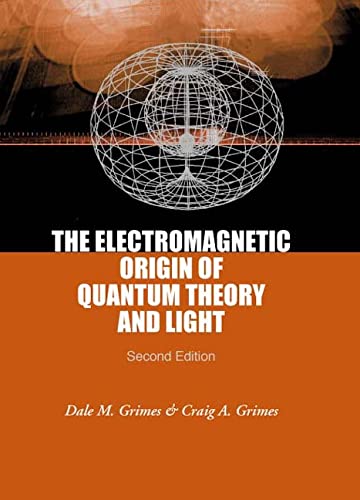
Bell anchored the logic chain begun by Einstein, Rosen, and Podolsky and tested by Aspect et al., showing that entangled electrons are nonlocal. Feynman showed that free electrons are nonlocal in that they travel between any two points using all possible paths. The authors postulate nonlocality of eigenstate electrons and find quantum theory arises from classical electromagnetic field theory. Source fields for photons are detailed.This volume: – Successfully bridges electromagnetism and quantum theory, detailing their common origin, – Significantly reduces the postulatory base of quantum mechanics, – Is particularly useful for photonics scientists seeking to understand properties of light, and- Provides a complete electromagnetic description of photons and the Ritz photonic power-frequency rules.It is a valuable reference for all physics graduate students and professionals interested in the fundamentals of their science, and for all electrical engineering graduate students and professionals interested in antennas.
User’s Reviews
Reviews from Amazon users which were colected at the time this book was published on the website:
⭐The authors of this book, father and son Dale and Craig Grimes, both have an association with Penn State University. Dale, the father, is now professor emeritus at the PSU Department of Electrical Engineering. Craig, the son, received his undergraduate degree in EE from PSU, and went on to receive his Ph.D. in EE from University of Texas at Austin. Later, Craig Grimes was a professor in the Material Science department at PSU. Given the fact that both of the authors are electrical engineers and apparently active in the field of antenna theory, it would seem quite natural for them to regard a photon-radiating atom with its cloud of negatively-charged electrons surrounding a positively charged nucleus as an object analogous to an antenna.The authors take up one of the strange consequences of classical mechanics and E&M that led to the development of quantum mechanics: the expectation that an electron orbiting the nucleus (and therefore suffering angular acceleration as it follows its orbit) continuously looses energy though electromagnetic radiation until it spirals into the nucleus. In order to get away from this catastrophic prediction, Bohr, Heisenberg, and the others who developed modern quantum mechanics mandated that energy could only be lost or gained in quantized amounts. The authors, however, visualize a different scenario in which the radiated electron is buoyed by the classical electromagnetic forces generated by the reactive field resulting from the radiating electron as it begins its fall into the nucleus. Using their knowledge of antenna theory, the authors calculate the forces that would buoy atomic electrons and find that they are adequate for this purpose.The actual link that the authors suggest might exist between quantum mechanics and antenna theory, however, seems extremely tenuous. They do not indicate how E=hv, p=hk, the value of Planck’s constant, or the Schrodinger equation might emerge from reactive electromagnetic forces. The authors show that the time-indepedent Schrodinger equation can be derived from calculating the energy of the system subject to the assumption that the wave function assumes the familiar exp(ip.r/h) form, but this is an obvious exercise that is not informed by antenna theory.The authors also put forward the intriguing notion that wavefunction collapse is the result of nonlinear instabilities (addressable via the Manley-Rowe equations) that develop under radiation pressure in the electron cloud and result in quantum atomic transitions and photon radiation, but few details are provided to support this conjecture. I am left to wonder how a similar argument might be advanced to describe electron diffraction in terms of reactive electromagnetic forces channeling the scattered electron into specific directions as it passes through a thin crystal.
⭐
⭐
⭐
⭐
Keywords
Free Download Electromagnetic Origin of Quantum Theory and Light, the (2nd Edition) in PDF format
Electromagnetic Origin of Quantum Theory and Light, the (2nd Edition) PDF Free Download
Download Electromagnetic Origin of Quantum Theory and Light, the (2nd Edition) 2004 PDF Free
Electromagnetic Origin of Quantum Theory and Light, the (2nd Edition) 2004 PDF Free Download
Download Electromagnetic Origin of Quantum Theory and Light, the (2nd Edition) PDF
Free Download Ebook Electromagnetic Origin of Quantum Theory and Light, the (2nd Edition)