

Ebook Info
- Published: 2010
- Number of pages: 297 pages
- Format: PDF
- File Size: 1.63 MB
- Authors: Robert Paul Lamb
Description
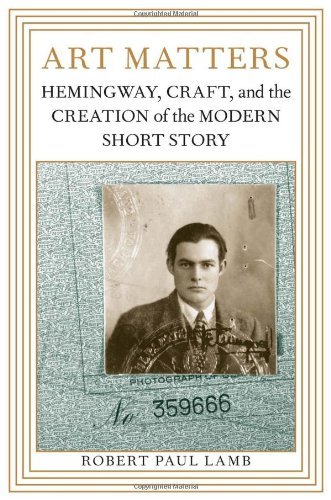
In Art Matters, Robert Paul Lamb provides the definitive study of Ernest Hemingway’s short story aesthetics. Lamb locates Hemingway’s art in literary historical contexts and explains what he learned from earlier artists, including Edgar Allan Poe, Paul Cézanne, Henry James, Guy de Maupassant, Anton Chekhov, Stephen Crane, Gertrude Stein, James Joyce, and Ezra Pound. Examining how Hemingway developed this inheritance, Lamb insightfully charts the evolution of the unique style and innovative techniques that would forever change the nature of short fiction.Art Matters opens with an analysis of the authorial effacement Hemingway learned from Maupassant and Chekhov, followed by fresh perspectives on the author’s famous use of concision and omission. Redefining literary impressionism and expressionism as alternative modes for depicting modern consciousness, Lamb demonstrates how Hemingway and Willa Cather learned these techniques from Crane and made them the foundation of their respective aesthetics. After examining the development of Hemingway’s art of focalization, he clarifies what Hemingway really learned from Stein and delineates their different uses of repetition. Turning from techniques to formal elements, Art Matters anatomizes Hemingway’s story openings and endings, analyzes how he created an entirely unprecedented role for fictional dialogue, explores his methods of characterization, and categorizes his settings in the fifty-three stories that comprise his most important work in the genre.A major contribution to Hemingway scholarship and to the study of modernist fiction, Art Matters shows exactly how Hemingway’s craft functions and argues persuasively for the importance of studies of articulated technique to any meaningful understanding of fiction and literary history. The book also develops vital new ways of understanding the short story genre as Lamb constructs a critical apparatus for analyzing the short story, introduces to a larger audience ideas taken from practicing storywriters, theorists, and critics, and coins new terms and concepts that enrich our understanding of the field.
User’s Reviews
Reviews from Amazon users which were colected at the time this book was published on the website:
⭐Hands down the best book on the craft of short fiction I’ve ever read, and I’ve read a lot of lit crit, theory, works of literary history, been through graduate school, and taught literature. I learned a ton from this book’s close attention to the details and the author’s gift for categorizing techniques and elaborating on them with detailed analyses if examples. A true gift to students of literature.
⭐Amazing book and a must read for any writer
⭐This is an excellent book that has openened my eyes to new possibilities as a writer. I had recently discovered Hemingway and viscerally felt the change in my writing, just through reading his work.But this book gave me the intellectual framework to control and explore. It was a masterclass in sophisticated writing technique. Loved it.
⭐I’ve taken up writing short stories and found the Hemingway style very helpful. He is succinct but understandable and interesting.
⭐I have never really been a huge Hemingway fan, and I have had a little trouble understanding what all the fuss was about, but after reading this book, I have a whole new level of respect for Hemingway’s art. Robert Paul Lamb focuses on Hemingway’s technique. He first establishes a framework for understanding the stories by setting out a set of critical categories (impressionism. expressionism, realism, naturalism, modernism, nonfocalized narratives, internal focalization, external focalization, etc.). The best parts of the book, in my opinion, are when Lamb analyzes a paragraph from a Hemingway story in minute detail using the critical categories and insights into Hemingway’s technique he has already laid out in a general way. Lamb’s analysis of the opening paragraphs of “A Cat in the Rain”, “Now I Lay Me’, and a paragraph from the opening section of “Che Ti Dice La Patria?” increased my respect for Hemingway a hundred-fold.Robert Paul Lamb begins his analysis of Hemingway with the assumption that “Hemingway and other authors actually have some idea what they are doing” (xiv). I find that too many readers in general, and probably some critics as well, fail to give authors enough credit. They think that authors create unconsciously, under the inspiration from the Muse, and have no understanding or control over what they do. One of the premises of Robert Paul Lamb’s book is that Hemingway knew exactly what he was doing and he did it very well. Robert Paul Lamb is also attempting to defend Hemingway from his casual dismissal within academia. Lamb quotes a number of well respected authors, including Faulkner, who thought very highly of Hemingway’s work, and he also quotes some modern authors who argue that there has probably been no other writer in the twentieth-century “who has produced such a direct effect on other people’s writing” (2). I think he is right about that. I tend to prefer Faulkner to Hemingway, both thematically and stylistically, but it definitely seems to me like Hemingway has had more of an influence on modern prose than Faulkner. Lamb also points out that Hemingway’s reputation has suffered because people tend to identify his characters, who are not always likable, with Hemingway himself, and Lamb points out, that rarely happens with authors like Faulkner, which I think is a good point. No one thinks that Jason in
⭐represents Faulkner, and no one criticizes Faulkner for being a jerk, just because he was able to create such an unlikable character.In the first chapter of the book Lamb lays out some of the aesthetic principles of Hemingway’s fiction. Lamb argues that Hemingway was a realist, a naturalist, and a modernist. Realism is defined as stories in which the “the characters follow a probability of motive…the text possesses verisimilitude…and the author/narrator is effaced in third-person, and even in first-person, narratives” (17). Naturalism is a world-view that highlights the indifference of nature to man’s plight, and man’s helplessness in relation to the greater forces operating in the world. Modernism is defined as literature with a “focus on consciousness and the unconscious…concern with epistemology,” and “continual experiments with form and narration” (18). Lamb also points to Hemingway’s rejection of “sentimental prose” and his adoption of Maupassant’s technique in which “emotion must be conveyed and evoked but never by language that is itself emotional” (23). I will have more to say on that at the end of my review because it is one of the hallmarks of Hemingway’s style and it is extremely difficult to write like Hemingway did. It takes real mastery. Hemingway had a theory that one should not present emotion directly but instead, “the real thing, the sequence of motion and fact which made the emotion” (24). If the author is able to do that it will elicit the emotion in the reader without having to be stated directly, while “An emotional presentation diverts the reader’s attention from the scene, undermining the fictional dream” (24)In the second chapter Lamb analyzes Hemingway’s minimal style. Hemingway minimizes words while maximizing meaning through suggestiveness, concision, and omission. Lamb discusses Chekhov’s dictum that a writer can capture the entire effect of a scene with a few well-chosen details (34-35) and then illustrates Hemingway’s use of this technique by analyzing the opening passage of “The Light of the World”: “When he saw us come in the door the bartender looked up and then reached over and put the glass covers on the two free-lunch bowls” (384). This one sentence conveys a lot: the bartender is suspicious, the people entering the bar probably look suspicious, the setting is somewhat seedy, etc.. A nineteenth-century novelist would have spent anywhere from a paragraph to a page conveying the same information. Lamb then goes on to to examine Hemingway’s famous iceberg theory and argues it has been misinterpreted. Lamb thinks that Hemingway’s iceberg theory is really about the omission of the subjective emotional responses of his characters rather than the omission of details (like the war in “Big Two-Hearted River” or the word abortion in “Hills Like White Elephants”). I am not sure whether I agree with Lamb on that. Hemingway himself is the one that referred to “Big Two-Hearted River” when talking about his iceberg theory, but Lamb’s analysis is interesting nonetheless.In the third chapter Lamb examines Hemingway’s methods of depicting consciousness. Lamb contrasts Hemingway’s impressionism with Willa Cather’s expressionism. Hemingway “limits himself to depicting perception, allowing readers to infer the sensation, while Willa Cather focuses on sensation and expects readers to infer perception” (51) (by sensation Lamb means emotional response or affect or the qualia of experience, i.e. what it feels like). Lamb analyzes the opening of “An Alpine Idyll” and shows how Hemingway presents the very process consciousness follows in synthesizing a scene as opposed to simply presenting the final product of synthesis. Hemingway uses short declarative sentences that each pick out one detail, as opposed to long sentences with subordinated clauses (62). Lamb also argues that Hemingway’s descriptions of nature follow the “logic of the eye”, moving from foreground to middle ground to background and back again, rather than trying to synthesize them all into a single coherent picture (66) All of these techniques are in the service of the same goal. They are all means for depicting consciousness in the very process of its synthesizing activities, and they help to convey immediacy, as opposed to retrospective synthesis.In the fourth chapter Lamb lays out his categories of focalization (or point of view). Focalizer means “through whose eyes we see and to whose mind we have access” (79). There are three categories of focalization: nonfocalized narratives (what is usually called omniscience), internal focalization (where we only have access to what one character knows), and external focalization (where the narrator may use a focalizer or focalizers to sight the action but never gives us access to their thoughts) (79). Internal focalization is itself broken down into three sub-categories: fixed internal focalization (limited to one focalizer), variable internal focalization (more than one focalizer), and multiple internal focalization (variable internal focalization where all focalizers are viewing the same event from their own perspectives) (80). Hemingway, according to Lamb, rejected nonfocalized narration since it implied a kind of knowledge that no one was in a position to posses and was “anathema to the spirit of modernism” (80-81). Lamb argues that “External focalization most suited…[Hemingway’s] aesthetics”, but, in reality, most of Hemingway’s stories are written in some form of internal focalization. However, Hemingway’s style is based on his “making all forms of focalization as close to external focalization as possible” (103).In the fifth chapter Lamb analyzes Hemingway’s use of repetition and juxtaposition. Lamb examines the debt that Hemingway owed to Gertrude Stein’s techniques as well as his departures from her techniques. Hemingway takes over Stein’s desire to “represent moments as they are being experienced rather than retrospectively” (116). Lamb claims that Stein’s techniques were like Picasso’s paintings. She presented various snapshots, or fragments, seen at different times and different perspectives, and just presented them all together, without working them over into a synthesis. For Stein, this is how we come to know character. We do not ever grasp a personality in its integrity. We grasp various disconnected pieces. Hemingway also learned from Stein that you could change the connotation or denotation of a word by repeating it in different contexts (121). Lamb provides a great analysis of the repetitions in a paragraph from “Che Ti Dice La Patria”, and shows how Hemingway was able to move the narrative along with his descriptions and convey the sense of driving through the country side; through his subtle repetitions of details Hemingway was able to combine description and narration, while also capturing the stasis of the Italian people under fascism. Quite an achievement! Lamb provides equally insightful analyses of the opening paragraphs of “In Another Country” and “Now I Lay Me” that, as I already said, increased my respect for Hemingway a hundred fold.In the sixth chapter Lamb lays out four different possible openings (in medias res without subsequent exposition, in medias res with exposition displaced to later in the text, traditional expository openings, and tonal openings that establish the mood from which the story organically unfolds) (139). Lamb then provides a great analysis of the tonal opening of “Cat in the Rain”, showing how all of the details Hemingway chose to depict, all work to highlight the isolation and loneliness felt by the wife in the story (143). Lamb then goes on to explain the notion of the disjunctive bump that is characteristic of short story endings. The endings of short stories tend to make the reader aware of their delimited space. There is an awareness that there is a greater world that lies outside the confines of the story and that continues to go on after the story ends. Lamb then goes on to to describe four different possible endings that are distinguished based on whether they highlight or conceal the disjunctive bump (open endings, rounded closed endings, seeded closed endings, and float-off endings). Obviously, Lamb illustrates the various endings with reference to Hemingway’s stories.In the seventh chapter Lamb examines the difference between what he calls the “normative center”, the “illustrative stamp”, and the “Joycean epiphany”. The nineteenth-century novel often had what he calls a “normative center”. It is a point in the story or novel where “tensions cease” and the author gives us a glimpse of “how things ought to be” (156). Lamb illustrates the idea with a scene from
⭐where the whalers see a herd of whales and their young offspring swimming next to the ship, and they find it beautiful. It is a scene of peaceful coexistence rather than obsessive antagonism and represents the proper relationship between man and nature by which the rest of the novel is judged (Lamb also uses a scene from
⭐to illustrate the same point). Lamb argues that in the twentieth-century the normative center was replaced by the “luminous moment”, while in the short story what we get is an “illustrative stamp”. The illustrative stamp is an image that manages to sum up the entire story along with its themes in a way that is memorable and really drives the themes and emotions home. Lamb then lays out the characteristics of Joycean epiphanies and explains why Hemingway did not use them (epiphanies reveal the “whatness” of things which, for Hemingway, would interfere with their “thingness”, and undermine the ultimacy of the physical world, 165).In the eight chapter Lamb analyzes Hemingway’s important innovations in the uses of dialogue. Lamb argues that dialogue was rarely used for characterization in the nineteenth-century, and “characters said what they consciously thought, meaning lay on the surface, and their words were remarkably free from the sorts of inner conflicts and psychological complexities inherent in the speech of real people” (170). Lamb argues that Henry James’ dialogue “served as a powerful model for Hemingway in its indirection, ambiguity, and portrayal of communication as veiled, partial, and difficult.” However, for James, dialogue was “purely complementary; its proper and only function was to be ‘directly illustrative of something given us by another method’ of presentation” (171). Hemingway’s revolution was to make dialogue primary, to convey things through dialogue that were not conveyed through exposition. Another difference between James and Hemingway is that, while James “focused on the consciousness of characters capable of rich perception, feeling, and self-awareness”, Hemingway often focused on characters who were “much less articulate, sophisticated, versed in the strategies of speech, and consciously self-aware” though they still possessed “the same complex unconscious motivations as any human character” (177).In the ninth chapter Lamb discusses plot, characterization, and setting. Lamb argues that, ultimately, there are only a limited number of plots, and “everything that is plot is inevitably about character” (206). The interest of plot arises from questions about how specific characters will react and how the various incidents reveal character. Lamb quotes Maupassant as claiming that “all psychology should be concealed [in fiction], as it is in reality, under the facts of existence” (207). This means that characterization should not be presented through long psychological analyses carried out by the narrator but in concrete behavior and reactions. In a short story there is rarely enough time to fully flesh out characters which means that the artist has to be very careful in picking out illustrative details (reactions to situations, dialogue, facial expressions, clothing, gestures, etc.) that are able to give the reader the sense of a fully rounded character. Lamb then examines the “hieroglyphics” that Hemingway provides for his characterizations in “A Pursuit Race, “In Another Country”, “The Killers”, and “The Doctor and the Doctor’s Wife”.In the coda, Lamb examines some reasons he believes Hemingway has had such a lasting influence, including his revolution in the use of dialogue and his use of omission and concision (226).I want to end this ridiculously long review with a personal anecdote that has increased my appreciation for Hemingway’s craft. The idea of writing fiction recently entered my head so I picked up a book called
⭐by John Gardner. The book has a number of writing exercises in it. In one of the exercises you are supposed to write a description of a barn as seen by a father who has just lost his son in a war, but you are not supposed to mention the son, the war, death, or the father, while still conveying the mood of grief and loss. Here is what I learned: it is relatively easy to convey the mood if you have recourse to what Maupassant called “emotional prose”. You can take the adjectives that you would usually apply to a person in grief and simply apply them to the details of your picture (you can describe hinges as “wailing”, or dust “drifting aimlessly” as people in grief tend to do). What is extremely difficult to do is exactly what Hemingway did: to convey the emotion with prose that is not itself emotional, through the selection of a few choice details. After trying this exercise I had a whole new respect for Hemingway. Personally, I have always preferred Faulkner to Hemingway, and I have always assumed that Faulkner was the better artist. However, it was not until I tried to do this writing exercise, and I set myself the challenge of trying to do it as Hemingway would have done it, as opposed to how I would do it, that I finally realized just how difficult it is to write like Hemingway. Hemingway makes it look easy and simple and, I think, that is one reason why his reputation may have suffered a bit in critical circles. However, anyone who says it is easy to write like Hemingway has never tried it.In conclusion, this is, by far, one of the best works of literary criticism I have ever read. It is great not only for those interested in Hemingway, but for all aspiring writers who take their craft seriously. And the great news is, Lamb has written a sequel
⭐. I have not read it yet, but I have ordered it from the library, so hopefully I will be getting it soon.
⭐I loved this book. It was very instructive. I learned a lot from Hemingway on the craft of writing. Robert Lamb’s analysis was clear as d engrossing.
⭐I don’t know how we managed to muddle through work as literary critics for so long without this book.Lamb’s is a dual study. First, it isolates Hemingway’s short stories and drives to the center of their power: Hemingway’s intense craftsmanship. Good writing does not emerge ex nihilo from the writer’s exquisite imagination in a stroke of genius, Lamb reminds us, but through a process of self-conditioning, in the writer’s case by reading carefully other craftspeople. Here Lamb tracks the development of Hemingway’s much-celebrated use of concision and omission (recall EH’s iceberg metaphor), and how Hemingway’s technical skill as a crafter of sentences changed the face of fiction. Second, emerging from this first project by locating Hemingway’s trajectory of influence and thinking carefully about what writers study in order to become writers, Lamb’s book presents a new–and remarkable–study of the short story genre. Often neglected by the academy as throw-away literature (training wheels in order for the great writers to get to their novels, perhaps), or relegated to the classroom as merely convenient pedagogical tools, the short story remains largely absent from serious critical scrutiny. For Lamb, however, the short story operates as a wholly separate genre, operating within its own set of generic rules–and as such, requires a critical apparatus that acknowledges this difference. Drawing on the languages of the visual arts and critical theory, and reassessing some of our forgotten implements in the critic’s toolchest, Lamb crafts a discourse with which we can now talk intelligibly about the short story that recuperates its place in the pantheon of genres, allowing it to stand along with the novel, the poem, and the play.I could spend pages exploring the intelligence of Lamb’s work. The text is so rich that to do so would be a disservice, though–how could I leave out any of the finer points that will reward readers of all critical dispositions? Most (if not all) will return again and again to Lamb’s as a sourcebook about how to think about short fiction that pays off on each dip into its pages.At the bottom of it, Lamb’s book is accessible without being simplistic, and complex while being readable. He says early on that his goal has been to write for an intelligent general audience without alienating the literary critical establishment out there. In the first task he’s succeeded remarkably; lay readers far and wide will find Lamb’s analysis of Hemingway’s terse, loaded prose opening up layer upon layer of nuance. In the second task, though, I wonder if he hasn’t thrown down the gauntlet. Unlike some scholars who produce obscure tracts for only a small coterie of peers and acolytes in order to secure their places as “difficult” thinkers, Lamb wants to be understood, to give writers their due as craftspeople, to think hard about what short fiction does. And so he writes exactly what he means. Though he introduces a legion of imminently useful terms, he does so without seeming as though he is amusing himself. They are, after all, immediately applicable. In this way, “Art Matters” might rankle the literary establishment a bit at its unashamedly smart, clean prose. So much the better for all lovers of literature, I argue, let it rankle. Perhaps they’ll feel embarrassed enough to try harder in their own craft.Bless you, Robert Paul Lamb. I’ll never read short fiction–or Hemingway–the same way again.
⭐pagine si staccano,
⭐
Keywords
Free Download Art Matters: Hemingway, Craft, and the Creation of the Modern Short Story (Southern Literary Studies) 1st Edition in PDF format
Art Matters: Hemingway, Craft, and the Creation of the Modern Short Story (Southern Literary Studies) 1st Edition PDF Free Download
Download Art Matters: Hemingway, Craft, and the Creation of the Modern Short Story (Southern Literary Studies) 1st Edition 2010 PDF Free
Art Matters: Hemingway, Craft, and the Creation of the Modern Short Story (Southern Literary Studies) 1st Edition 2010 PDF Free Download
Download Art Matters: Hemingway, Craft, and the Creation of the Modern Short Story (Southern Literary Studies) 1st Edition PDF
Free Download Ebook Art Matters: Hemingway, Craft, and the Creation of the Modern Short Story (Southern Literary Studies) 1st Edition