

Ebook Info
- Published: 1984
- Number of pages: 159 pages
- Format: PDF
- File Size: 0.86 MB
- Authors: Peter G. Doyle
Description
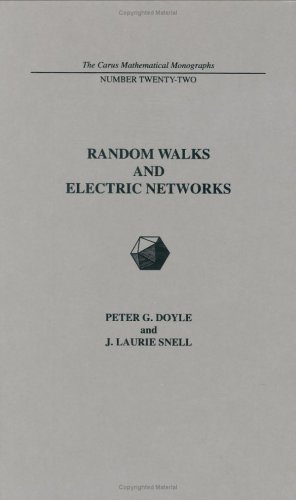
Book by Doyle, Peter G., Snell, Laurie
User’s Reviews
Reviews from Amazon users which were colected at the time this book was published on the website:
⭐This book is a real and rare gem of mathematical teaching. It explains in easy and accessible language the links between the topics in the title with remarkable clarity and simplicity. Of course the real strength of a book like this is to show to beginner mathematicians the power one can acquire by looking at a given problem from several perspectives, and this is where the book really excels.The authors are doing a great job in reducing all concepts to the essential, but never – on the other side – trivializing or leaving essential things unexplained. College algebra is all what is required to understand it, and you will certainly be rewarded.
⭐The book brings together two of my passions : randomwalks and electric networks. It turns out that there areinteresting relationships between these two areas, so insightsin one provide can be used to prove things in the other.There is this beautiful theorem by Polya which states that arandom walker on an infinite street network in d-dimensionalspace is bound to return to the starting point when d = 2,but has a positive probability of escaping to infinity withoutreturning to the starting point when d >= 3. The bookreinterprets this theorem as a statement about electric networks,and then proves the theorem using techniques from classicalnetwork theory. The proof relies on showing that the resistanceof the corresponding electric network in 1 and 2 dimensionsis infinite, whereas it is finite in the 3 dimensional case.Thus some current [like our random walker] can flow to infinity.Strongly recommended!. Also check out Peter Doyle’s webpageat Dartmouth “[…]”
⭐This book provides fascinating insights and analogies between random walks and electric networks- and how you can exploit these analogies to solve difficult problems in one using the other… there’s also a nice proof of the “Polya’s theorem” using these analogies- basically Polya’s theorem says that a random walk in dimensions >2 is transient, while a random walk on a plane or a line always returns to its starting point…
Keywords
Free Download Random Walks and Electrical Networks (Carus Mathematical Monographs) 0th Edition in PDF format
Random Walks and Electrical Networks (Carus Mathematical Monographs) 0th Edition PDF Free Download
Download Random Walks and Electrical Networks (Carus Mathematical Monographs) 0th Edition 1984 PDF Free
Random Walks and Electrical Networks (Carus Mathematical Monographs) 0th Edition 1984 PDF Free Download
Download Random Walks and Electrical Networks (Carus Mathematical Monographs) 0th Edition PDF
Free Download Ebook Random Walks and Electrical Networks (Carus Mathematical Monographs) 0th Edition