

Ebook Info
- Published: 1961
- Number of pages: 432 pages
- Format: PDF
- File Size: 29.19 MB
- Authors: Donald H. Menzel
Description
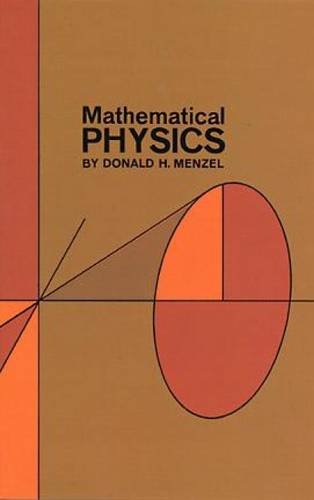
This is a thorough treatment in one volume of the mathematical techniques vital in classical mechanics, electromagnetic theory, quantum theory, and relativity. Designed for junior, senior, and graduate courses in mathematical physics, it presents full explanations of function theory, vectors, matrices, dyadics, tensors, partial differential equations, and other advanced mathematical techniques in their logical order during the presentation of the various physical theories. The completeness of the derivations makes the book especially useful for self-study.Several topics seldom presented, such as electron theory and relativity, appear in considerable detail, because an understanding of them is increasingly vital to the student of atomic physics. But the author’s treatment of his chosen subjects in classical physics is no way slighted, and his book has proved valuable to students in all fields of physics.The opening section provides scores of definitions, conversion factors, dimensional constants, and electromagnetic quantities for ready reference later on. There follows a full treatment of the main branches of classical physics: potential theory, spherical harmonics, vector analysis, dyadics, matrices, tensors, hydrodynamics, advanced dynamics, waves and vibrations, quantum mechanics, electromagnetic theory, and radiation theory. The book concludes with a discussion from first principles of the theory of relativity.Nearly 200 problems ranging over a wide level of difficulty and selected from many different fields of physics are included, with answers, at ends of chapters.”The treatment is more detailed than normal for an advanced text . . . excellent set of sections on Dyadics, Matrices, and Tensors. . . . The part on waves and vibrations is well done . . . problems well varied in difficulty.” ― Journal of the Franklin Institute.
User’s Reviews
Reviews from Amazon users which were colected at the time this book was published on the website:
⭐Love this book. It is a little dated, but you can pick it up only knowing mathematics. Recommended prerequisites are ODE (PDE), Multivariable Calculus, and Linear algebra (vector analysis), but you could get by with Calculus 1/Calculus 2. Physical concepts start pretty much from scratch and then quickly gets to the more serious information that you won’t see in the modern intro physics classes. Super fun book I recommend it to anyone that wants to bridge over to physics from mathematics.
⭐This is a good textbook on the most classical aspects of mathematical physics. However, it is dated, having been published originally in 1947 (Dover edition corresponds to the 2nd ed. of 1953, corrected), and its age becomes apparent in the choice of names, notation, and topics.Regarding the choice of topics, the book lacks a decent presentation of the special functions of mathematical physics, analytic functions, and integral equations, and nothing is said about Hilbert space (even if only to put orthogonal polynomials into a more unifying perspective…), generalized functions, Green’s functions, continuous groups, etc. To be completely frank, this book is much more a (dated, average only) compendium of classical physics (mechanics and electrodynamics, mostly) than a book on mathematical physics.On the positive side, there is physical insight in many parts of the presentation, and this is some added value (albeit on page 383 we learn that “astronomers generally believe that nuclear reactions furnish the heat radiated by the sun and stars.” – oh, really?). I do also consider the opening chapter on dimensional analysis a must read for everyone, something that most physicists are not familiar with (except, perhaps, fluid dynamicists!) but definitely should be.If you are a beginner, undergrad student, forget about this book and go for one of the more modern textbooks (
⭐and
⭐are good choices), while if you are a more advanced student, go for Byron & Fuller ”
⭐.” I strongly recommend Byron & Fuller for a modern view on classical mathematical physics. Students interested in some mild formalism should pick S. Hassani’s ”
⭐.” Now, if you are a professional mathematician or mathematical physicist, then you have reached this page by mistake!
⭐This is a good reference work for students and professionals. It has many tables, charts anddiagrams to develop the important constants of physics and the subject of mechanics includingrelativity.
⭐still trying to understand this stuff but this book helps lots really great for anyone interested in physics!!! love it
⭐thank you.
⭐looks quite god thanks
⭐Perhaps I am unusual in expecting books dealing with mathematics, whether at the simple or the complex level, to be as elegantly and lyrically written as the equations contained within the book, but there it is. There is my personal bias. I do – contrary to the accepted serious-text style – want that beauty and poetry in the writing style.Yet in spite of my faint bias, this book is worthy of a five-star review. In terms of presenting the information, exceptional clarity is maintained, but a couple of times I did feel my attention wandering. I forced my attention back to the book, and found that it rewards the patient reader.In terms of content? Terrific. Gauss’ law is described and illustrated with equations and explanation as clearly as one could wish. Professor Menzel’s discussion of the properties of spherical harmonics is unambiguous and thorough. In the classical electromagnetic theory section, the explication of electomagnetic force field calculations is step by step, clear, but not laboured.This is NOT a book for beginners, but for the serious student of the mathemetics required in classical mechanics, quantum theory, relativity and electromagnetic theory. For those who are looking for advanced mathematics for use in a variety of the fields wtihin the study of physics, this is a very good resource.
⭐I switched over from a BS in math to get a Ph.D. in physics. My grad courses used all of the standard texts: Goldstein for Mechanics, Jackson for Electrodynamics, etc. I did fine but I never felt like I mastered the material, especially the why and how of the mathematics.Now, I just discovered Menzel’s “Mathematical Physics” with a year left in my Ph.D. program. I wanted to review some of the basics I hadn’t used since I started research full time and what a joy this book is!!! I fell in love with the first few pages. He succinctly introduces the basics of mechanics and analytical geometry in a few pages…and you understand clearly!I then discovered that he covers tensors and differential geometry. I can tell you from having looked at many books on General Relativity that Menzel’s coverage of the math for General Relatively is excellent, insightful, and intuitive.My suggestion for grad students of physics is to pick up this little gem as a supplement to their assigned texts and to keep it handy as a refresher whenever needed.
⭐I bought this book as a reminder of the stuff I did in my physics degree at uni back in the 80s. It’s great in that it goes at just the right speed and in the right depth.HOWEVER, it isn’t written in SI units, so isn’t very useful for today’s students. It skips between ESU, EMU and CGS units which is quite confusing even for an oldie like me. The maths, though, is spot on, and that’s what I bought it for.
⭐this book is a must for any applied mathematician, physicist or engineer!!!!ive just read the first formal chapter of the book (chapter 2, chapter one is just defining some keywords) and wow!! no words, made tears come out! from newtons three laws, Dr. Menzel has, with mathemagical manipulation of f=ma, have proved that energy in a field is conserved!!! they then prove the conservation of momentum!!! i mean it doesnt get better because Dr. Menzel did this in just two pages! this book has no wordy or lengthy paragraphs! just straight to the equations and their mathemagical beauty!!!excellent buy and probably my favourite!
⭐Compact and concise, covers all topics and very useful to have handy.
⭐like a lot already using in anger
⭐Good quality, fast delivery
Keywords
Free Download Mathematical Physics (Dover Books on Physics) in PDF format
Mathematical Physics (Dover Books on Physics) PDF Free Download
Download Mathematical Physics (Dover Books on Physics) 1961 PDF Free
Mathematical Physics (Dover Books on Physics) 1961 PDF Free Download
Download Mathematical Physics (Dover Books on Physics) PDF
Free Download Ebook Mathematical Physics (Dover Books on Physics)