

Ebook Info
- Published: 2090
- Number of pages: 1118 pages
- Format: PDF
- File Size: 25.83 MB
- Authors: David M. Young
Description
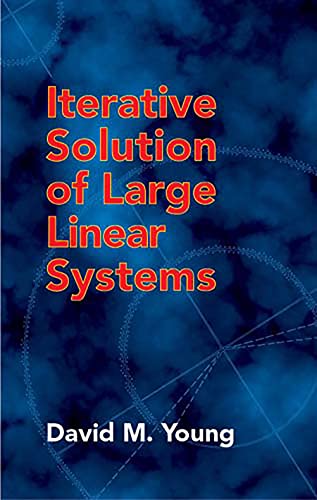
This self-contained treatment offers a systematic development of the theory of iterative methods. Its focal point resides in an analysis of the convergence properties of the successive overrelaxation (SOR) method, as applied to a linear system with a consistently ordered matrix. The text explores the convergence properties of the SOR method and related techniques in terms of the spectral radii of the associated matrices as well as in terms of certain matrix norms. Contents include a review of matrix theory and general properties of iterative methods; SOR method and stationary modified SOR method for consistently ordered matrices; nonstationary methods; generalizations of SOR theory and variants of method; second-degree methods, alternating direction-implicit methods, and a comparison of methods. 1971 edition.
User’s Reviews
Reviews from Amazon users which were colected at the time this book was published on the website:
⭐SOR is a very good method in numerical methods. The method can be extended and hybrid with others methods to improve the solutions.
⭐That means that there’s a huge amount of valuable information here. It also means that you’ll spend a huge amount of effort digging that information out and refining it into commercially useful form.The topic is an important one. Million-by-million systems of linear equations are painfully common. Quite often, however, they’re sparse – only a few percent or fraction of a percent of off-diagonals are nonzero. Under some circumstances, you can process only those few nonzeroes iteratively into a very good answer very fast. The questions, then, are when, how, how good, and how fast, especially when compared to the Gaussian elimination algorithms. This book answers all of them in meticulous detail. 500+ pages mean that it explores many different answers, including special forms for band diagonal, symmetric, real, and other special forms of matrix. It’s all here, complete with detailed analyses of convergence criteria and rates.My work with non-standard processors makes me very receptive to new ways of addressing important problems, and this approach has a lot going for it: it’s 100% payload with no fussing around in zeroes, some forms parallelize well, some forms update in place, and many algorithms avoid division (don’t laugh – it matters). The problem is that this is a mathematician’s book. It has all the formal rigor you could want. If you’re trying to tease debuggable code out of the notation, though, you’d better put on an extra pot of coffee and tell your dinner-date that you might not make it. In fact, practical algorithms are so irrelevant to this text that you might have a tough time seeing just where they are.So, as a computing practitioner, I can’t give this the highest grades. I’m patient enough to come back and extract the codable parts if ever I need them, but not when the deadline is tight. I just hope, very sincerely, that I never need them – or that I find other references a bit closer to practicable form.//wiredweird
⭐The book arrived in perfect conditions. The content is excellent. Really useful if a deep analysis of linear iterative methods is needed, but not of more modern methods. It’s a must if interested in smoothers for multigrid methods.
Keywords
Free Download Iterative Solution of Large Linear Systems (Dover Books on Mathematics) in PDF format
Iterative Solution of Large Linear Systems (Dover Books on Mathematics) PDF Free Download
Download Iterative Solution of Large Linear Systems (Dover Books on Mathematics) 2090 PDF Free
Iterative Solution of Large Linear Systems (Dover Books on Mathematics) 2090 PDF Free Download
Download Iterative Solution of Large Linear Systems (Dover Books on Mathematics) PDF
Free Download Ebook Iterative Solution of Large Linear Systems (Dover Books on Mathematics)