Ebook Info
- Published: 2014
- Number of pages: 658 pages
- Format: PDF
- File Size: 4.21 MB
- Authors: Michael J. Panik
Description
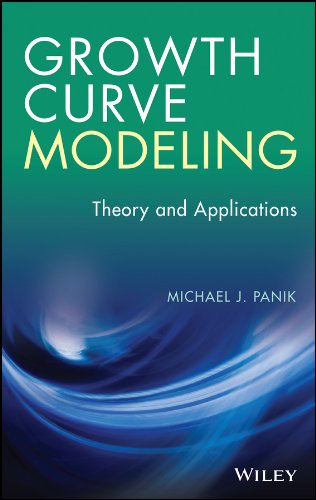
Features recent trends and advances in the theory and techniques used to accurately measure and model growthGrowth Curve Modeling: Theory and Applications features an accessible introduction to growth curve modeling and addresses how to monitor the change in variables over time since there is no “one size fits all” approach to growth measurement. A review of the requisite mathematics for growth modeling and the statistical techniques needed for estimating growth models are provided, and an overview of popular growth curves, such as linear, logarithmic, reciprocal, logistic, Gompertz, Weibull, negative exponential, and log-logistic, among others, is included.In addition, the book discusses key application areas including economic, plant, population, forest, and firm growth and is suitable as a resource for assessing recent growth modeling trends in the medical field. SAS® is utilized throughout to analyze and model growth curves, aiding readers in estimating specialized growth rates and curves. Including derivations of virtually all of the major growth curves and models, Growth Curve Modeling: Theory and Applications also features:• Statistical distribution analysis as it pertains to growth modeling • Trend estimations • Dynamic site equations obtained from growth models • Nonlinear regression • Yield-density curves • Nonlinear mixed effects models for repeated measurements dataGrowth Curve Modeling: Theory and Applications is an excellent resource for statisticians, public health analysts, biologists, botanists, economists, and demographers who require a modern review of statistical methods for modeling growth curves and analyzing longitudinal data. The book is also useful for upper-undergraduate and graduate courses on growth modeling.
User’s Reviews
Reviews from Amazon users which were colected at the time this book was published on the website:
⭐I’m writing this review from the perspective of a research professional working in industry, and having a background in economics and statistics. I’ve found Panik’s “Growth Curve Modeling” to be useful for what it is, and I will describe the approach because I think not all who are looking for a text with examples on growth modeling will quite find what they want here.The target audience includes users with a background in both SAS (a statistical programming language, perhaps the most commonly-used of the licensed or not-open-source languages) and statistics who need to work with data that describes growth over time – financial markets, demographics, ecology, biology, etc. Panik’s approach is that of a “toolkit”, with sections organized by technique rather than by problem type. I think those who get the most out of it will be research professionals who are primarily statisticians and need to know how to build their models in SAS, rather than SAS programmers who are told to run a specific analysis.For example, if you want to code for a Shinozaki-Kira yield-density curve, that’s on page 234. Kernal density estimation? Page 318. Etc. And if you want to know the differences between the Janoschek, Lundqvist-Korf, and Schnute growth models, that’s pages 62 through 66. There’s also a primer on basic growth functions (exponential, logarithmic, etc) in the beginning. With this layout, it’s hard to imagine a course syllabus except for a class that surveyed growth models across disciplines.In contrast, a text like Vittinghoff, Glidden, Shiboski and McCulloch’s “Regression Models in Biostatistics” takes an approach that’s more problem-motivated. Note that this is not a text strictly on growth although growth is often modeled in biostats. Individual problems motivate the solutions, so that after exploring inference the development of the model and a suggested type of solution is given. The context of the problem drives the type of model selected.So Vittinghoff et al’s text is more meant to be a self-learning tool, while Panik’s text, about which this review is written, is more of a reference. A SAS programmer might use it to help set up PROC NLIN (the non-linear estimation procedure in SAS) for a specific model that’s called-for by a senior statistician, or a researcher might compare the theoretical bases for different models within the same sphere in the process of fitting a model to data.I would not recommend this as an introduction to growth models, although I can’t think of a text I’ve used that would actually serve as an introduction to growth models in general. I think many who use growth models learn them not as a discrete subject but rather as a component of their chosen field. For example, my understanding of growth modeling was first through economics and finance, which is more sensitive to problems such as variance that correlates with time (in other words, that the stock market moves more in years when the Dow is at 12,000 than in earlier years when the Dow was at 2,000), while someone coming through biology might be more sensitive to models that incorporate a monotonically-declining rate of growth in an animal’s body mass with respect to age (or, that babies gain weight more quickly than adults).So, because of this rather unique spot of being an actual text about growth modeling, I’m inclined to think favorably towards it. I found the material to be easily comprehensible, and the proofs limited. Greater emphasis is given to understanding and deriving the closed-form (ie, getting from one formula to another), and I can’t recall any mention of set theory where non-mathematicians are going to get entirely lost. I think one could use this even without a class on mathematical statistics, which puts it high in the realm of accessibility.I deducted one star because I’m a little disappointed that there wasn’t more SAS code. This was a big attraction for me to this text initially, and I expected a thorough treatment of growth modeling in SAS. However, SAS is really used here to help illustrate the theory provided by fleshing it out in examples, rather than motivating an in-depth explanation of the PROCs used. The code includes PROCs NLIN, NLMIXED, QLIM, KDE, NLINREG, REG and the %dftest macro, though you will need to turn to SAS’s online help at a few points to adapt the models presented here to your own purposes. Panik’s description of the outputs, though, is very useful, so I do feel bad deducting the one star.
⭐Title of the book is well chosen, in that it lays out (in about 400 pages) a very wide range of growth models of 10 chapters. I liked this book a lot, in that is written at the upper undergraduate/graduate level and really is aimed at showing a range of models (with derivations, some of which are in appendices) and their use. The book uses mostly standard algebra (at the level of a good regression) with limited use of matrix notation in the appendices. The book covers a wide range of models and then gives examples thoughout, including SAS code needed to run the models. The book has two purely applied chapters (one on modelling growth and ize distribution of firms, the second on population dynamics) that show how some of these models are use in practice.I like this book a lot,in that it is quite comprehesive and (assuming good understanding of regression that would come from a year’s course) realtively easy to follow. The notation is good and I found the text to be quite readable and as “user friendly” as this type of book can be.I recommend this book if you have good statistical training and are interested in the important topic of estimating growth from a data series. It can be used to as survey of the topic (and I suppose a text) or as a reference to determine what models might be most appropriately be used to model growth,
⭐This book continues Wiley’s extensive list of statistical imprints, directed at specialists in the field. The author addresses a common problem. How to estimate whether the growth curve [eg. of revenue of a firm] matches some particular functional form. Like it is more of a sigmoid, or instead another type. So you can treat the entire text as specialised regression advice.An important type modelled is the expolinear. This acknowledges a common observation that initial observations of some data stream yield small values that appear to increase exponentially. But of course nothing can forever. So what you then see is the growth tapering to conform perhaps to a linear fit. Panik cites how this arose out of crop formation and growth. But leaving aside the mechanics specific to that case, you are likely to have empirically seen this elsewhere.Other topics include the Pareto distribution and Gibrat’s law. Observations and results from economics.One nice aspect of the text is that it is not confined to just walking through the theory. Numerical packages are a necessity these days. To wit, SAS code examples are used, so that you are guided and can borrow and alter such source code for your needs. Though I wonder if also including some examples in R might also help. The latter has emerged as a popular choice in stats departments throughout the world, with a resultant large set of routines already written and debugged for free.
⭐This book is marketed as an accessible introduction to growth curve modeling. It is not. Rather it is a mathematically rigorous (complete with proofs and derivations) dense read where many, if not most, of the pages are covered in formulas. If you have an advanced degree in math or perhaps economics this may be a good buy but if you, like me, do applied work (say in biology) this is not a good buy.If you have a very strong math background, take a look at the book’s website which has a table of contents but no sample chapters.There is some nicely annotated SAS code intermixed into the book but the website for the book does not include the code or the data sets. Procedures covered include plot ad gplot (but not sgplot), reg, autoreg, arima, nlin, model, nlmixed and kde. Nearly none of the code takes advantage of modern SAS features, like the ODS or proc sgplot.If you are looking for a graduate level math/statistics text which only uses SAS give this a look. Otherwise, pass it by.
Keywords
Free Download Growth Curve Modeling: Theory and Applications 1st Edition in PDF format
Growth Curve Modeling: Theory and Applications 1st Edition PDF Free Download
Download Growth Curve Modeling: Theory and Applications 1st Edition 2014 PDF Free
Growth Curve Modeling: Theory and Applications 1st Edition 2014 PDF Free Download
Download Growth Curve Modeling: Theory and Applications 1st Edition PDF
Free Download Ebook Growth Curve Modeling: Theory and Applications 1st Edition