

Ebook Info
- Published: 2001
- Number of pages: 127 pages
- Format: PDF
- File Size: 3.72 MB
- Authors: Richard T. Cox
Description
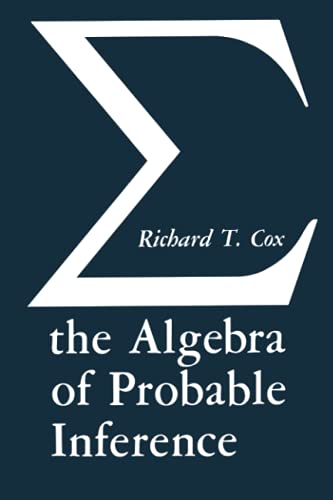
In Algebra of Probable Inference, Richard T. Cox develops and demonstrates that probability theory is the only theory of inductive inference that abides by logical consistency. Cox does so through a functional derivation of probability theory as the unique extension of Boolean Algebra thereby establishing, for the first time, the legitimacy of probability theory as formalized by Laplace in the 18th century.Perhaps the most significant consequence of Cox’s work is that probability represents a subjective degree of plausible belief relative to a particular system but is a theory that applies universally and objectively across any system making inferences based on an incomplete state of knowledge. Cox goes well beyond this amazing conceptual advancement, however, and begins to formulate a theory of logical questions through his consideration of systems of assertions―a theory that he more fully developed some years later. Although Cox’s contributions to probability are acknowledged and have recently gained worldwide recognition, the significance of his work regarding logical questions is virtually unknown. The contributions of Richard Cox to logic and inductive reasoning may eventually be seen to be the most significant since Aristotle.
User’s Reviews
Editorial Reviews: Review [This book] is, in my opinion one of the most important ever written on the foundations of probability theory, and the greatest advance in the conceptual, as opposed to the purely mathematical, formulation of the theory since Laplace. — E. T. Jaynes ― American Journal of PhysicsTransformed my view of probability and enriched my career as a physicist. — Bruce Partridge ― Physics Today From the Publisher “[This book] is, in my opinion one of the most important ever written on the foundations of probability theory, and the greatest advance in the conceptual, as opposed to the purely mathematical, formulation of the theory since Laplace.”E. T. Jaynes, American Journal of Physics About the Author Richard T. Cox was a professor of physics at the Johns Hopkins University. He was the author of several books on physics and biology including Statistical Mechanics of Irreversible Change, also published by Johns Hopkins University Press. Read more
Reviews from Amazon users which were colected at the time this book was published on the website:
⭐… but not something to change my practice.This book starts with basic notions of probability (conditional probability, entropy, etc.) and expands them in the direction of Boolean algebra. Although some notions seem to extend well to later developments in soft logics, this development stays very close to traditional probabilistic reasoning. The manipulations are clear, well justified, and meticulously developed. But, as a potential user, this struck me as filling in gaps that had never really bothered me rather than expanding the range of logical mechanism.But, whether I put this to use or not, I find it interesting for at least two reasons. First, it predates many of the other soft logic developments by many years. Consciously or not, directly or not, later workers owe many of their more distant explorations to first steps like these. Second, it’s simply a pleasure to read. I’ve found this true again and again: if you want to understand something abstruse, skip the “explainers” and go to the primary source. Goedel, Heisenberg, and many others stand behind Cox as founders in their fields, and stand unexcelled as proponents of their insights. Information, like water, becomes clearer as you go upstream. Cox seems to be the original spring from which many downstream developments arose. Even if his thoroughness might wear on a pragmatic reader, his development pulls you along. Rigorous proofs bring certainty, of a sort, but not always understanding. Given this book’s limited and specific range, it offers real understanding.– wiredweird
⭐This is a great, great book that I’m absolutely ecstatic to see back in print. I was introduced to it when I was in graduate school (mathematics) and rooming in the house of a physics professor who swore by Richard Threlkeld Cox’s account of subjective probability. I haven’t had a copy of it in my hand for nearly twenty years; I happened across this page today and ordered it at once. So pardon me while I gush:What Cox accomplishes in this deceptively slim volume is amazing. He places Bayesian probability theory on an axiomatic foundation, as a natural extension of Boolean logic, identifying probabilities with degrees of subjective belief in propositions rather than directly with frequencies of events (though he also argues that the subjectivist interpretation accords with the frequentist interpretation whenever the latter makes sense at all).Essentially, he shows that the ordinary laws of probability theory are normative laws of thought that apply to degrees of belief in propositions, and that we have to conform to them if we want to think consistently.If you like math and logic books, you’ll find this one eminently readable; I haven’t seen it in years and yet I still remember the stunning clarity of Cox’s rigorous exposition.This is the book that originally sold me on Bayesianism. If you have any interest in this subject at all, grab this one while it’s available.
⭐That Gian-Carlo Rota and I both admired this book largelyexplains why I have my present position at MIT. But Icannot write book reviews the way Rota did.Why should the conventional sum and product rules ofprobability hold when probabilities are assigned, notto *events* that are *random* according to theirrelative frequencies of occurrence, nor to subsets ofpopulations as proportions of the whole, but ratherto *propositions* that are *uncertain* according to thedegree to which the evidence supports them? The tenetthat the same rules should apply to such “degrees ofbelief,” whether they are “subjective” probabilities or”logical” probabilities, is the essence of Bayesianism.The relative merits of Bayesian and frequentist methods ofstatistical inference have been debated for decades. Butseldom is the question with which I started this paragraphaddressed. Several answers to that question have beenproposed. Richard Cox’s book embodies one of them.Many writers on foundations of statistical inference arecallously imprecise about the kind of topic dealt within this book. Cox is their antipode, writing not onlyclearly, but supremely efficiently, beautifully, perhapssometimes poetically, about functional differentialequations and about delicate philosophical questions.Cox also deals with the relationship between entropy anddistributive lattices. Shannon entropy is to distributivelattices as probability is to Boolean algebras. I do notthink Cox was familiar with standard work on lattice theory.He never uses the word “lattice,” nor other standardlattice-theory nomenclature.
⭐Book in great condition as described.
⭐The Algebra of Probable Inference is a classic in the fields of probability and statistics for the clarity with which Cox explains the concepts of entropy, expectation and induction. Moving seamlessly between verbal and mathematical language the astute reader can gain an introduction to these key concepts of modern statistical practice. Even those with a firm grasp on these concepts may have their insight sharpened.It is true that the conclusions can now be found in textbooks but could one there see induction explained by an example from Macbeth? Similar choice analogies are sprinkled throughout thIs text.Succinctly written with lively prose, I recommend this classic to all with an interest in statistical theory.
Keywords
Free Download Algebra of Probable Inference in PDF format
Algebra of Probable Inference PDF Free Download
Download Algebra of Probable Inference 2001 PDF Free
Algebra of Probable Inference 2001 PDF Free Download
Download Algebra of Probable Inference PDF
Free Download Ebook Algebra of Probable Inference