

Ebook Info
- Published: 2013
- Number of pages: 528 pages
- Format: PDF
- File Size: 4.70 MB
- Authors: Hosmer
Description
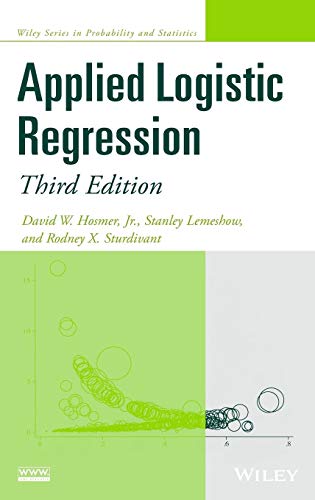
A new edition of the definitive guide to logistic regression modeling for health science and other applicationsThis thoroughly expanded Third Edition provides an easily accessible introduction to the logistic regression (LR) model and highlights the power of this model by examining the relationship between a dichotomous outcome and a set of covariables.Applied Logistic Regression, Third Edition emphasizes applications in the health sciences and handpicks topics that best suit the use of modern statistical software. The book provides readers with state-of-the-art techniques for building, interpreting, and assessing the performance of LR models. New and updated features include:A chapter on the analysis of correlated outcome dataA wealth of additional material for topics ranging from Bayesian methods to assessing model fitRich data sets from real-world studies that demonstrate each method under discussionDetailed examples and interpretation of the presented results as well as exercises throughoutApplied Logistic Regression, Third Edition is a must-have guide for professionals and researchers who need to model nominal or ordinal scaled outcome variables in public health, medicine, and the social sciences as well as a wide range of other fields and disciplines.
User’s Reviews
Editorial Reviews: Review “In conclusion, the index was mercifully complete, and all items searched for were found (nice cross-referencing too) In summary: Highly recommended.” (Scientific Computing, 1 May 2013) From the Inside Flap A new edition of the definitive guide to logistic regression modeling for health science and other applicationsPraise for the Second Edition”. . . an excellent book that balances many objectives well. . . . Applied Logistic Regression is an ideal choice.” —Technometrics”. . . it remains an extremely valuable text for everyone working or teaching in fields like epidemiology.” —Statistics in MedicineThis thoroughly expanded Third Edition provides an easily accessible introduction to the logistic regression (LR) model and highlights the power of this model by examining the relationship between a dichotomous outcome and a set of covariables.Applied Logistic Regression, Third Edition emphasizes applications in the health sciences and handpicks topics that best suit the use of modern statistical software. The book provides readers with state-of-the-art techniques for building, interpreting, and assessing the performance of LR models. New and updated features include:A chapter on the analysis of correlated outcome dataA wealth of additional material for topics ranging from Bayesian methods to assessing model fitRich data sets from real-world studies that demonstrate each method under discussionDetailed examples and interpretation of the presented results as well as exercises throughoutApplied Logistic Regression, Third Edition is a must-have guide for professionals and researchers who need to model nominal or ordinal scaled outcome variables in public health, medicine, and the social sciences as well as a wide range of other fields and disciplines. From the Back Cover A new edition of the definitive guide to logistic regression modeling for health science and other applicationsPraise for the Second Edition”. . . an excellent book that balances many objectives well. . . . Applied Logistic Regression is an ideal choice.” —Technometrics”. . . it remains an extremely valuable text for everyone working or teaching in fields like epidemiology.” —Statistics in MedicineThis thoroughly expanded Third Edition provides an easily accessible introduction to the logistic regression (LR) model and highlights the power of this model by examining the relationship between a dichotomous outcome and a set of covariables.Applied Logistic Regression, Third Edition emphasizes applications in the health sciences and handpicks topics that best suit the use of modern statistical software. The book provides readers with state-of-the-art techniques for building, interpreting, and assessing the performance of LR models. New and updated features include:A chapter on the analysis of correlated outcome dataA wealth of additional material for topics ranging from Bayesian methods to assessing model fitRich data sets from real-world studies that demonstrate each method under discussionDetailed examples and interpretation of the presented results as well as exercises throughoutApplied Logistic Regression, Third Edition is a must-have guide for professionals and researchers who need to model nominal or ordinal scaled outcome variables in public health, medicine, and the social sciences as well as a wide range of other fields and disciplines. About the Author DAVID W. HOSMER, Jr., PhD, is Professor Emeritus of Biostatistics at the School of Public Health and Health Sciences at the University of Massachusetts Amherst.STANLEY LEMESHOW, PhD, is Professor of Biostatistics and Founding Dean of the College of Public Health at The Ohio State University, Columbus, Ohio.RODNEY X. STURDIVANT, PhD, is Associate Professor and Founding Director of the Center for Data Analysis and Statistics at the United States Military Academy at West Point, New York. Read more
Reviews from Amazon users which were colected at the time this book was published on the website:
⭐I use logistic regression in fundraising analytics and find this text a necessary part of my library in order to perform my job well. While a touch too mathematical at times for me personally, it is still accessible to me, a person with a PhD in nonprofit leadership. I find critical nuggets in its pages that greatly aid my practical business applications.
⭐This is a new seller, so I was somewhat hesitant – but I am fully satisfied.
⭐This book has everything you need to develop a logistic regression model. From a mathematician’s point of view, I found the derivation insightful and helped bring a fuller understanding to the methods.
⭐I just finished reading ( well, learning) the first 2 chapters, while in parallel am writing the code ( programming with Mathematica) the formulas appearing in the book while trying to understand all the statistical background about Logistic Regression. I can only say that I enjoy every page of it, and I hope the rest of the book will be as entertaining as the first 2 chapters
⭐An update of the classic, required, text on logistic regression modeling. Contains important new enhancements practitioners and students should study.
⭐This is an update of the classic text. Excellent reference for the basics of logistic regression. Should be on the bookshelf of anybody who uses the technique regularly.
⭐Although the book is an applied on logistic regression, it is easy understood by anyone whose having no enough background and experience on statistics. Theories on basic statistical concepts are often boring and frightening, but this book makes learning statistics enjoyable.
⭐It met my need to understand logistic regression application. I have been struggling with the understanding of its application but this book helped.
⭐If you want to know everything about applied logistic regression, and how to make the most out of utilising this method and more, this is by far the BEST book on the topic. It is advanced knowledge made readily available. Suitable for primary outcomes of individual randomised controlled trials, cluster randomised, cohort studies. I do not think that there is a group of authors’ that know any more or any better on this topic other than these authors themselves. Other authors of other books do not seem in this league. A tome. Obviously, as it is in its third edition!
⭐This text is often considered a classic in the field of logistic regression. Its outstanding step-by-step introduction of the methods needed, without concern for mathematical challenges for the reader nor glossing over intricate steps is noteworthy and laudable. A must-read.Having said that, there are some grave caveats. One: the authors spend an undue amount of space trying to shoehorn significance into the outcomes of logistic regression where there do not exist any (the authors repeatedly point out that these are approximations and quite often misleading/wrong). My advice: just discard all that and use (if need be) permutation and jack-knife testing. In all fairness: these significance issues were needed (despite their shortcomings) in a time when computer power was extremely expensive and occasionally unavailable. Times have changed, and the text should take these changes into consideration. The other caveat is more serious: the authors are quite cavalier about using logistic regression where the “predictor variable” is a categorical variable. Of course, one may not set up a logistic regression model where the predictor variable is not continuous. If the predictor variable is categorical: there exist other methods, most notably correspondence analysis. A shame that this book, which doubtless has become a classic and is certainly relied on by many researchers, still perpetuates this methodolological flaw, which does not invalidate logistic regression, but requires careful thinking about the nature of the data set.
⭐Good book to have a thorough understanding of the concepts
⭐Excelente y rápidoReally informatics.
Keywords
Free Download Applied Logistic Regression, 3rd Edition 3rd Edition in PDF format
Applied Logistic Regression, 3rd Edition 3rd Edition PDF Free Download
Download Applied Logistic Regression, 3rd Edition 3rd Edition 2013 PDF Free
Applied Logistic Regression, 3rd Edition 3rd Edition 2013 PDF Free Download
Download Applied Logistic Regression, 3rd Edition 3rd Edition PDF
Free Download Ebook Applied Logistic Regression, 3rd Edition 3rd Edition