Ebook Info
- Published: 1996
- Number of pages: 378 pages
- Format: PDF
- File Size: 5.43 MB
- Authors: Alonzo Church
Description
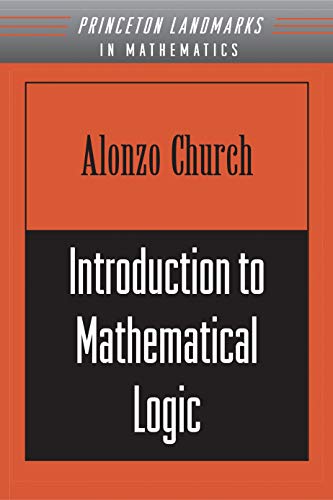
One of the pioneers of mathematical logic in the twentieth century was Alonzo Church. He introduced such concepts as the lambda calculus, now an essential tool of computer science, and was the founder of the Journal of Symbolic Logic. In Introduction to Mathematical Logic, Church presents a masterful overview of the subject–one which should be read by every researcher and student of logic. The previous edition of this book was in the Princeton Mathematical Series.
User’s Reviews
Editorial Reviews: Review “This volume . . . is a reprint of the revised 1956 version of this notable title first published in 1944 in the Annals of Mathematics Studies. Quite a pedigree . . . [I]t is fitting that the release of this inexpensive reprint should make his masterly treatise available to everyone with an interest in the subject.”, Australian & New Zealand Physicist From the Publisher One of the pioneers of mathematical logic in the twentieth century was Alonzo Church. He introduced such concepts as the lambda calculus, now an essential tool of computer science, and was the founder of the Journal of Symbolic Logic. In Introduction to Mathematical Logic, Church presents a masterful overview of the subjectone which should be read by every researcher and student of logic. The previous edition of this book was in the Princeton Mathematical Series. From the Back Cover This book is intended to be used as a textbook by students of mathematics, and also within limitations as a reference work. As a textbook it offers a beginning course in mathematical logic, but presupposes some substantial mathematical background. About the Author Alonzo Church (1903-1995) was a renowned mathematician, logician, and philosopher. Together with his student Alan Turing, he is considered one of the founders of computer science. Read more
Reviews from Amazon users which were colected at the time this book was published on the website:
⭐This 1944 book by Church is historically important, but it is still an excellent introduction to logic. It is not difficult to read, despite the use of the archaic dot-notation instead of the more modern parentheses.This book appeared near the start of a new wave of mathematical logic textbooks which treated logic as a kind of symbol manipulation game with mechanical rules, divorced from the meanings of the symbols. Church calls this the logistic method on pages 47-58. On page 48, he wrote as follows.”Our procedure is not to define the new language merely by means of translations of its expressions (sentences, names, forms) into corresponding English expressions, because in this way it would hardly be possible to avoid carrying over into the new language the logically unsatisfactory features of the English language. Rather, we begin by setting up, in abstraction from all considerations of meaning, the purely formal part of the language, so obtaining an uninterpreted calculus or logistic system.”To some extent, this formalistic tendency could be seen in the 1920s and 1930s logic books by Hilbert/Ackerman and Hilbert/Bernays. Two earlier notable textbooks of the 1940s were Quine 1940 ”
⭐” and Tarski 1941 ”
⭐”, both of which were essentially modernized presentations of Whitehead/Russell 1910-1913. By contrast, Church went deeply into the formal analysis of mathematical logic in a way which could be executed on a computer, if sufficiently powerful digital computers had existed at that time. This, I think, is the real historical significance of this book. Following Church’s book, a flurry of mathematical logic textbooks appeared in the 1950s, by Quine 1950, Rosenbloom 1950, Kleene 1952, Wilder 1952, Rosser 1953, Tarski/Mostowski/Robinson 1953, Carnap 1954, Suppes 1957, and so forth. These later textbooks partially or totally abandoned the old idea of a single “correct” logical formalism and adopted instead a kind of “cultural relativism” where the validity of a language was reduced to the mere requirement of consistency. Pages 64-68 discuss the semantics and interpretation of a language as a secondary issue, which is now the orthodox approach to first-order languages and model theory, but the formalization of this approach was quite new at the time.The list of logical operators on page 37 is noteworthy for including the “but-not” and “not-but” operators, which do not appear in any of the other 45 logic and set theory books in my collection.On pages 72 and 82-83, substitution is formalised as an inference rule, which was quite new at the time. This once again emphasizes the mechanization of logic, removing the need for human intervention.On page 75, the dot-notation is presented, which is an over-hang from the early 20th century logic notations.Page 119 has the three Łukasiewicz axioms for propositional logic, which are the most popular axioms for the logic systems of later academic logic books.Pages 168-172 present a predicate calculus in a style which I do not like. It is of little value for practical mathematics. (For that you would need some kind of “natural deduction”.)Pages 196-205 present a deduction metatheorem. Most authors do present some kind of “deduction theorem”, but personally I regard this as an overhang from Hilbert’s style of logic as contrasted with “natural deduction” systems, where the deduction theorem is an axiom.The rest of the book, pages 218-356, presents many metatheorems regarding first and second order languages.By the way, one annoyance I find with this book is that the bibliographic references are all in footnotes instead of alphabetically arranged at the end of the book. That’s fine for a 10-page paper, but in a 360-page book, it’s not so fine.
⭐Alonzo Church (1903-1995) was an American mathematician and logician who made major contributions to mathematical logic and the foundations of theoretical computer science. He also wrote
⭐.He wrote in the Preface, “This is a revised and much enlarged edition … [of the Introduction] which was published in 1944 as one of the Annals of Mathematics Studies. In spite of extensive additions, it remains an introduction rather than a comprehensive treatise. It is intended to be used as a textbook by students of mathematics, and also within limitations as a reference work. As a textbook it offers a beginning course in mathematical logic, but presupposes some substantial mathematical background.”He states in the Introduction, “it is desirable or practically necessary for purposes of logic to employ a specially devised language, a FORMALIZED LANGUAGE as we shall call it, which shall reverse the tendency of the natural languages and shall follow or reproduce the logical form—at the expense, where necessary, of brevity and facility of communication. To adopt a particular formalized language thus involves adopting a particular theory or system of logical analysis.” (Pg. 2-3)But he acknowledges, “There is not yet a theory of the meaning of proper names upon which general agreement has been reached as the best. But it is necessary to outline briefly the theory which will be adopted here, due in its essentials to Gottlob Frege.” (Pg. 3-4) Later, he explains, “The notations which we use as sentence connectives—and those which we use as quantifiers—are adaptations of those in Whitehead and Russell’s
⭐(some of which were taken from Peano). Various other notations are in use, and the student who would compare the treatments of different authors must learn a certain facility in shifting from one system of notation to another.” (Pg. 38-39)He explains, “In setting up a formalized language we first employ as meta-language a certain portion of English. We shall not attempt to delimit precisely this portion of the English language, but describe it approximately by saying that it is just sufficient to enable us to give general directions for the manipulation of concrete physical objects… It is thus a language which deals with matters of everyday human experience, going beyond such matters only in that no finite upper limit is imposed on the number of objects that may be involved in any particular case, or on the time that may be required for their manipulation according to instructions. Those additional portions of English are excluded which would be used in order to treat of infinite classes or of various like abstract objects which are an essential part of the subject matter of mathematics. Our procedure is not to define the new language merely by means of translations of its expressions… into corresponding English expressions, because in this way it would hardly be possible to avoid carrying over into the new language the logically unsatisfactory features of the English language. Rather, we begin by setting up, in abstraction from all considerations of meaning, the purely formal part of the language, so obtaining an uninterpreted calculus or LOGISTIC SYSTEM.” (Pg. 47-48)He outlines, “In this book we will be concerned with the task of formalizing an object language, and theoretical syntax will be treated informally, presupposing in any connection such general knowledge of mathematics as is necessary for the work at hand. Thus we do not apply even the informal axiomatic method to our treatment of syntax. But the reader must always understand that syntactical discussions are carried out in a syntax language whose formalization is ultimately contemplated, and distinctions based upon such formalization may be relevant to the discussion.” (Pg. 59)He observes, “The notion of CONSISTENCY of a logistic system is semantical in motivation, arising from the requirement that nothing which is logically absurd or self-contradictory in meaning shall be a theorem, or that there shall not be two theorems of which one is the negation of the other. But we seek to modify this originally semantical notion in such a way as to make it syntactical in character (and therefore applicable to a logistic system independent of the interpretation adopted for it). This may be done by defining ‘relative consistency with respect to’ any transformation by which each sentence or propositional form ‘A’ is transformed into a sentence or propositional form ‘A-prime’…. Or we may define ‘absolute consistency’ by the condition that not every sentence and propositional form whatever would be proved… Or, following Hilbert, we might in the case of a particular system select an appropriate particular sentence and define the system as being consistent if that particular sentence is not a theorem… Or if the system has propositional variables, we may define it as being ‘consistent in the sense of Post’ if a ‘wff’ consisting of a propositional variable alone is not a theorem.” (Pg. 108)He points out historically, “The logistic method was first applied by Frege in
⭐, 1879]… However, Frege’s work received little recognition or understanding until long after its publication, and the propositional calculus continued development from the older point of view, as may be seen in the work of C.S. Peirce, Ernst Schröder, Guiseppe Peano, and others. The beginnings of a change (though not yet the logistic method) appear in the work of Peano and his school. And from this course A.N. Whitehead and Bertrand Russell derived much of their earlier inspiration; later they became acquainted with the more profound work of Frege and were perhaps the first to appreciate its significance. After Frege, the earliest treatments of propositional calculus by the linguistic method are by Russell. Some indications of such a treatment may be found in
⭐(1903). It is extended propositional calculus which is there contemplated rather than propositional calculus; but by making certain changes in the light of later developments, it is possible to read into Russell’s discussion the following axioms for a partial system … of propositional calculus with implication and conjunction as primitive connectives…” (Pg. 156)He notes, “abstract algebra is thus formalized within one of the pure functional calculi, and in this sense we may say if we like that it has been reduced to a branch of pure logic. Many other branches of mathematics are customarily treated in a similar way, so that their formalization brings them entirely within one of the pure functional calculi. And though it is more natural or more usual in some cases than other, it seems clear that every branch of mathematics might be treated in this way if we chose… Thus it is possible to say that all of mathematics is reducible to pure logic, and to maintain that logic and mathematics should be characterized, not as different subjects, but as elementary and advanced parts of the same subject.” (Pg. 332)As a “textbook” for beginning students, this book is obviously somewhat “behind the times”; but serious students of logic wanting to follow the history and development of their subject may find this important and influential work by a “giant” in the field well worth studying.
⭐Seriously, after all these years, Princeton still have the errata list at the back of the book instead of incorporating it in the text. What a lazy publisher ! The book was originally from the 1940s for god’s sake ! It’s even referred to in TURING’S thesis. Wouldn’t it be appropriate to release this book with corrections after all these years & to finally have an error free with all the errata corrections being incorporated in the text itself. It’s a classic text, it deserves some attention.
Keywords
Free Download Introduction to Mathematical Logic in PDF format
Introduction to Mathematical Logic PDF Free Download
Download Introduction to Mathematical Logic 1996 PDF Free
Introduction to Mathematical Logic 1996 PDF Free Download
Download Introduction to Mathematical Logic PDF
Free Download Ebook Introduction to Mathematical Logic