

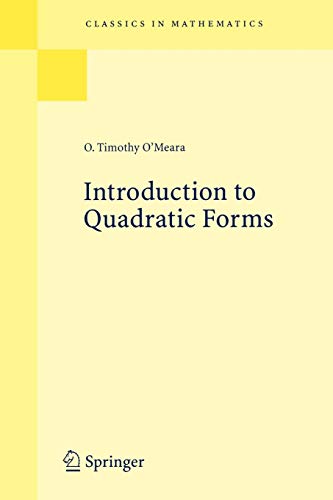
Ebook Info
- Published: 2000
- Number of pages: 358 pages
- Format: PDF
- File Size: 11.95 MB
- Authors: O. Timothy O’Meara
Description
From the reviews: “Anyone who has heard O’Meara lecture will recognize in every page of this book the crispness and lucidity of the author’s style. […] The organization and selection of material is superb. […] deserves high praise as an excellent example of that too-rare type of mathematical exposition combining conciseness with clarity.” Bulletin of the AMS
User’s Reviews
Editorial Reviews: Review “The exposition follows the tradition of the lectures of Emil Artin who enjoyed developing a subject from first principles and devoted much research to finding the simplest proofs at every stage.” – American Mathematical Monthly From the Back Cover Timothy O’Meara was born on January 29, 1928. He was educated at the University of Cape Town and completed his doctoral work under Emil Artin at Princeton University in 1953. He has served on the faculties of the University of Otago, Princeton University and the University of Notre Dame. From 1978 to 1996 he was provost of the University of Notre Dame. In 1991 he was elected Fellow of the American Academy of Arts and Sciences. O’Mearas first research interests concerned the arithmetic theory of quadratic forms. Some of his earlier work – on the integral classification of quadratic forms over local fields – was incorporated into a chapter of this, his first book. Later research focused on the general problem of determining the isomorphisms between classical groups. In 1968 he developed a new foundation for the isomorphism theory which in the course of the next decade was used by him and others to capture all the isomorphisms among large new families of classical groups. In particular, this program advanced the isomorphism question from the classical groups over fields to the classical groups and their congruence subgroups over integral domains. In 1975 and 1980 O’Meara returned to the arithmetic theory of quadratic forms, specifically to questions on the existence of decomposable and indecomposable quadratic forms over arithmetic domains. About the Author Biography of O. Timothy O’MearaTimothy O’Meara was born on January 29, 1928. He was educated at the University of Cape Town and completed his doctoral work under Emil Artin at Princeton University in 1953. He has served on the faculties of the University of Otago, Princeton University and the University of Notre Dame. From 1978 to 1996 he was provost of the University of Notre Dame. In 1991 he was elected Fellow of the American Academy of Arts and Sciences. O’Mearas first research interests concerned the arithmetic theory of quadratic forms. Some of his earlier work – on the integral classification of quadratic forms over local fields – was incorporated into a chapter of this, his first book. Later research focused on the general problem of determining the isomorphisms between classical groups. In 1968 he developed a new foundation for the isomorphism theory which in the course of the next decade was used by him and others to capture all the isomorphisms among large new families of classical groups. In particular, this program advanced the isomorphism question from the classical groups over fields to the classical groups and their congruence subgroups over integral domains. In 1975 and 1980 O’Meara returned to the arithmetic theory of quadratic forms, specifically to questions on the existence of decomposable and indecomposable quadratic forms over arithmetic domains. Read more
Reviews from Amazon users which were colected at the time this book was published on the website:
⭐good
⭐
Keywords
Free Download Introduction to Quadratic Forms (Classics in Mathematics) 2000th Edition in PDF format
Introduction to Quadratic Forms (Classics in Mathematics) 2000th Edition PDF Free Download
Download Introduction to Quadratic Forms (Classics in Mathematics) 2000th Edition 2000 PDF Free
Introduction to Quadratic Forms (Classics in Mathematics) 2000th Edition 2000 PDF Free Download
Download Introduction to Quadratic Forms (Classics in Mathematics) 2000th Edition PDF
Free Download Ebook Introduction to Quadratic Forms (Classics in Mathematics) 2000th Edition