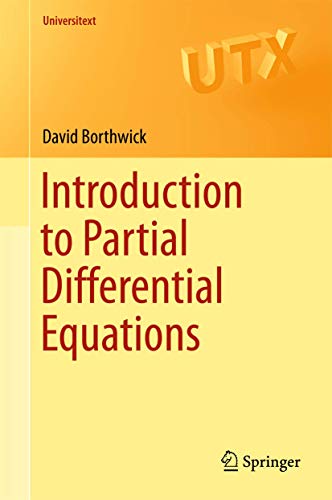
Ebook Info
- Published: 2016
- Number of pages: 299 pages
- Format: PDF
- File Size: 3.38 MB
- Authors: David Borthwick
Description
This modern take on partial differential equations does not require knowledge beyond vector calculus and linear algebra. The author focuses on the most important classical partial differential equations, including conservation equations and their characteristics, the wave equation, the heat equation, function spaces, and Fourier series, drawing on tools from analysis only as they arise. Within each section the author creates a narrative that answers the five questions: What is the scientific problem we are trying to understand?How do we model that with PDE?What techniques can we use to analyze the PDE?How do those techniques apply to this equation?What information or insight did we obtain by developing and analyzing the PDE?The text stresses the interplay between modeling and mathematical analysis, providing a thorough source of problems and an inspiration for the development of methods.
User’s Reviews
Editorial Reviews: Review “The book under review is intended for an introductory course for students. The author gives a balanced presentation that includes modern methods, without requiring prerequisites beyond vector calculus and linear algebra. Concepts and definitions from analysis are introduced only as they are needed in the text.” (Dian K. Palagachev, zbMATH 1364.35001, 2017) From the Back Cover This modern take on partial differential equations does not require knowledge beyond vector calculus and linear algebra. The author focuses on the most important classical partial differential equations, including conservation equations and their characteristics, the wave equation, the heat equation, function spaces, and Fourier series, drawing on tools from analysis only as they arise.Within each section the author creates a narrative that answers the five questions: (1) What is the scientific problem we are trying to understand? (2) How do we model that with PDE? (3) What techniques can we use to analyze the PDE? (4) How do those techniques apply to this equation? (5) What information or insight did we obtain by developing and analyzing the PDE? The text stresses the interplay between modeling and mathematical analysis, providing a thorough source of problems and an inspiration for the development of methods. About the Author David Borthwick, Department of Mathematics and Computer Science, Emory University, Atlanta, GA 30322 Read more
Reviews from Amazon users which were colected at the time this book was published on the website:
⭐The author’s goal (to the best of my understanding) when writing this text is to provide a modern and theoretical treatment of the field of PDEs while requiring minimal knowledge. In other words the author attempts to guide the reader through what would constitute a graduate level course on the subject, but while only requiring linear algebra and vector calculus. Thus he attempts to expose the reader to topics in analysis, topology, functional analysis, etc. An admirable goal!The issue with this text is that the chapter that introduces the reader to these topics reads like an appendix! The reader with these minimal prerequisites will have little to no mathematical maturity at this point in their career and the exposition is at the (early) graduate level. Very bare bones and minimal detail in the single most important chapter in this text in particular. This is supposed to be the strong point of the text and it falls short.The text is only 273 pages long, which even for a classical text on the subject would be SHORT. The chapter that discusses these topics is about 14 pages long, with a real analysis appendix in the back of the book that’s five pages. For a text that focuses so much on theoretical concepts I would have really appreciated some elaboration. I understand that this isn’t a text on analysis/functional analysis but you’re not going to convince me that more examples would have been a bad thing.There are about 5-10 exercises in the back of each chapter that are varying in difficulty with multiple parts to many of them. There are no solutions included however. This again I cannot understand. It is an “intro” book after all, so then why are there no solutions?It feels as if the author forgot who his audience was. Check out the text: The Lebesgue Integral for Undergraduates by Johnston. He is a master explainer and NEVER forgets that he is attempting to expose readers that have only completed Calculus II to the Lebesgue Integral. That text is all you need for that subject, whereas this one might prove impossible to read for students with vector calc and LA.If you do not mind referencing multiple different sources/professor for information then try this book out. I think the book could easily be 5/5 with some elaboration and solutions.3/5
Keywords
Free Download Introduction to Partial Differential Equations (Universitext) in PDF format
Introduction to Partial Differential Equations (Universitext) PDF Free Download
Download Introduction to Partial Differential Equations (Universitext) 2016 PDF Free
Introduction to Partial Differential Equations (Universitext) 2016 PDF Free Download
Download Introduction to Partial Differential Equations (Universitext) PDF
Free Download Ebook Introduction to Partial Differential Equations (Universitext)