

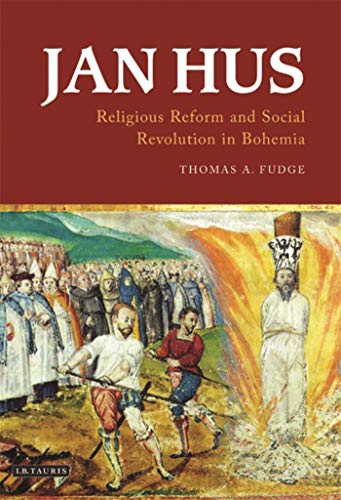
Ebook Info
- Published: 2017
- Number of pages: 392 pages
- Format: PDF
- File Size: 3.13 MB
- Authors: Thomas A. Fudge
Description
A century before Martin Luther and the Reformation, Jan Hus confronted the official Church and helped to change the face of medieval Europe. A key figure in the history of Europe and Christianity and a catalyst for religious reform and social revolution, Jan Hus was poised between tradition and innovation. Taking a stand against the perceived corruption of the Church, his continued defiance led to his excommunication and he was ultimately burned at the stake in 1415. What role did he play in shaping Medieval Europe? And what is his legacy for today? In this important and timely book Thomas A. Fudge explores Jan Hus, the man, his work and his legacy. Beginning his career at Prague University, this brilliant Bohemian preacher was soon catapulted by virtue of his radical and popular theology to the forefront of European affairs. This book fills a real gap in contemporary understanding of the medieval Church and offers an accessible and authoritative account of a most significant individual and his role in history. Jan Hus belongs to the pantheon of extraordinary figures from medieval religious history. His story is one of triumph and tragedy in a time of chaos and change.
User’s Reviews
Editorial Reviews: About the Author Thomas A. Fudge is author of The Magnificent Ride: First Reformation in Hussite Bohemia and The Crusade Against the Heretics in Bohemia, 1418-1437. He has worked as Senior Lecturer in European History at the University of Canterbury in Christchurch, New Zealand. More recently he taught in the Texas prison system and served as Director of the Hewitt Research Foundation in Washington
Reviews from Amazon users which were colected at the time this book was published on the website:
⭐Interestng,however too academic.
⭐A modern scholarly look at the life of Jan Hus – the man Martin Luther credited as an inspiration. Hus is a historical figure worth reading about. Thanks to Mr. Fudge for his research and book!
⭐In this useful corrective study of Jan Hus, Thomas Fudge successfully places his subject in his historical time and contextualises both his life and ideas within the theology and thought of the turn of the fourteenth and fifteenth centuries, while also properly scrutinising the process of Hus’ trials from 1408 onwards, culminating in his examination, sentencing, and execution at the Council of Constance in 1415, with reference to contemporary canon law and later medieval beliefs about what constituted heresy.Intellectually, Fudge substantiates two interrelated claims, firstly, that Hus was a realist and not a nominalist, and, secondly, that his thought developed independently from that of John Wyclif, whose writings on both the eucharist and dominion were more overtly nominalist. Importantly, he conclusively shows that Hus never rejected transubstantiation in favour of Wyclif’s remanentism, and that his eucharistic beliefs were strictly orthodox. While Wyclif was a radical whose ideas undermined the whole basis of Christian society and authority and denied the real presence of the mass, Hus was a reformer whose beliefs remained embedded in traditional catholic dogma, however much he questioned the authority of ecclesiastical bodies and persons.So, why then was Hus burned as a heretic? In a sense, Hus was a substitute for the deceased Wyclif, a live subject who could be publicly executed in place of the Oxford doctor, and this explains why his accusers were so willing to accuse Hus of holding Wyclifite beliefs on the eucharist which he never actually propounded: by burning Hus they could by extension burn Wyclif and his ideas.However, it is also the case that Hus was influenced by Wyclif when it came to ecclesiology, particularly in regard to the illegitimacy of immoral priests and the lack of authority of magistrates not in grace (although he continued to reject donatism, the claim that unworthy priests lacked sacramental efficacy) and in the categorical difference between the invisible Church of those saved by grace and the visible institutional church of sinful believers. However, as Fudge also explains, in no sense were these beliefs in accord with what would later become protestantism – Hus, like Wyclif, grounded his theology of grace in Augustine (most of Hus’ references to Wyclif are actually to the latter’s use of Augustine), developed no theory of double predestination, as in Luther and Calvin, and, alongside transubstantiation, defended the efficacy of good works, while never going as far as Wyclif in his theory of dominion which ultimately questioned all visible ecclesiastical authority, only recognising the authority of those ministers of the invisible Church in a state of grace. But, what Hus did do, again in accord with Wyclif, was question papal authority, although he did not go so far as him in attacking monasticism or episcopacy, and postulated that a pope was not necessary for the government of the Church, a clearly heretical doctrine (the conciliarists at Constance, while abrogating to themselves the government of the Church and the power to depose contending popes, never questioned the necessity of the papacy for normative ecclesiastical governance and regarded the election of a new pope recognised by all participants as their prime duty and the principal cause of the Council). Hus was, and until his death professed himself to be, a true catholic who sought to return the Church to its purer origins and the teachings of Christ, but at the same time he did hold beliefs about the papacy and authority which were clearly heretical by contemporary standards. Hus did not and could not make the intellectual jumps made by Wyclif and later by Luther and Calvin into outright denial of the legitimacy of the Church of Rome.Ultimately, it was Hus’ unwillingness to recognise traditional Church authority, whether it be of popes Gregory XII and John XXII, or of the archbishop of Prague, or of the Council of Constance, and to elevate his own conscience, subject to appeal to Christ as revealed in the Bible, as ultimate arbiter of the legitimacy of belief above that of ecclesiastical institutions and canon law that led to his trials and ultimate punishment. As Fudge rightly reveals, Hus was not executed for his beliefs per se, which the Council did not properly explore, but for contumacy – his persistent failure to accept correction by his ecclesiastical superiors – and that in the accepted practices of his time, this constituted heresy. For a Church seeking through a general council to reunify after the Great Schism and put aside three competing popes with differing allegiances, and thereby to restore order and authority to the Church, Jan Hus, with his questioning of authority, whether papal, consiliar, priestly, or temporal, and in his denial of the necessity for a pope, arguing Christ not Peter was the rock upon which the Church was founded, was a threat once he refused to accept correction and the judgement of those in ecclesiastical authority over him. Those who claimed the keys to the kingdom of heaven through the Petrine commission and apostolic succession could not tolerate one who stubbornly denied their authority if he considered their teaching in error or their conduct unworthy.Fudge also traces Hus’ afterlife, detailing how his death created a martyr cult which encouraged and propounded far more radical ideas about the eucharist, episcopacy, and iconoclasm than he ever held, and provided the seed for a Bohemian nationalism which he had never declaimed. Even in the Ultraquism – lay communion in both kinds – which provided the unifying theological reason for the Hussite revolt after his death, Hus had never been a militant, arguing in its favour but not making it a matter of doctrinal purity. The problem for the Church, as with his views on authority, was not so much the beliefs about lay communion which Hus held, but his refusal to properly amend them when instructed so to do.Hus, despite later historiography, iconography, and mythology was not a proto-protestant. He was a catholic reformer who at a time of disputed authority went so far in challenging the ecclesiastical hierarchy as to attract censure, refused to accept correction, and was too willing to associate with the ideas of Wyclif which the Church had found heretical. Hus was found a heretic not so much because of his beliefs but because he continued to hold them when ordered not to, thus denying the authority of the Church hierarchy and showing himself contumaneous. As a theologian Hus was not original, and indeed can best be described as an Augustinian more than a Wyclifite, rejecting as he did Wyclif’s denial of the real presence, but he was an effective preacher and propagandist, radicalised by the trials he underwent, who by his questioning of authority, belief in the superiority of his own conscience, and stubbornness in failing to obey ecclesiastical instruction brought about his fiery fate, dying as much a catholic as he had ever been. And, as Fudge shows, it is as a catholic reformer, not as some presage of protestantism, that Jan Hus is to be under stood, both as product of and and moral challenge to the thought and practices of his age, a heretic not by belief but through contumacy and as judged by the prevailing tenets of his time made into a martyr to Christian conscience.
Keywords
Free Download Jan Hus: Religious Reform and Social Revolution in Bohemia (International Library of Historical Studies) in PDF format
Jan Hus: Religious Reform and Social Revolution in Bohemia (International Library of Historical Studies) PDF Free Download
Download Jan Hus: Religious Reform and Social Revolution in Bohemia (International Library of Historical Studies) 2017 PDF Free
Jan Hus: Religious Reform and Social Revolution in Bohemia (International Library of Historical Studies) 2017 PDF Free Download
Download Jan Hus: Religious Reform and Social Revolution in Bohemia (International Library of Historical Studies) PDF
Free Download Ebook Jan Hus: Religious Reform and Social Revolution in Bohemia (International Library of Historical Studies)